




Volume 194 - Issue 1
Expiry of patent protection on statins: effects on pharmaceutical expenditure in Australia
Authors: Philip M Clarke and Edmund M Fitzgerald
Med J Aust 2011; 194 (1): 52-54. || doi: 10.5694/j.1326-5377.2011.tb04157.x
Published online: 3 January 2011
Published online: 3 January 2011
In reply: The main purpose of our recent article1 was to quantify estimates of pharmaceutical expenditure over the next decade using various assumptions regarding the price and use of generic statins. We report estimates of billions of dollars in potential savings associated with various scenarios that increase the current off-patent statin use in Australia from around 25% of prescriptions to between 50% and 100%. Simoens misinterprets our conclusions as recommending only using generic statins in Australia. We do not advocate any particular level of generic substitution, but argue that the optimal mix of patented and generic statins should be determined by using cost-effectiveness analysis.
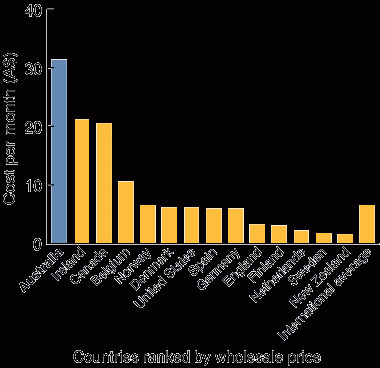
Simoens questions whether our results would change if we had compared statin prices with a country other than England. To address this issue we have compiled a comparison of current or recent wholesale price of 40 mg simvastatin across 13 countries in the Organisation for Economic Co-operation and Development (Box). Although there is some variation between countries, the main difference is with Australia, which has the highest wholesale price — about five times greater than the average price across all comparator countries. This price ratio is similar to the one used in our original study.
Also, Simoens highlights several issues relating to alternative pricing arrangements for statins and other generic drugs in European countries. We agree that Australia may be able to learn from overseas experience when reforming its system of pricing generic pharmaceuticals.
The impact on expenditure of the tendering system for supply of generic pharmaceuticals may have been counteracted by changes in prescribing behaviour in Belgium, but it has been successfully used in the Netherlands to cut the price of simvastatin and other major generics by over 80%. This has been estimated to save around 310 million euros annually.2
However, tenders are not the only way to reduce the price of generic pharmaceuticals. In Canada, the Ontario Ministry of Health and Long-Term Care has recently introduced a policy which sets the subsidy for generics at 25% of the original price under patent. Generic 40 mg atorvastatin, whose patent in Canada recently expired, now costs just A$17 per month.3 In contrast, under the recent Memorandum of Understanding4 between the Australian Government and Medicines Australia, the current wholesale price of A$61 for 40 mg atorvastatin will decline by only 16% after the patent expires in Australia in 2012, and there will be no further downward adjustment until at least 2014.
Wholesale price of simvastatin 40 mg in 13 countries in the OECD*
Competing interests
Philip Clarke has received funding from Servier Laboratories Australia for travel to attend the International Society for Pharmacoeconomics and Outcomes Research 2010 Conference to present work related to the ADVANCE study.
References
- Clarke PM, Fitzgerald EM. Expiry of patent protection on statins: effects on pharmaceutical expenditure in Australia. Med J Aust 2010; 192: 633-636. 0_CHDBIDFG
- Kanavos P, Seeley L, Vandoros S. Tender systems for outpatient pharmaceuticals in the European Union: evidence from the Netherlands, Germany and Belgium. London: LSE Health, 2009. 0_pgfId-2224614
- Ontario Ministry of Health and Long-Term Care. Update R1 Ontario Drug Benefit Formulary/Comparative Drug Index No. 41. Effective June 18, 2010. Summary of changes. http://www.health. gov.on.ca/english/providers/program/drugs/formulary/41_update_r1_20100608.pdf (accessed Sep 2010).
- Memorandum of Understanding between the Australian Government and Medicines Australia. http://www.health.gov.au/internet/main/publishing.nsf/Content/C6EC4D1258BBFFB6CA257721000520A2/$File/MOU%20MA.pdf (accessed Sep 2010).
Capturing the Benefits of Clinical Quality Registries
Taryn Bessen, Stephen McDonald
Medical Colleges Have an Obligation to Ensure Full Participation in Clinical Quality Registries
Thomas J. Hugh
Getting on the Same Page: Why Australia Needs a National Maternity Early Warning System (MEWS) Chart
Briony A. Cutts, Lucy Bowyer, Nisha Khot, Sandra Lowe, Stefan C. Kane
Data for Equity: Can Linked Administrative Data Inform Pathways to More Equitable Child Health?
Sarah Gray, Shuaijun Guo, Meredith O'Connor, Elodie O'Connor, Katrina Williams, Hannah Badland, Susan Woolfenden, Josie Dickerson, Gerry Redmond, Marnie Downes, Sharon R. Goldfeld
Specialty College Selection: Why Change is Critical to Support a Future Rural Workforce
Matthew R. McGrail, Jenny May AM, Katherine Logan
Differentiated and simplified oral HIV pre‐exposure prophylaxis (PrEP) models hold the key to virtually eliminating HIV transmission in Australia by 2030
Tyson Arapali, Sarah Warzywoda, Anthony K J Smith, Curtis Chan, Timothy R Broady, Erin Sullivan, Catherine MacPhail, Mohamed A Hammoud, Alexander Dowell‐Day, Benjamin R Bavinton