




Volume 193 - Issue 1
A cruel custom
Author: Caroline M De Costa
Med J Aust 2010; 193 (1): 56.
Published online: 5 July 2010
Published online: 5 July 2010
 |
|
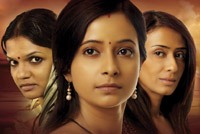
Riwayat. Sanjay Patole, Ajay Rane, producers. Horizon Films, 2010. http://www.riwayatmovie.com. |
It’s not often that the Journal publishes film reviews. It’s not often, however, that two busy Australian clinicians get together to produce a full-length Bollywood extravaganza, complete with swooning love scenes and beautifully crafted song sequences.
While the essential ingredients of love, death, family feuding and a happy ending are all present, Riwayat is no ordinary Bollywood set piece. Instead, Indian-born Townsville urogynaecologist Ajay Rane and Perth neonatologist Sanjay Patole have taken on the serious medical and social topic of “the missing millions” of Indian women — those female infants who, over the past few decades, were conceived and sometimes born but either aborted or killed at birth simply because they were female.
“Riwayat” means “tradition” in Hindi — and, traditionally, many female infants in India have been killed at birth, mainly in poor communities. More recently, ultrasound has been misused, by those who can afford it, to detect female fetuses for the purpose of abortion. The film is in Hindi, with English subtitles, and will be screened in India as well as overseas.
Riwayat is the story of three generations of the upper-class Desai family, whose two sons and their wives are expected to follow the dictates of its autocratic patriarch. This has already led to two abortions and the consequent psychological distress of the elder son’s wife. (Conveniently, the Desais include a private hospital and ultrasound facility in their substantial property portfolio.)
The wife of the younger son, who had a love match rather than the traditional arranged marriage, is made of sterner stuff. Having also conceived a female child, she leaves the family home when ordered to abort and returns to the village where she has been working for a non-government organisation (NGO) — an opportunity for the filmmakers to display the beautiful Indian countryside, take a few digs at the doubtful benefits of NGOs to poverty-stricken Indian citizens, and demonstrate the weight of traditional customs at village level.
Her Portia-like intervention in the court case of a villager who kills his daughter at birth is designed to show Hindi-speaking viewers the urgent need to cast off this dreadful aspect of their “tradition”, disastrous for those girls and women denied life, but also for society as a whole.
Riwayat is both an enjoyable romp and an important piece of social commentary. Hopefully, it will be widely shown in Australia.
Forty Years in the Making: Reporting on the Co-Creation of a National Roadmap for Birthing on Country Services for the Best Start to Life
Res McCalman, Anneka J. Bowman, Roianne West, Kristie Watego, Jyai Allen, Claire Clack, Sue Kildea, Sue Kruske, Melanie Briggs, Cleone Wellington, Rebecca Coddington, Yu Gao, Isabella Garti, Sascha Kowalenko, Sarah Ireland, Catherine Austin, John D. Boffa, Marah Prior, Kelsie Kahl, Bettina Chaseling, Sarah Khaw, Emily Armstrong, Donna Hartz, Yvette Roe
Temporal Trends in Preterm Birth Associated With Hypertensive Disorders of Pregnancy in Victoria, Australia: A Population-Based Interrupted Time-Series Study
Melvin Marzan, Heng Jiang, Daniel Lorber Rolnik, Joanne M. Said, Lisa Hui
Linguistic Manoeuvres: Obstetric Violence Camouflages Harm and Loss of Consent From Birth
Liz Sutton, Harsha Ananthram, Rebecca Matthews
Linguistic Manoeuvres: Obstetric Violence Camouflages Harm and Loss of Consent From Birth
Bashi Kumar-Hazard, Andrew M. Bisits, Sharon L. Settecasse, Jenny Gamble, Hazel Keedle, Hannah G. Dahlen
Linguistic Manoeuvres: Obstetric Violence Camouflages Harm and Loss of Consent From Birth
Wendy Pollock, Alissa Fleming, Ensieh Fooladi, Joy Kloester, Anne Tremayne, Yasmin Zisin, Bethany Carr, Kym Davey, Suzanne Willey, Jenny Gamble
Getting on the Same Page: Why Australia Needs a National Maternity Early Warning System (MEWS) Chart
Briony A. Cutts, Lucy Bowyer, Nisha Khot, Sandra Lowe, Stefan C. Kane