




Volume 192 - Issue 6
Precincts, people and places: forging new partnerships in health innovation
Authors: Terry Cutler, Michael Still, James B Moody and Peter M Brooks
Med J Aust 2010; 192 (6): 303-305. || doi: 10.5694/j.1326-5377.2010.tb03527.x
Published online: 15 March 2010
Published online: 15 March 2010
This short report summarises the proceedings of the international symposium “Precincts, people and places — forging new partnerships”, held in Brisbane on 24 and 25 July 2009
The international symposium “Precincts, people and places — forging new partnerships” was organised by the University of Queensland (UQ) and the Pharmacy Australia Centre of Excellence (PACE) precinct initiative.
The PACE precinct is a 1.7 hectare site adjoining the Princess Alexandra Hospital (one of Australia’s largest tertiary referral hospitals) and only 10 minutes walk from the St Lucia campus of UQ. The precinct will encompass the UQ School of Pharmacy and adjacent health-related commercial developments, the Translational Research Institute and BioPharmaceuticals Australia. The UQ School of Pharmacy will open in 2010, and other developments on the site will be phased in over the next 5 years. The location of the precinct offers an opportunity to explore innovative solutions to bioscience developments around translational research, health promotion and diseases prevention and the various forms of e-health platforms.
A physical location does not, itself, ensure that those working around that precinct will interact — something else is required. While the PACE precinct offers a significant opportunity for health research innovation in that it links the universities, hospitals and medical research institutes with health industry developments, it is that “something else” we wished to debate in the “Precincts, people and places” symposium.
Participants in the symposium were drawn from universities, research agencies and institutes, industry, government, and health service providers, and included architects and designers. Discussion sessions and panels were interspersed with provocations from speakers from the United States, United Kingdom and India. Transcripts of these contributions, videos of special presentations, and copies of selected presentation materials will be available on the PACE website.1 Norman Swan, well known health journalist and commentator, moderated the symposium proceedings with energy and critical probing. Presentations from those working in health “precincts” in Australia, the UK, the US and India were interspersed with small group sessions and discussion. We are grateful for the table facilitators who helped crystallise the outcomes of the discussions.
The symposium tackled the role of special precincts as productive hotspots and “living laboratories” for innovation, and examined the particular importance of precincts in the health system as a springboard and case study for discussion. Four broad challenges were identified.
How do we move beyond mere collocation to multi-party engagement and deep collaboration?
How do we better promote real innovation outcomes, and mark out a place for innovative precincts within the wider innovation system?2
How do we shape precincts that are “fit for purpose” in the 21st century and, in particular, how do we optimise across the physical and the virtual? What, for example, can really only be achieved by a face-to-face interaction and what can be done from a “virtual” perspective?
Within the health system, could we envisage a national effort similar in ambition to the one on which the UK has embarked?3,4
The discussion at the symposium was organised around four basic questions.
Why precincts matter
The main conclusions from the group are summarised below. A consensus emerged that precincts matter because they:
Provide the scale to attract good people, funding, facilities and global partnerships;
Support first-class facilities to support first-class research and learning;
Provide proximity and access to people and capabilities that are task-critical, as well as to the end-users of outcomes (thus nesting problem-solving within an engaged community);
Facilitate synergies, serendipity, focus and, most importantly, multidisciplinary and transdisciplinary capabilities (allowing unstructured conversations across disciplines and entities);
Provide a catalyst for intergovernmental coordination and for economic development strategies (combining new facility and infrastructure development, the coordination of information technology platforms and hubs, and the expression of new business models);
Address the inbuilt human need for face-to-face social contact (fostering social capital);
Unlock latent intellectual capital and underused assets;
Secure better public (socioeconomic) outcomes for the investment of time, effort and money; and
Facilitate a more creative, culturally attuned innovation ecosystem.
In contemplating the question of the interface between the physical and the virtual, it was concluded that special attention needed to be given to this interface and to focusing on what can only be best done within a physical precinct.
The purpose of precincts
The answers to the basic question about the particular function of precincts were summarised in seven propositions. These were that precincts should:
achieve transformative and sustained excellence in science, industry and economic outcomes;
provide “living laboratories” and arenas for innovation through embedded practice;
set a challenge that hasn’t been set before;
shape emerging value chains (accelerating the change to new models) and support innovations across these value chains;
shift emphasis from the physicality of place to a sense of social belonging and community;
connect and cross-fertilise ideas drawn from deep expertise from different areas of knowledge to resolve complex challenges needing significant economies of scale and scope; and
enable smart people to be in close proximity and develop an ecology that keeps them engaged.
What can we learn from our experience?
A panel of people with experience of a cross-section of precincts from around Australia opened up this discussion. It would be fair to say that, essentially, the overall verdict was that most precincts are currently collocations of convenience, often prompted by the desire for access to, or to support, large-scale facilities or infrastructure. Such collocation typically translates into little else. The implication is that “more of the same” is not going to change things or unleash the potential of significant investments.
This led into a productive discussion of how we might describe the critical specifications for a successful precinct. The resulting summary checklist of the views of participants shown in Box 1 is in no particular order of priority.
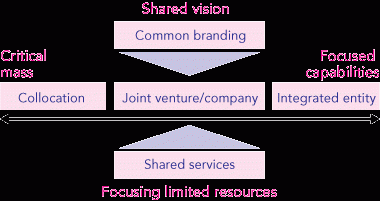
It was generally agreed that there is no “one size fits all” model, but rather a spectrum of models and approaches, shaped around different priorities and emphases. This was illustrated by one discussion group as shown in Box 2.
Precinct issues and challenges
Eight particular challenges were identified as demanding close attention and further work.
The process for engaging stakeholders and the community.
Calibrating meaningful success factors (including benefits to the community), involving:
Performance indicators and milestones;
A focus on outcome measures; and
Assuring adequate and appropriate contributions by participants.
Articulating the governance options on a “horses for courses” basis.
Delivering the “curatorial” role in precinct organisation and evolution.
How to embed “openness” and inclusiveness in all their dimensions (and noting the tension with focus and differentiation).
Avoiding the risk of precincts becoming silos in themselves, and thus inward looking.
Articulating the characteristics of a good “precinct leader”.
Assuring recurrent as well as capital investment, in order to avoid the brass plaque syndrome which leaves institutions with inadequate ongoing resources.
Barriers to progress
In elaborating on these issues, the symposium participants identified and highlighted a number of barriers to progress. These barriers included:
risk aversion, inflexibility, lack of ambition, and conflicting paradigms;
asymmetric power structures and relationships;
stakeholder fear of brand dilution within partnerships and collaborations;
use of traditional and inappropriate metrics to represent outcomes;
lack of scale and critical mass;
the unintended consequences of government regulatory and planning constraints; and
the negative impact of perverse incentives.
In addressing these issues various participants stressed the need to:
appreciate the evolutionary options and pathways for progressive precinct development;
recognise the different motivations in play and to accommodate them within inclusive incentive structures;
develop new metrics, such as the use of social network analysis to map emerging outcomes and relationship opportunities;5
think big and not be under-ambitious; and
provide for transient access and engagement.
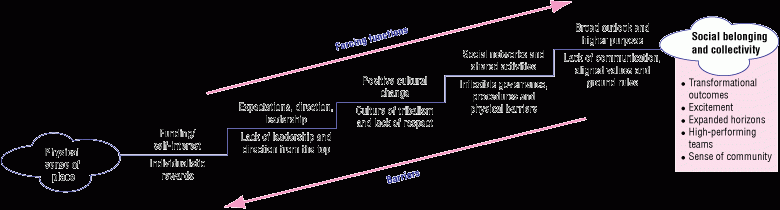
It was noted that the expertise from business schools, which routinely deal with governance structures and the building of innovative teams, was an underused resource in the discussion of precincts. One table group summarised the enabling and constraining factors as shown in Box 3.
Other important issues that were raised included the need to consider precincts in the wider context of the overall ecosystem in which they interact, and the importance of managing the accelerating pace of change so important to their development. We need to build flexibility and adaptability into our systems, to ensure we have appropriate ways of measuring the success of collaborations and to avoid creating silos within precincts. Essentially, we need to be in the business of building new models of collaboration and embedded practice, all within an end-user environment. These need to be unashamedly focused on community outcomes and with community engagement at all levels of the process.
At the conclusion of the symposium, distinguished IBM Fellow and Alumnus Nick Donofrio, outlined some challenges which we ignore at our peril. These are listed in Box 4.
A number of exciting new bioscience hubs will be developed in Australia over the next few decades. Innovation precincts are emerging around areas such as next-generation manufacturing, marine resources and tropical industries, and it is to be hoped that the discussions reported here will provide some guidance as to how to get the best out of each particular precinct.
1 Summary of critical specifications for a successful precinct as developed by participants at the “Precincts, people and places — forging new partnerships” symposium
A clearly articulated and understood mission, with short-term, medium-term, and long-term goals. This needs to be a shared vision, and one that is “owned” by all the interested parties. The tension between what is achievable in the short term and stretch targets was noted.
The vision needs “fit for purpose” governance arrangements to sustain it.
Shared cultural values around excellence, openness, adaptability, risk-taking and risk-sharing, tolerance for failure, and generosity.
Strong and self-assured leadership with “fit for purpose” management and enabling skills.
Clear “cross-fertiliser” roles, possibly involving:
a curatorial function;
funding compacts and incentives; and
mobilising functions for program leaders.
Clear terms of engagement around resources and roles.
An engagement strategy for stakeholders and the community.
Pulling power through being on the global radar (and developed through brand, marketing, and communications).
A high concentration of appropriate expertise and standing.
The capacity to deal with complexity and to ensure diversity of contributions from the major partners in the precinct.
An embedded educational role (and learning capacity).
Industry connections, connectivity and relevance.
Porous, permeable boundaries which promote a clear focus on market and outcome domains (not institutional domains).
Incentives geared to outcomes (not inputs).
“3D” use of land and space (through tiered rather than linear occupancy categories, with more than one thing in the one space).
Shared and creative “play spaces”.
Time-based and sequenced development priorities, enabling evolutionary pathways.
Sufficient scale to be able to accommodate risk.
2 The spectrum of available precinct models as illustrated by one discussion group at the “Precincts, people and places — forging new partnerships” symposium
4 Challenges discussed at the “Precincts, people and places — forging new partnerships” symposium by IBM Fellow and Alumnus Nick Donofrio
Leadership is what it is all about — and that leadership needs to be real and hopeful.
Look to developing 21st century models — look for how and where the physical adds value over the virtual to create new hybrid models.
Remember that money is not everything — too much may be as bad as too little — and scarcity can help to drive innovation.
Precincts need to be dynamic — activities should be allowed to expand and contract.
For the right task, at the right time, and within the right environment, the talent will come.
A collection of things is important, but to make precincts really work we need a system that works as well.
Competing interests
None identified.
References
- Pharmacy Australia Centre of Excellence [homepage on the internet]. http://www.paceprecinct.com.au (accessed Jan 2010).
- Cairncross F. Death of distance: how the communications revolution will change our lives. Boston, MA: Harvard Business School Press, 1997. 0_i1091978
- Brooks PM. The challenge of academic health partnerships. Med J Aust 2009; 191: 26-27. 0_i1091980
- Byrne E. Clinical research in the United Kingdom: a new era. Med J Aust 2009; 190: 172-173. 0_i1091982
- Pope J, Lewis J. Improving partnership governance: using a network approach to evaluate partnerships in Victoria. Aust J Public Admin 2008; 67: 443-456. 0_i1091985
Capturing the Benefits of Clinical Quality Registries
Taryn Bessen, Stephen McDonald
Medical Colleges Have an Obligation to Ensure Full Participation in Clinical Quality Registries
Thomas J. Hugh
Getting on the Same Page: Why Australia Needs a National Maternity Early Warning System (MEWS) Chart
Briony A. Cutts, Lucy Bowyer, Nisha Khot, Sandra Lowe, Stefan C. Kane
Data for Equity: Can Linked Administrative Data Inform Pathways to More Equitable Child Health?
Sarah Gray, Shuaijun Guo, Meredith O'Connor, Elodie O'Connor, Katrina Williams, Hannah Badland, Susan Woolfenden, Josie Dickerson, Gerry Redmond, Marnie Downes, Sharon R. Goldfeld
Specialty College Selection: Why Change is Critical to Support a Future Rural Workforce
Matthew R. McGrail, Jenny May AM, Katherine Logan
Differentiated and simplified oral HIV pre‐exposure prophylaxis (PrEP) models hold the key to virtually eliminating HIV transmission in Australia by 2030
Tyson Arapali, Sarah Warzywoda, Anthony K J Smith, Curtis Chan, Timothy R Broady, Erin Sullivan, Catherine MacPhail, Mohamed A Hammoud, Alexander Dowell‐Day, Benjamin R Bavinton