




Volume 191 - Issue 9
Straight to the emergency department: burns in children caused by hair-straightening devices
Authors: Zoe M Poiner, Michael D Kerr, Belinda A Wallis and Roy M Kimble
Med J Aust 2009; 191 (9): 516-517. || doi: 10.5694/j.1326-5377.2009.tb02919.x
Published online: 2 November 2009
Published online: 2 November 2009
To the Editor: Contact burns in children caused by hair-straightening devices are increasingly common. Although the dangers of hair dryers and other similar devices are well known,1 there is less awareness of the risks associated with hair straighteners. The relevant Australian Standard does not mention hair straighteners.2 Four recent studies from the United Kingdom have reported on this problem,3-6 but there is no readily identifiable published information from Australia.
Hair straighteners consist of two opposing ceramic plates that are held apart when not in use. The plates are reported to reach average temperatures of 169.5°C within 4 minutes 20 seconds of being switched on. They can cause burns (temperature > 66°C) on short-term contact (10 seconds) for a period of up to 9 minutes 20 seconds after being switched off,3 and can take 30 minutes to cool to below 50°C, at which temperature they can cause superficial burns on prolonged contact.
Using data collected by the Stuart Pegg Paediatric Burns Centre at the Royal Children’s Hospital, Brisbane, and the Queensland Injury Surveillance Unit, we identified 22 patients treated for hair-straightener injuries between January 2004 and June 2009. Sixteen of these were treated within the past 2 years.
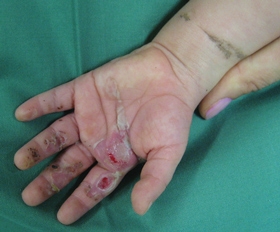
The median age of patients was 43.4 months (range, 9 months to 14 years). A mean of 1% of total body surface area was involved. Injuries were to the forearm and hands (16 patients) (Box), foot and lower leg (five patients), and the back (one patient). The burns were significant, with 19 partial-thickness burns, and three full-thickness burns requiring surgery. Nine of the 22 children (41%) required long-term scar management.
We observed two typical patterns of injury. In toddlers (16 patients aged 9–48 months), the main mechanism of injury was grasping or pulling down a hair straightener that was either turned on or cooling, with inadequate supervision a common factor. An early-teen group (three patients) had self-inflicted burns from accidental contact or misuse, including one patient who misguidedly used the device in an attempt to remove leg hair, sustaining full-thickness burns requiring skin grafting.
Increased awareness of the potential dangers of hair straighteners might help prevent burns. We suggest four precautions:
Hair straighteners should be placed out of reach of children during use and storage;
Children should be supervised while the device is warming or cooling;
Manufacturers should label the device to warn of potential dangers; and
Manufacturers should either redesign the device so that plates are not exposed, or provide a cool-touch cover.
References
- Simons M, Brady D, McGrady M, et al. Hot iron burns in children. Burns 2002; 28: 587-590.
- Australian/New Zealand Standard. Household and similar electrical appliances — safety. Part 2.23: particular requirements for appliances for skin or hair care (IEC 60335-2-23 Ed 5.1, MOD). Standards Australia, Standards New Zealand, 2004. (AS/NZS 60335.2.23:2004.) 0_pgfId-1923144
- Mehta S, Barnes D, Edwin A, Pape S. Burns in children caused by hair straighteners: epidemiology and investigation of heating/cooling curves. J Burn Care Res 2008; 29: 650-654. 0_pgfId-1923149
- Wilson Jones N, Wong P, Potokar T. Electric hair straightener burns: an epidemiological and thermodynamic study. Burns 2008; 34: 521-524. 0_pgfId-1923156
- Breuning EE, Papini RPG. Hair straighteners: a significant burns risk. Burns 2008; 34: 703-706. 0_pgfId-1923164
- Duncan RA, Waterson S, Beattie TF, Stewart K. Contact burns from hair straighteners: a new hazard in the home. Emerg Med J 2006; 23 (3): e21. Ref6
Barriers and Facilitators to Timely Detection and Optimal Management of Chronic Wet Cough in Aboriginal Children Across Australia From the Perspectives of Carers of Aboriginal Children: A Qualitative Study
Gloria T. Y. Lau, Pam Laird, Robyn Aitken, Melanie Barwick, Liam Bedford, Emily R. Bowden, Jamie Everingham, Angela Fuery, Reece Griffin, Neha Jain, Mina Kinghorn, Renae Knapp, Gabrielle B. McCallum, Peter Morris, Richard Norman, Peter C. Richmond, Aarti Saiganesh, Slade Sibosado, Cameron Taylor, Maree Toombs, Roz Walker, Joan Wilson, Anne B. Chang, André Schultz
Barriers and Facilitators to Timely Detection and Optimal Management of Chronic Wet Cough in Aboriginal Children Across Australia From the Perspective of Health Care Providers: A Qualitative Study
Gloria T. Y. Lau, Pamela Laird, Robyn Aitken, Melanie Barwick, Liam Bedford, Emily R. Bowden, Corey Dalton, Jamie Everingham, Angela Fuery, Reece Griffin, Neha Jain, Mina Kinghorn, Renae Knapp, Gabrielle B. McCallum, Peter Morris, Richard Norman, Peter C. Richmond, Aarti Saiganesh, Slade Sibosado, Maree Toombs, Roz Walker, Joan Wilson, Anne B. Chang, André Schultz
Short-Term Safety of Concomitant Meningococcal B and National Immunisation Program Vaccines in Infants Aged < 15 Months: A Survey-Based Surveillance Study
Thuy Nguyen, Evelyn C. S. Tay, Michael Dymock, Thomas L. Snelling, Lucy Dawes, Julie Marsh, Yue Wu, Alan Leeb, Nicholas Wood, Lucy Deng
The GenV Biobank: Enabling Biological Research in a Large Longitudinal Population-Representative Cohort of Australian Newborns and Their Parents
Katherine Lange, Kim L. Powell, Yeukai Mangwiro, Tony Frugier, Donna T. Geddes, Melissa Wake, Richard Saffery
Watchful Waiting Compared With Immediate Antibiotics for Urban Aboriginal and Torres Strait Islander Children With Uncomplicated Acute Otitis Media (WATCH): A Non-Inferiority Randomised Controlled Trial
Jennifer S. Reath, Hasantha Gunasekera, Sanja Lujic, Amanda J. Leach, Letitia Campbell, Robyn Walsh, Tim Usherwood, Geoffrey K. Spurling, Claudette A. Tyson, Deborah A. Askew, Kelvin Kong, Chelsea J. Watego, Peter Morris, Wendy Hu, Penelope A. Abbott
A Rare Case of Storage Mite Anaphylaxis in Infancy
Eliza Kluckow, Katie Frith