




Volume 191 - Issue 1
Childhood obesity in Australia remains a widespread health concern that warrants population-wide prevention programs
Authors: Lyn M Roberts, Tessa R Letcher, Alexandra A Gason and Tim Lobstein
Med J Aust 2009; 191 (1): 45-47. || doi: 10.5694/j.1326-5377.2009.tb02682.x
Published online: 6 July 2009
Published online: 6 July 2009
To the Editor: There is a substantial volume of evidence from a range of national and state-based surveys illustrating increases in the rates of obesity and overweight among Australian children over the past two decades,1 concurring with trends observed in most developed countries.2 The recent article by Gill and colleagues highlighted questions that have been raised publicly regarding the extent and impact of levels of obesity and overweight among Australian children, including whether trends have been exaggerated.1
To examine these issues using the latest data available, we present data from the three most recent national surveys in which weight and height of Australian children were measured: the Australian Health and Fitness Survey (1985),3 the National Nutrition Survey (1995),4 and the Australian National Children’s Nutrition and Physical Activity Survey (2007).5 We examined overweight and obesity levels among young Australians from comparable age groups at three time points over more than 20 years, using the same internationally accepted definitions of childhood overweight and obesity.
For 1985 and 1995 data, we used the figures reported by Magarey et al in 2001,6 which compared results from the 1985 and 1995 surveys using new standard international definitions to classify overweight and obesity among Australian children and adolescents.7 We calculated body mass index for the 2007 Australian National Children’s Nutrition and Physical Activity Survey using the raw data file obtained through the Australian Social Science Data Archive,8 categorising children as overweight or obese based on the same international definitions used by Magarey et al.6 We based our calculations on the age group common to each of the three surveys: 7–15-year-olds.
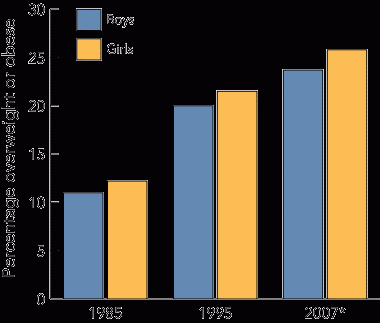
As shown in the Box, the prevalence of overweight and obesity in boys aged 7–15 years has risen from 11.0% (95% CI, 10.99%–11.01%) in 1985 to 20.0% (95% CI, 19.97%–20.03%) in 1995 and 23.7% (95% CI, 23.68%–23.72%) in 2007. In 7–15-year-old girls, the prevalence of overweight and obesity has increased from 12.2% (95% CI, 12.19%–12.21%) in 1985 to 21.5% (95% CI, 21.47%–21.53%) in 1995 and 25.8% (95% CI, 25.78%–25.82%) in 2007.
While data from additional time points are required to map national trends more comprehensively, our analysis clearly indicates an upward trend in overweight and obesity levels in both boys and girls aged 7–15 years between 1985, 1995 and 2007. This trend is cause for alarm, given the widely recognised body of evidence on the significant short-term and long-term consequences of childhood obesity.9
Prevalence of overweight and obesity in Australian children aged 7–15 years, 1985–2007
 | |||||||||||||||
|
* Data weighted for age, sex and region with the weighting variable in the raw data file obtained from the Australian Social Science Data Archive.8 | |||||||||||||||
References
- Gill TP, Baur LA, Bauman AE, et al. Childhood obesity in Australia remains a widespread health concern that warrants population-wide prevention programs. Med J Aust 2009; 190: 146-148. 0_i1091874
- Baur LA. Tackling the epidemic of childhood obesity. CMAJ 2009; 180: 701-702. 0_i1091876
- Pyke JE. Australian Health and Fitness Survey 1985. Adelaide: Australian Council for Health, Physical Education and Recreation, 1987. 0_i1091878
- McLennan W, Podger A. National nutrition survey, 1995. Nutrient intakes and physical measurements. Canberra: Australian Government Publishing Service, 1998. 0_i1091880
- Australian National Children’s Nutrition and Physical Activity Survey — main findings. Prepared by the Commonwealth Scientific Industrial Research Organisation (CSIRO) Preventative Health National Research Flagship, and the University of South Australia. Canberra: Australian Government Department of Health and Ageing, 2008. http://www.health.gov.au/internet/main/publishing.nsf/Content/phd-nutrition-childrens-survey (accessed May 2009).
- Magarey AM, Daniels LA, Boulton TJ. Prevalence of overweight and obesity in Australian children and adolescents: reassessment of 1985 and 1995 data against new standard international definitions. Med J Aust 2001; 174: 561-564. (Correction in Med J Aust 2001; 175: 392.) <eMJA full text>
- Cole TJ, Bellizzi MC, Flegal KM, Dietz WH. Establishing a standard definition for child overweight and obesity worldwide: international survey. BMJ 2000; 320: 1240-1243. 0_i1091887
- Australian Social Science Data Archive. http://assda.anu.edu.au/ (accessed May 2009).
- Lobstein T, Baur L, Uauy R. Obesity in children and young people: a crisis in public health. Obes Rev 2004; 5 Suppl 1: 4-85. 0_i1091892
Fatty Liver Disease in Australia: A Narrative Review on the Epidemiology, Natural History, Prognostication and Management in People With Metabolic Dysfunction
Karl Vaz, Daniel Clayton-Chubb, William W. Kemp, Stuart K. Roberts, Ammar Majeed
Sex Differences in Management and Outcomes of People With ST-Elevation Myocardial Infarction, New South Wales, 2011–2020: A Retrospective Cohort Study
Adam C. Livori, Jedidiah I. Morton, Dianna J. Magliano, Jonathan E. Shaw
Rethinking Rheumatic Fever Diagnosis: Progress, Pitfalls and the Path Towards a Definitive Test
Anna P. Ralph, Rachel Webb, Tom Parks, Nicole J. Moreland, Asha C. Bowen, Benjamin Jones, Emma Ndagire, Andrea Z. Beaton
Sex Differences in Management and Outcomes of People With ST-Elevation Myocardial Infarction, New South Wales, 2011–2020: A Retrospective Cohort Study
Samia Kazi, Simone Marschner, Clara K. Chow
Distribution of Cardiovascular Disease Risk Based on the Updated 2023 Guideline-Recommended Australian Cardiovascular Disease Risk Algorithm and Comparison With the 2012 Algorithm: An Observational Study
Nina Lazarevic, Meghana Bhat, Grace Joshy, Danielle C. Butler, Mark Woodward, Anushka Patel, Rod T. Jackson, Garry Jennings, Rosemary Wyber, Ellie Paige, Emily Banks
They Brought the Hospital to Me
Hugh N. Burrill