




Volume 190 - Issue 5
The rise and fall of suicide in New South Wales
Authors: Matthew M Large, Olav B Nielssen and Steven M Lackersteen
Med J Aust 2009; 190 (5): 282. || doi: 10.5694/j.1326-5377.2009.tb02398.x
Published online: 2 March 2009
Published online: 2 March 2009
To the Editor: Between 1997 and 2006, suicide rates fell in all mainland Australian states and territories.1 Despite a rise in the small-population jurisdictions of Tasmania (1997–2006)1 and an earlier rise in the Northern Territory (1981–2002),2 the overall unadjusted national suicide rate has fallen steadily, from 14.7 per 100 000 in 1997 to 9.06 per 100 000 in 2006, the year for which the most recent statistics are available.
Trends in suicide occurrence are usually examined with reference to suicide rates. However, because there has been population growth in all parts of Australia, examination of the actual number of suicide deaths in each region is also useful to ascertain whether the demographic changes accompanying population growth can alter unadjusted suicide rates.
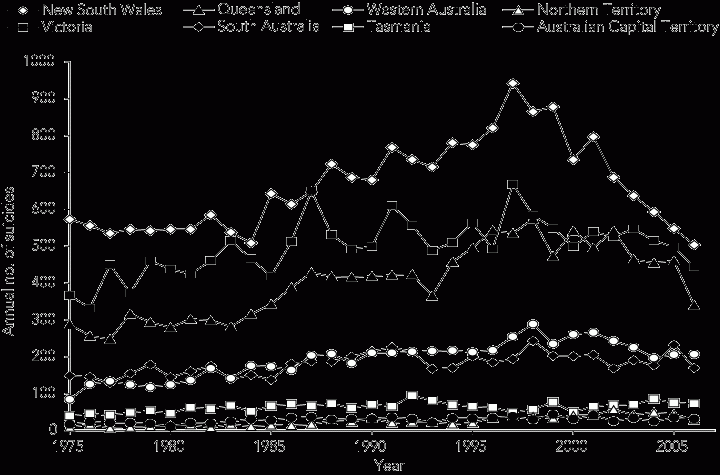
Annual suicide mortality statistics by state and territory from 1975 to 20061,3,4 show that the number of suicides peaked in every mainland state in 1997 or 1998. Since then, the number of suicides has fallen in New South Wales by 46.5%, in Victoria by 33.5% and in Queensland by 36.4% (Box). There has been larger variation in the number of suicides over time in NSW than in other states. Suicides in NSW rose from under 600 per year (approximately 11 per 100 000 population) in the early 1980s to a peak of 935 suicides in 1997 (14.9 per 100 000) and then fell to 504 suicides (7.4 per 100 000) in 2006. Data available to 2002 indicate that the decline in suicides occurred in almost every NSW health service area and was mainly due to a reduction in the number of suicide deaths in males, including young males.5 By 2006, NSW had the lowest suicide rate in Australia of 7.69 per 100 000 compared with 9.73 per 100 000 for other states and territories.
The reasons for the steeper rise and subsequent fall in suicide in NSW compared with other states are unclear, but warrant further investigation with a combined clinical and epidemiological approach. The decline in suicide in NSW coincided with a change to the Mental Health Act 1990 in 1997 that broadened criteria for involuntary care and allowed more people to be treated. However, this factor alone would not explain the extent of the decrease nor the continued decline over a decade. It is possible that programs to prevent suicide or measures to improve access to psychiatric care in NSW have been more successful than those in other parts of Australia.
Competing interests
Steven Lackersteen was supported by a grant from Janssen-Cilag.
References
- Australian Bureau of Statistics. Causes of death, Australia, 2006. Suicides. Table 4.5: Suicide, state and territory, number of deaths, standardised death rate, sex, 1997–2006. (ABS Cat. No. 3303.0.) http://www.abs.gov.au/AUSSTATS/abs@.nsf/DetailsPage/3303.02006?OpenDocument (accessed Oct 2008).
- Measey ML, Li SQ, Parker R, Wang Z. Suicide in the Northern Territory, 1981–2002. Med J Aust 2006; 185: 315-319. <eMJA full text>
- Australian Bureau of Statistics. Cause of death collection, 1975–1978 (ICD-8 codes E950–E959, Suicide and self-inflicted injury). ABS data available on request. 0_CHDIIFJH
- Australian Bureau of Statistics. Cause of death collection, 1979–1998 (ICD-9 codes E950–E959, Suicide and self-inflicted injury). ABS data available on request (accessed Apr 2008). 0_i1091863
- NSW Health. Suicide in New South Wales. We need to know more — the NSW suicide data report. Sydney: NSW Health, 2000. http://www.health.nsw. gov.au/pubs/2004/suicidedata0504.html (accessed Dec 2008).
Co-Designed Best Practice Principles for the Care of Fathers and Non-Birthing Parents Exposed to Perinatal Trauma: A Participatory Action Research Study
Alka Kothari, Dale Trevor, Glen Quinn, Jane Geltch, Joel Dulhunty, Helen Skouteris, Leonie K. Callaway
Reorienting Allied Health Into Community-Based Care for People Experiencing Trauma and Social Disadvantage
Simon Rosenbaum, Grace McKeon, Gulsah Kurt, Oscar Lederman, Kemi Wright, Sabuj Kanti Mistry, Jackie E. Curtis, Philip B. Ward, Zachary Steel, Hamish Fibbins, Rachel Morell, Melissa C. Eaton, Andrew Watkins, Ben Harris-Roxas, Brendan Goodger, Eleanor Beck, Megan Teychenne, Joseph Firth, Davy Vancampfort, David Burns, Russell Roberts, Tristan Favaloro, Danielle Weber, Rosanna Barbero, Vasili Maroulis, Melissa Holmes, Stefan Mackenzie, Chiara Mastrogiovanni, Afsana Anwar, Uzma Choudhry, Catherine Sherrington, Jane Currie, Thomas Gadsden, Scott Teasdale
Stigmatising Attitudes Towards People With Depression, Bipolar Disorder, Borderline Personality, ADHD and Early and Long-Term/Untreated Schizophrenia: Representative Survey of Australian Adults
Amy J. Morgan, Anna M. Ross, Gayle McNaught, Rachel Green, Nicola J. Reavley
Psychosocial Hazards for Healthcare Workers: Supporting the Second Victim Also Helps the Primary Victims
Sarah Michael
Supporting Population Mental Health in the Wake of Mass Tragedies
Susan J. Rees, Derrick M. Silove