




Volume 190 - Issue 3
Povidone–iodine (Betadine) solution: a simple protectant in surgical gloves
Author: George D S Turner
Med J Aust 2009; 190 (3): 167. || doi: 10.5694/j.1326-5377.2009.tb02333.x
Published online: 2 February 2009
Published online: 2 February 2009
To the Editor: Needlestick injuries are inevitable during surgery, particularly if operating hurriedly by “feel” in blood-obscured fields, such as in Caesarean sections. The risks associated with these injuries were accentuated by the advent of the HIV pandemic. While working in rural Zimbabwe, an article describing Betadine inactivating HIV in an infected cell culture, with the cells surviving, triggered my interest.1
Betadine (Mundipharma, Basel, Switzerland) is povidone–iodine. Povidone is a polymer — polyvinylpyrrolidone, (C6H9NO)n — with many applications, including past usage as a plasma expander. It is hypoallergenic, has lubricating properties, and forms a loose chemical combination (iodophore) with iodine up to about a 10th of its weight.2 Therefore, a 10% solution of Betadine contains about 1% iodine. The iodophore is usually non-staining, although the iodine retains its chemical properties, such as turning starch dark blue.
Povidone–iodine is a powerful antiseptic that kills Staphylococcus aureus and saprophyticus, Streptococcus pyogenes and pneumoniae, Neisseria gonorrhoea, Haemophilus vaginalis, Candida albicans and Trichomonas vaginalis within 30 seconds of contact, and Clostridium tetani spores in 30 minutes.2 In also destroying HIV,1 it may thus be regarded as a self-sterilising solution.
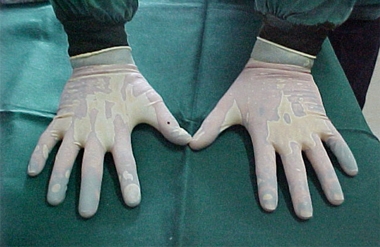
Betadine can be applied as a simple protectant in surgical gloves. Before donning, 5–10 mL of Betadine are poured into each glove, with the operator inserting his or her hand and massaging the solution around, up to the gusset, ensuring the digits are liberally coated. Digital sensitivity is unaffected. Betadine’s brown colour (blue-black if the gloves were starch-dusted) makes its presence apparent through the semitransparent latex, and any glove perforation is evident by leakage of the solution (Box, A). Although licensed for topical application only, Betadine has for many years been used internally, as in peritoneal douching, so minor leakage from the gloves into body cavities would be of little consequence.
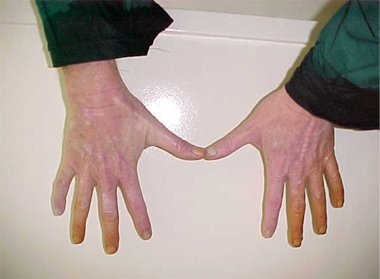
On glove removal after prolonged operating, the skin surfaces of the operator’s hands are stained dark brown by the iodine, except, strangely, the dorsal aspect of the thenar muscles, seemingly because the hotter working digits cause exothermic deliquescence (Box, B). This stain is easily washed off, except for discolouration of the nails, which can be removed with scraping or will otherwise disappear in a day or so as the iodine sublimates.
Although this technique needs formal evaluation, using Betadine in surgical gloves has several advantages:
It is hypoallergenic, inexpensive, readily available and easy to apply.
It provides a powerful additional protective barrier to needlestick injury infection transmission from patient to surgeon and vice versa.
It can be used as an adjunct to “scrubbing up”, increasing surgical sterility.
It obviates clumsy double gloving, pre-gloving hand drying, and dusting with fibromata-inducing talcs.
It has an obvious presence that is psychologically reassuring.
Glove perforations are easily detectable, allowing rapid intraoperative re-gloving.
References
- Harbison MA, Hammer SM. Inactivation of human immunodeficiency virus by Betadine products and chlorhexidine. J Acquir Immune Defic Syndr 1989; 2: 16-20. 0_CHDJEHHG
- Todd RG, editor. Martindale’s extra pharmacopoeia. 25th ed. London: The Pharmaceutical Press, 1967: 502-504, 683. 0_CBBGIGFF
Capturing the Benefits of Clinical Quality Registries
Taryn Bessen, Stephen McDonald
Medical Colleges Have an Obligation to Ensure Full Participation in Clinical Quality Registries
Thomas J. Hugh
Getting on the Same Page: Why Australia Needs a National Maternity Early Warning System (MEWS) Chart
Briony A. Cutts, Lucy Bowyer, Nisha Khot, Sandra Lowe, Stefan C. Kane
Data for Equity: Can Linked Administrative Data Inform Pathways to More Equitable Child Health?
Sarah Gray, Shuaijun Guo, Meredith O'Connor, Elodie O'Connor, Katrina Williams, Hannah Badland, Susan Woolfenden, Josie Dickerson, Gerry Redmond, Marnie Downes, Sharon R. Goldfeld
Specialty College Selection: Why Change is Critical to Support a Future Rural Workforce
Matthew R. McGrail, Jenny May AM, Katherine Logan
Differentiated and simplified oral HIV pre‐exposure prophylaxis (PrEP) models hold the key to virtually eliminating HIV transmission in Australia by 2030
Tyson Arapali, Sarah Warzywoda, Anthony K J Smith, Curtis Chan, Timothy R Broady, Erin Sullivan, Catherine MacPhail, Mohamed A Hammoud, Alexander Dowell‐Day, Benjamin R Bavinton