




Volume 190 - Issue 2
Learning to face death
Author: Michael P Barbato
Med J Aust 2009; 190 (2): 73. || doi: 10.5694/j.1326-5377.2009.tb02279.x
Published online: 19 January 2009
Published online: 19 January 2009
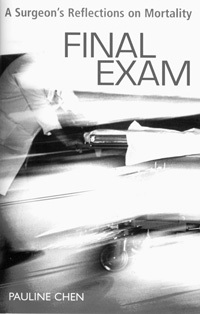
Final exam: a surgeon’s reflections on mortality
. Pauline Chen. London: Souvenir Press, 2008 (xv + 267 pp). ISBN 978 0 28563 811 2.
Although it is more than 40 years since I graduated, reading A surgeon’s reflections on mortality revived memories of my own undergraduate and postgraduate years. Replete with detailed recollections of the author’s initiation into medicine and specialist practice, this is more than a trip down memory lane. At its heart resides a concern that many will, as was the case with the author, find challenging and unsettling.
Pauline Chen uses narrative and reflection to tell us of her transition from a frightened and anxious medical student to a compassionate transplant surgeon. The stories reveal a maturation process that inevitably leads her to evaluate the agendas that direct her life as well as her clinical practice. The journey brings her face to face with her own mortality and the realisation that to become a good doctor she needs to prepare for her “final exam”, namely her own death.
The book ultimately confronts the issue of end-of-life care and, somewhat bravely, the author suggests it is not the disease process, place of death or service delivery but a doctor’s fear of and aversion to dying that influences outcomes. This, she asserts, is “the most difficult and fundamental human obstacle in changing end of life care.” Not everyone will agree with this conclusion, but the issues raised within the book cannot be summarily dismissed. Is it the art or the science of care that matters most? According to Ken Wilber, a transpersonal psychologist of some repute, the crucial ingredient is not the doctor’s bag with all its tricks but the holder of that bag. In “doctor speak”, this can be translated as “physician heal thyself”. Chen invites us to heal.
A future for the hospital‐in‐the‐home (HITH) deteriorating patient: shifting the paradigm
Aaron BO Wong, Brian H Le
Models of care across settings supporting ageing in place: a narrative review
Maria C Inacio, Stephanie Harrison, Johannes Schwabe, Maria Crotty, Gillian E Caughey
Implementing voluntary assisted dying in New South Wales correctional settings
Diya Ahluwalia, Leigh Haysom
Improving palliative care for people who use alcohol and other drugs
Grace FitzGerald, Jon Cook, Peter Higgs, Charles Henderson, Sione Crawford, Thileepan Naren
Inequity of access to voluntary assisted dying for New Zealand citizens residing permanently in Australia
Christopher J Barlow
Dying of heart failure: how do we improve the experience?
Dominica Zentner, Vithoosharan Sivanathan, Jennifer Philip, Natasha Smallwood