




Volume 189 - Issue 9
Venous thromboembolism associated with train travel
Authors: Jeet Ram Kashyap, Sanjay D’Cruz, Sandeep Chauhan and Suman Kochhar
Med J Aust 2008; 189 (9): 535-536. || doi: 10.5694/j.1326-5377.2008.tb02170.x
Published online: 3 November 2008
Published online: 3 November 2008
To the Editor: Venous thromboembolism (VTE) is frequently described among air travellers but data on VTE related to train travel are limited.1-3 We report a case of VTE in a patient after a prolonged train journey.
A 35-year-old man presented with sudden onset of breathlessness, perspiration and syncope after a 14-hour train journey, during which he had limited mobility. He had no history of similar episodes, no significant comorbidities or previous periods of prolonged immobility and no family history of thromboembolic disorders, and he was vegetarian. Physical examination revealed tachycardia, tachypnoea, blood pressure of 90/60 mmHg, raised jugular venous pressure and a right ventricular third heart sound. Blood-gas analysis showed hypoxaemia with respiratory alkalosis: Pao2, 49 mmHg (reference range [RR], 95 ± 5 mmHg), pH 7.49 (RR, 7.40 ± 0.02), Paco2, 22 mmHg (RR, 40 ± 2 mmHg). A plasma D-dimer test result was positive.
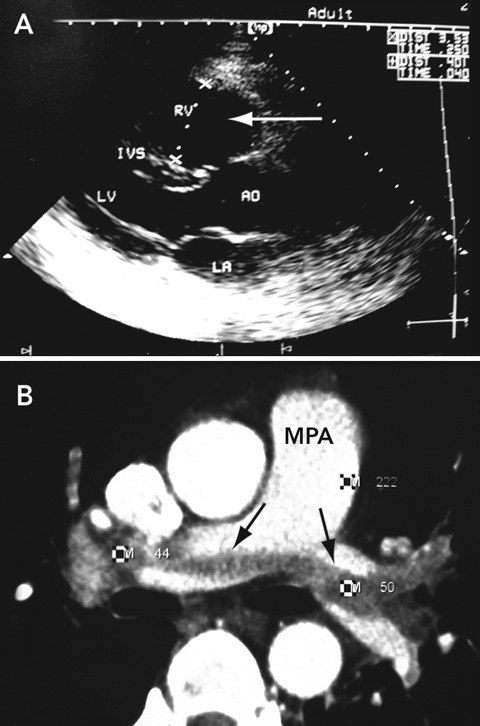
Electrocardiography revealed right axis deviation with an S1Q3T3 pattern. Echocardiography revealed right ventricular dilatation, a thrombus in the main pulmonary artery, and pulmonary arterial hypertension (pulmonary artery systolic pressure, 65 mmHg) (Box, A). Computed tomographic angiography of the pulmonary artery confirmed the presence of a large saddle embolus at the bifurcation of the main pulmonary artery (Box, B) and a wedge-shaped infarct in the middle lobe of the right lung. Venous Doppler imaging showed a thrombus in the left popliteal vein.
The patient had fasting hyperhomocysteinaemia (plasma homocysteine level, 36.6 μmol/L; RR, 4.4–10.8 μmol/L] secondary to nutritional vitamin B12 deficiency (serum vitamin B12 level, 42 pmol/L; RR, 206–735 pmol/L]. Tests for antithrombin III, protein C, protein S, factor V Leiden mutation and antiphospholipid antibodies returned normal results.
The patient was successfully treated with intravenous streptokinase followed by standard anticoagulation therapy and vitamin B12 supplementation. He was well on follow-up.
The association between thrombosis and prolonged travel was first described in 1954.1 Symptoms usually develop within 1–8 weeks of travel. Any journey of more than 4 hours poses a risk of VTE. Factors involved are low humidity, hypoxia, immobilisation and cramped conditions.2,3 Individuals with underlying hypercoagulation states such as factor V Leiden mutation, prothrombin gene G20210A mutation, and protein C and protein S deficiency have increased risk of VTE.4 Recently, hyperhomocysteinaemia has also been identified as an important risk factor for VTE.5 Acquired risk factors include obesity, oral contraceptive use, pregnancy, recent trauma or surgery, malignancy and history of VTE.
This case highlights the association between train travel and VTE, and the importance of considering all types of prolonged travel as potential risk factors for VTE.
Echocardiogram and angiogram of a patient with venous thromboembolism after prolonged train travel
References
- Homans J. Thrombosis of the leg veins due to prolonged sitting. N Engl J Med 1954; 250: 148-149. 0_CBBEEJJC
- Ferrari E, Chevallier T, Chapelier A, Baudouy M. Travel as a risk factor for venous thromboembolic disease. Chest 1999; 115: 440-444. 0_i1091854
- Cannegieter SC, Doggen CJ, Van Houwelingen HC, et al. Travel-related venous thrombosis: results from a large population-based case control study (MEGA Study). PLoS Med 2006; 3: e307. 0_i1091856
- Okumus G, Kiyan E, Arseven O, et al. Inherited thrombophilic risk factors in venous thromboembolism: factor V Leiden and prothrombin 20210 A. Turk Respir J 2004; 5 (2): 82-85. 0_CBBDFECF
- Delluc A, Le Gal G, Lacut K, et al. Body mass index, mild hyperhomocysteinemia and venous thromboembolism risk [abstract]. J Thromb Haemost 2007; 5 Suppl 2: P-T-534. 0_CBBFAGDB
Splenic injury in severe cases of the zoonoses Q fever and rickettsial infection: diagnostic challenges
Ashleigh Drury, Philippa Harrison, Aiveen Bannan
Health and economic benefits of improving pre‐hospital identification of stroke in Australian women: a modelling study
Thomas Gadsden, Lei Si, Emily R Atkins, Cheryl Carcel, Xia Wang, Stephen Jan, Mark Woodward, Laura E Downey
Updating the diagnosis and management of elevated serum ferritin levels in the era of routine ferritin testing of blood donors by Australian Red Cross Lifeblood
Gary D Zhang, James Chen, Daniel M Johnstone, Martin B Delatycki, Katie Allen, John K Olynyk
Early cardiovascular collapse after envenoming by snakes in Australia, 2005–2020: an observational study (ASP‐31)
Geoffrey K Isbister, Katherine Z Isoardi, Angela L Chiew, Shane Jenkins, Nicholas A Buckley
Updated recommendations for warfarin reversal in the setting of four‐factor prothrombin complex concentrate
Danielle Robinson, James McFadyen, Eileen Merriman, Chee Wee Tan, Ross Baker, Huyen Tran
Updating the diagnosis and management of iron deficiency in the era of routine ferritin testing of blood donors by Australian Red Cross Lifeblood
Gary D Zhang, Daniel Johnstone, Michael F Leahy, John K Olynyk