




Volume 188 - Issue 3
Tuberculosis in children: a tertiary centre perspective
Authors: Paul D Robinson, Dianne Dalton, Terri Cripps, Nicholas J Wood, Alison M Kesson and David Isaacs
Med J Aust 2008; 188 (3): 190-191. || doi: 10.5694/j.1326-5377.2008.tb01577.x
Published online: 4 February 2008
Published online: 4 February 2008
To the Editor: The growing problem of tuberculosis in resource-rich countries has been recently highlighted,1 with immigration thought to be an important contributor. To assess a possible increase in incidence, we performed a retrospective case record review of all children who had tuberculin skin tests or who were diagnosed with tuberculosis at The Children’s Hospital at Westmead for 3 years from 2004 to 2006. This period included the establishment of a refugee clinic in May 2005, which routinely tests refugees by tuberculin skin testing. We compared our findings with published data from 1982 to 1991.2
Latent tuberculosis infection was defined as tuberculin skin test induration of ≥ 10 mm (regardless of prior BCG vaccination) and a decision by the treating physician to start isoniazid monotherapy. Proven active tuberculosis disease was defined as a child with a positive isolate of Mycobacterium tuberculosis from culture or positive polymerase chain reaction for tuberculosis or positive tuberculin skin test in association with a clinical picture strongly suggestive of active tuberculosis disease.
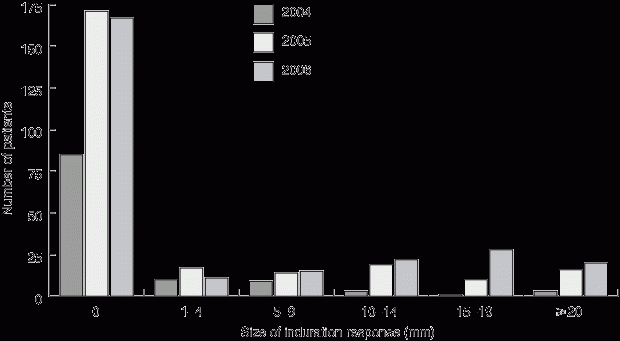
The number of tuberculin skin tests performed increased through the study period (Box 1), largely because the refugee clinic saw 90 new patients in 2005 and 150 in 2006. The proportion of children with an increased induration response increased over the study period (Box 1 and Box 2). We observed an increase in latent tuberculosis infection, both in absolute numbers and in the proportion of the total caseload. The absolute number, but not the proportion, of cases of active tuberculosis disease increased during the study period. Over the same period, hospital admissions remained static at about 26 000 per year. Extrapulmonary tuberculosis was present in 12 of 23 patients (52%) with active tuberculosis, compared with 34% in the earlier study.2 There was no increase in tuberculosis meningitis.
The active tuberculosis cohort ethnicity was consistent with the earlier study, with 22 of 23 patients of non-European origin, and 18 born outside Australia. The predominant ethnic groups were from Africa (eight, all born outside Australia) and the Indian subcontinent (four, two born outside Australia).
Our finding of an increase in the proportion of patients with latent tuberculosis infection but not active tuberculosis disease is largely due to increased testing of refugees. It is reassuring that we did not find active tuberculosis. The United Kingdom has reported an increased incidence of tuberculosis in African immigrants.1,3 Australian immigration trends have shown a demographic shift, with increasing numbers of refugees from Africa.4 Although our study is likely to suffer from referral bias, it is the largest review of paediatric tuberculosis from a tertiary centre in Australia.
Children very rarely transmit tuberculosis, but it is important to identify and treat latent tuberculosis to prevent progression to active disease.5 We believe our results are encouraging in showing a low incidence of active tuberculosis and indicate the need to screen refugees for latent tuberculosis to direct chemoprophylaxis.
1 Comparison data on tuberculosis among children, 2004–2006
References
- Anderson SR, Maguire H, Carless J. Tuberculosis in London: a decade and a half of no decline in tuberculosis epidemiology and control. Thorax 2007; 62: 162-167.
- McIntosh ED, Isaacs D, Oates RK, et al. Extrapulmonary tuberculosis in children. Med J Aust 1993; 158: 735-740. 0_i1091962
- Balasegaram S, Watson JM, Rose AM, et al. A decade of change: tuberculosis in England and Wales 1988–98. Arch Dis Child 2003; 88: 772-777. 0_i1091964
- Australian Government Department of Immigration and Citizenship. Settler arrivals 1996–97 to 2006–07. Australia, states and territories. Canberra: Department of Immigration and Citizenship, 2007. http://www.immi.gov.au/media/publications/statistics/settler-arrivals/settler-arrivals-0607.pdf (accessed Nov 2007).
- Smieja MJ, Marchetti CA, Cook DJ, Smaill FM. Isoniazid for preventing tuberculosis in non-HIV infected persons. Cochrane Database Syst Rev 2000; (2): CD001363. 0_i1091970
Barriers and Facilitators to Timely Detection and Optimal Management of Chronic Wet Cough in Aboriginal Children Across Australia From the Perspectives of Carers of Aboriginal Children: A Qualitative Study
Gloria T. Y. Lau, Pam Laird, Robyn Aitken, Melanie Barwick, Liam Bedford, Emily R. Bowden, Jamie Everingham, Angela Fuery, Reece Griffin, Neha Jain, Mina Kinghorn, Renae Knapp, Gabrielle B. McCallum, Peter Morris, Richard Norman, Peter C. Richmond, Aarti Saiganesh, Slade Sibosado, Cameron Taylor, Maree Toombs, Roz Walker, Joan Wilson, Anne B. Chang, André Schultz
Barriers and Facilitators to Timely Detection and Optimal Management of Chronic Wet Cough in Aboriginal Children Across Australia From the Perspective of Health Care Providers: A Qualitative Study
Gloria T. Y. Lau, Pamela Laird, Robyn Aitken, Melanie Barwick, Liam Bedford, Emily R. Bowden, Corey Dalton, Jamie Everingham, Angela Fuery, Reece Griffin, Neha Jain, Mina Kinghorn, Renae Knapp, Gabrielle B. McCallum, Peter Morris, Richard Norman, Peter C. Richmond, Aarti Saiganesh, Slade Sibosado, Maree Toombs, Roz Walker, Joan Wilson, Anne B. Chang, André Schultz
Short-Term Safety of Concomitant Meningococcal B and National Immunisation Program Vaccines in Infants Aged < 15 Months: A Survey-Based Surveillance Study
Thuy Nguyen, Evelyn C. S. Tay, Michael Dymock, Thomas L. Snelling, Lucy Dawes, Julie Marsh, Yue Wu, Alan Leeb, Nicholas Wood, Lucy Deng
The GenV Biobank: Enabling Biological Research in a Large Longitudinal Population-Representative Cohort of Australian Newborns and Their Parents
Katherine Lange, Kim L. Powell, Yeukai Mangwiro, Tony Frugier, Donna T. Geddes, Melissa Wake, Richard Saffery
Watchful Waiting Compared With Immediate Antibiotics for Urban Aboriginal and Torres Strait Islander Children With Uncomplicated Acute Otitis Media (WATCH): A Non-Inferiority Randomised Controlled Trial
Jennifer S. Reath, Hasantha Gunasekera, Sanja Lujic, Amanda J. Leach, Letitia Campbell, Robyn Walsh, Tim Usherwood, Geoffrey K. Spurling, Claudette A. Tyson, Deborah A. Askew, Kelvin Kong, Chelsea J. Watego, Peter Morris, Wendy Hu, Penelope A. Abbott
A Rare Case of Storage Mite Anaphylaxis in Infancy
Eliza Kluckow, Katie Frith