




Volume 188 - Issue 12
The ethics of tomorrow’s health care
Author: Stephen R Leeder
Med J Aust 2008; 188 (12): 697. || doi: 10.5694/j.1326-5377.2008.tb01848.x
Published online: 16 June 2008
Published online: 16 June 2008
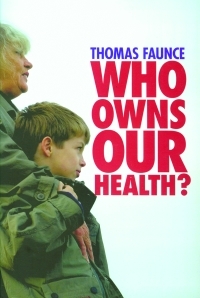
Who owns our health? Medical professionalism, law and leadership beyond the age of the market state.
Thomas Faunce. Sydney: UNSW Press, 2007 (xi + 298 pp). ISBN 978 086840 821 7.
Global warming, unsustainable global demands for fossil fuel as China and India come on line, threats to biodiversity, obesity, 1.1 billion people in extreme poverty, wars and rumours of wars — it’s enough to make you sick. How, in a world like this, can we find the strength to be a doctor? Faced with this mess, you might choose to retreat into silence, keep your own council, look after your family and plan for retirement.
Not prepared to retreat or be silent, Thomas Faunce — doctor, lawyer, philosopher and ethicist at the Australian National University — writes passionately in pursuit of a future for medical professionalism. He is deeply worried about how market fundamentalism has come to dominate everything, including politics, and explores what might be a satisfactory foundational ethic, or basic moral commitment, for tomorrow’s doctor. He considers the market state will not last, but in the meantime, we need to keep the flame of professionalism alight.
Of the market state, which Faunce finds so objectionable, he writes:
Governments are controlled by the will not of the people, but of . . . corporate executives [who] espouse . . . socially and environmentally damaging, profit-laden values . . . creating a world where . . . individualistic consumers grow increasingly apathetic about the erosion of their rights and responsibilities as citizens.
Faunce sees the progressive privatisation of health care as a manifestation of the growing dominance in politics, without a popular mandate, of the private health insurance funds, large pharmaceutical and device manufacturers, and those seeking to make huge profits on behalf of shareholders from the care of the sick. Here is market fundamentalism on full display.
After extended excursions into philosophy and ethics, and multiple literary allusions, Faunce proposes that the foundational value — the base plate — for medical practice should be “loyalty to the relief of patient suffering”. He does not think that medicine should primarily be promoting communal welfare, nor promoting and maintaining health. These are worthy actions, but they lack the voltage to power the engine of dedicated medical practice. If we cut medicine off from a strong connection to individual human suffering, then we cut it off at the knees.
The relief of patient suffering, Faunce argues, is a strong moral force that generates action that is externally and publicly focused. There are many good things that come from being a doctor, such as status, job satisfaction and money, that motivate us, but none of these internally directed, individualistic ambitions provides all the strength for medical practice that responds to the need of individual patients who come seeking help. This requires us to put suffering patients always ahead of ourselves. A primary moral commitment to the relief of patient suffering then allows us, Faunce argues, to build a structure of other ethical action that constitutes truly professional practice.
Mending the Road: A Way Forward From Silence and Silencing
Ayman Hamdan, Anisa J. N. Jafar
Seven Vessel Spontaneous Coronary Artery Dissection and Concurrent Transient Global Amnesia After an Emotional Trigger
Michael J. Stewart, Tom R. Sutherland
Seven Vessel Spontaneous Coronary Artery Dissection and Concurrent Transient Global Amnesia After an Emotional Trigger
Virginia Barbour
Research Priority Setting Is Not Research: A Call for Ethical Clarity in Australia
Bec Jenkinson, Gordon McGurk, Jonathan Quicke, Janelle Bowden, Nadine E. Foster
Organ Donation After Oral Ingestion of a Voluntary Assisted Dying Substance
Joanne Kantianis, Helen I. Opdam, Rohit L. D'Costa
Equity, Diversity and Inclusion From the Start: Reforming Australia's Research Infrastructure for Inclusive Participation
Danielle M. Muscat, Kirsten J. McCaffery, Heather L. Shepherd, Marguerite Tracy