




Volume 188 - Issue 12
In-vivo characterisation of coronary atherosclerosis with optical coherence tomography
Authors: Peter Barlis, Giuseppe Ferrante, Francesca Del Furia and Carlo Di Mario
Med J Aust 2008; 188 (12): 728. || doi: 10.5694/j.1326-5377.2008.tb01856.x
Published online: 16 June 2008
Published online: 16 June 2008
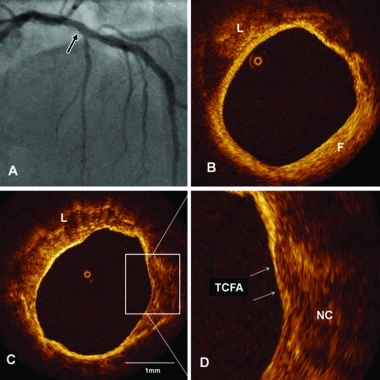
The burden of atherosclerosis has triggered intense interest in the study of “vulnerable” plaques at high risk of rupture. Optical coherence tomography (OCT) has recently contributed to the in-vivo visualisation of plaque, providing unique insights into the atherosclerotic process, previously only attainable through postmortem examination. This technique uses near infrared light and an optical imaging wire attached to a patient interface unit with a pullback speed of up to 3.0 mm/s.
In this patient, a 62-year-old man with treatment-resistant dyslipidaemia and stable angina, coronary angiography revealed possible non-flow-limiting plaque in the proximal left anterior descending coronary artery (arrow; Figure, A). OCT images confirmed extensive non-flow-limiting plaque (Figure, B–D), consisting of lipid (L)-rich areas with characteristic low reflectivity and homogenous appearance (Figure, B and C), and a fibrous (F) plaque with a high reflective and homogenous appearance (Figure, B). The images revealed almost circumferential thin cap fibroatheroma (TCFA; Figure, D), a marker of plaque vulnerability, as well as the plaque’s necrotic core (NC; Figure D). This case demonstrates the potential of OCT to visualise plaque and detect TCFA. This is particularly useful in stable patients in whom aggressive management of risk factors might prevent future adverse events.
Fatty Liver Disease in Australia: A Narrative Review on the Epidemiology, Natural History, Prognostication and Management in People With Metabolic Dysfunction
Karl Vaz, Daniel Clayton-Chubb, William W. Kemp, Stuart K. Roberts, Ammar Majeed
Sex Differences in Management and Outcomes of People With ST-Elevation Myocardial Infarction, New South Wales, 2011–2020: A Retrospective Cohort Study
Adam C. Livori, Jedidiah I. Morton, Dianna J. Magliano, Jonathan E. Shaw
Rethinking Rheumatic Fever Diagnosis: Progress, Pitfalls and the Path Towards a Definitive Test
Anna P. Ralph, Rachel Webb, Tom Parks, Nicole J. Moreland, Asha C. Bowen, Benjamin Jones, Emma Ndagire, Andrea Z. Beaton
Sex Differences in Management and Outcomes of People With ST-Elevation Myocardial Infarction, New South Wales, 2011–2020: A Retrospective Cohort Study
Samia Kazi, Simone Marschner, Clara K. Chow
Distribution of Cardiovascular Disease Risk Based on the Updated 2023 Guideline-Recommended Australian Cardiovascular Disease Risk Algorithm and Comparison With the 2012 Algorithm: An Observational Study
Nina Lazarevic, Meghana Bhat, Grace Joshy, Danielle C. Butler, Mark Woodward, Anushka Patel, Rod T. Jackson, Garry Jennings, Rosemary Wyber, Ellie Paige, Emily Banks
They Brought the Hospital to Me
Hugh N. Burrill