




Volume 186 - Issue 3
Performance indicators of a primary care skin cancer clinic network
Authors: Deborah A Askew, David Wilkinson and Gordon L Patrick
Med J Aust 2007; 186 (3): 159. || doi: 10.5694/j.1326-5377.2007.tb00848.x
Published online: 5 February 2007
Published online: 5 February 2007
To the Editor: Primary care skin cancer clinics continue to receive negative publicity. We have previously reported on the workload profile of one network of clinics.1 We report here the profile of clinical activity of the four MoleScan skin cancer clinics situated on the Sunshine Coast, Queensland. Between them, these clinics have been open for a total of 22 years, ranging from 2 years to nearly 9 years of operation.
MoleScan is a service company with clinics across Australia. Doctors are employed as subcontractors and are provided with digital dermascopes. The clinics do not have dedicated day surgery facilities, and surgical procedures are conducted in the consulting rooms (http://www.molescan.com.au).
Using Medicare Benefits Schedule item number billing data (as previously reported1), we calculated the number of consultations, biopsies, excised lesions (benign, non-melanoma skin cancers [NMSCs] and melanoma), surgical repairs, non-surgical treatment of skin cancers, and non-surgical treatment of other skin lesions. We also estimated the number needed to treat (NNT), defined as the number of benign lesions removed per melanoma.
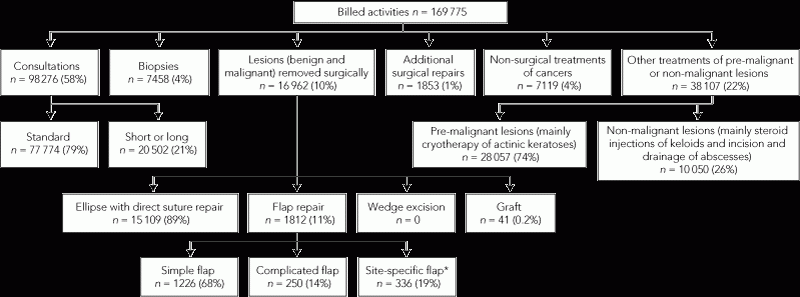
There were 98 276 consultations at the four clinics during the 22 years of operation (Box). In all, 14 982 skin cancers were treated: 395 melanomas and 7468 NMSCs by surgical excision, and 7119 NMSCs by non-surgical methods. The estimated NNT was 22.5.
Of the 16 962 lesions excised, 11% (1812) were repaired by a skin flap, 68% (1226) of which were simple flaps. Our previous report, on a different network of clinics,1 showed a different pattern of surgical repairs: 33% (2651) of the 8055 lesions excised were repaired by a skin flap, 45% (1187) of which were simple flaps. Clearly, the clinical practices of these two clinic networks vary.
Another area of apparent difference between the two clinic groups is the NNT — 22.5 reported here, compared with 28.6 from the other network.1 The lower NNT in these MoleScan clinics may result from the use of digital dermoscopy, but this requires further study.
These early findings from our analyses of MoleScan data highlight the dangers of generalising about the activities of primary care skin cancer clinics from one dataset. Workload profiles of different clinical services may vary markedly, and the widely expressed concern about large numbers of inappropriate surgical repairs may not be warranted.
Competing interests
Gordon Patrick is the founder and a director of MoleScan. He is also a practising clinician working in a MoleScan clinic. MoleScan made the data available for our study with no restriction on the analysis undertaken. The company viewed this letter for accuracy prior to submission, but had no influence on the data presented or their interpretation.
References
- Wilkinson D, Askew DA, Dixon A. Skin cancer clinics in Australia: workload profile and performance indicators from an analysis of billing data. Med J Aust 2006; 184: 162-164. 0_DCGGGIJD
Shifting focus to adolescent wellbeing and inclusive participation in the digital age
Allyson R Todd, Elena Wang, Stephanie R Partridge
The clinical presentation, investigation, and management of women diagnosed with endometriosis in Australian general practices, 2011–2021: an open cohort study
Danielle Mazza, Kailash Thapaliya, Sharinne B Crawford, Alissia Hui, Maryam Moradi, Luke E Grzeskowiak
The impact of the Breast Screen NSW transition from film to digital mammography, 2002–2016: a linked population health data analysis
Rachel Farber, Nehmat Houssami, Katy J L Bell
Non‐technical errors associated with deaths in surgical care, Australia, 2012–2019, by surgical specialty (Australian and New Zealand Audit of Surgical Mortality): a retrospective cohort study
Jesse Ey, Victoria Kollias, Octavia Lee, Kelly Hou, Matheesha Herath, John B North, Ellie Treloar, Suzanne Edwards, Martin Bruening, Adam J Wells, Guy J Maddern
The CURE Asthma roadmap
Gary P Anderson, Anthony Flynn, Phil G Bardin, John D Blakey, Shyamali C Dharmage, Paul Foster, Peter G Gibson, Adam Jaffe, Alan James, Christine R Jenkins, Sundram Sivamalai, Peter D Sly, Guy B Marks, Vanessa M McDonald, Judy Wetttenhall
Evidence from Australian cohort studies about asthma trajectories and transitions across the life course: a narrative review
Caroline Lodge, Xin Dai, Ingrid A. Laing, Michael P Menden, Anthony Flynn, Gary P Anderson, Sarath Ranganathan, Shyamali C Dharmage