




Volume 185 - Issue 7
An inside account of SARS
Author: Peter A Cameron
Med J Aust 2006 || doi: 10.5694/j.1326-5377.2006.tb00599.x
Published online: 10 March 2006
Published online: 10 March 2006
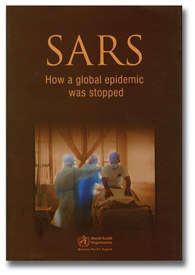
SARS. How a global epidemic was stopped.
World Health Organization. Geneva: World Health Organization, 2006 (x + 307 pp). ISBN 92 9061 2134.
The title of this book suggested to me that it might well be a self-congratulatory review by an organisation trying to claim credit for stopping a brief but frightening epidemic in its tracks. The fact that it was published by the World Health Organization also led me to believe that it might be a dry chronology of events and difficult for the average medical reader to penetrate. So I was pleasantly surprised to find that I enjoyed reading SARS and that facts are presented in a balanced manner.
The best feature of this book is that it presents a worldwide phenomenon in easy-to-read prose, with excellent diagrams, pictures and tables, in just over 300 pages. There are detailed accounts, with expert content from each region. In particular, judging from my personal experience, the account from Hong Kong is accurate and concise.
The authors start and finish the book by commenting that the lessons learnt from the SARS (severe acute respiratory syndrome) epidemic have not been analysed and promulgated widely enough. This is a view with which I strongly concur. Surveillance and control measures, the process of developing new tests and vaccines, clinical management of unknown viral conditions, and adoption of evidence-based infection control procedures were areas of controversy during the epidemic. The different approaches taken by different groups give important insights and should help guide us in planning for the next epidemic.
The reality is that we are still not sure where the SARS epidemic came from, how it spread rapidly sometimes and not others, and why it disappeared completely after only a few months. We do know that many lives were saved by a swift, well coordinated global response, limiting the number of cases and confining the epidemic to just a few regions of the world.
This is a great book for anyone interested in the SARS epidemic (or future pandemics) wanting a balanced, well referenced, accessible and concise summary.
Peter A Cameron Head, Pre-Hospital and Emergency Trauma Group, Alfred Hospital, Melbourne, VIC
Dousing the burning inequity of global warming for people experiencing homelessness
Timothy English, Alejandro Vásquez Hernández, Glenn Miller, Nuala Fogarty, Charles Cosgrove, Paul Rosenthal, Matthew Larkin, Jon Swain, Danielle Austin, Jo River
The contribution of evidence‐based practice and the practice‐based evidence approaches to contemporary Australian psychology: implications for culturally safe practice
Paul Gray (Wiradjuri), Dawn Darlaston‐Jones, Pat Dudgeon AM (Bardi), Kate Derry, Joanna Alexi, William Smith (Wiradjuri and Wemba Wemba), Tanja Hirvonen (Jaru and Bunuba), David Badcock, Shraddha Kashyap, Belle Selkirk (Noongar)
Explaining risk in chronic conditions: the Yolŋu science of signs
Emma Haynes, Alison Mitchell, Minitja Marawili (Yolŋu), Dawn C Bessarab (Bardi)
Is it time to retire the label “CALD” in public health research and practice?
Sabine Allida, Della Maneze
What do Aboriginal people in the Northern Territory value during the operation journey? A qualitative study
Edith B Waugh, Marita Hefler, Sophie Pascoe, Mark Mayo, Matthew JL Hare, David A Story, Neil Wilkshire, Peter Henwood, David Croker, Jampijinpa Ross
Fulfilling First Nations health, cultural safety and equity accreditation standards in primary medical education: reflections from a First Nations desktop review team
Paul Saunders, Nicole Mercer, Maria Mackay, Ian Lee, Madelyne Hudson‐Buhagiar, Miriam Cavanagh, Emma Milliss, Melody Muscat, Kathleen Martin, Adam Shipp, Melissa Johnson, Belinda Gibb