




Volume 183 - Issue 9
Hepatitis E virus: overseas epidemics and Victorian travellers
Authors: Benjamin C Cowie, Alan Breschkin and Heath Kelly
Med J Aust 2005; 183 (9): 491. || doi: 10.5694/j.1326-5377.2005.tb07133.x
Published online: 7 November 2005
Published online: 7 November 2005
Benjamin C Cowie,* Alan Breschkin,† Heath Kelly‡
* Infectious Diseases Physician, † Senior Scientist, Infectious Disease Serology, ‡ Head of Epidemiology, Victorian Infectious Diseases Reference Laboratory, 10 Wreckyn Street, North Melbourne, VIC 3051. Benjamin.CowieATmh.org.au
To the Editor: Hepatitis E virus (HEV) infection is uncommon in Australia. The HEV cases detected are almost always in patients who have recently arrived from HEV-endemic regions of the world.1 We previously reported a significant increase in highly reactive serology results for anti-HEV IgG antibodies measured by enzyme im-munoassay (EIA) at the Victorian Infectious Diseases Reference Laboratory (VIDRL) in the first 6 months of 2004.2
Nine of the 10 Victorian patients with highly reactive samples in the previous report had had a history of recent clinically compatible illness and travel in a disease-endemic region within the incubation period (2–9 weeks). This indicated a strong association between highly reactive anti-HEV IgG measured by EIA and acute HEV infection, as has been shown previously.3 At the time, we hypothesised an association with overseas HEV epidemics, particularly in India, as seven of the nine patients with acute HEV infection had travelled there.
We have now reviewed HEV serology results at VIDRL for the subsequent 9 months and compared them with our ex-perience of the past 5 years (Box). In the first quarter of 2005, we recorded the highest quarterly number of highly reactive anti-HEV serology results since testing commenced at VIDRL. Also marked on the figure are the dates, over the same time period, when an outbreak of hepatitis in India (either suspected or confirmed to be caused by HEV) was reported on ProMED-mail, the global electronic reporting program for emerging diseases hosted by the International Society for Infectious Diseases (http://www.promedmail.org).
It would appear that epidemic HEV activity in India is reflected in significant increases in the number of highly reactive anti-HEV serology results in our laboratory. In fact, as shown in the Box, increases in highly reactive anti-HEV serology at VIDRL have sometimes preceded an outbreak noti-fication on ProMED-mail, and may provide early warning of such an event. A similar association is not observed for epidemics in other countries.
Travellers to developing countries must be advised of preventive measures against HEV and other enterically transmitted diseases, and a diagnosis of HEV infection should be considered in any febrile traveller recently arrived from an HEV-endemic area, particularly if jaundice or abnormal liver function tests are present. This is especially important in pregnant women because of the risk of fulminant hepatitis, with maternal mortality in excess of 20% in the third trimester.4 All cases should be notified to state health authorities.
Highly reactive anti-HEV IgG EIA results at VIDRL per quarter, 1 Apr 2000 to 31 Mar 2005. Also marked are confirmed (in bold) or suspected epidemics of HEV in India listed on ProMED-mail* during the same period
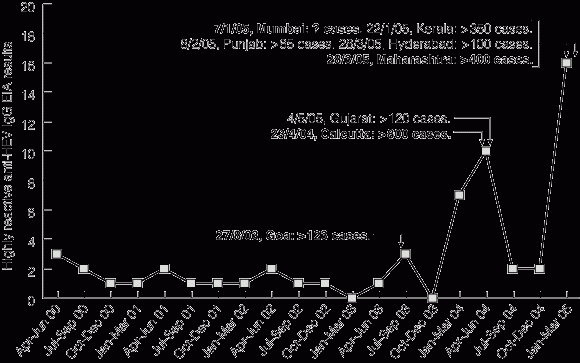
EIA = enzyme immunoassay. HEV = hepatitis E virus. VIDRL = Victorian Infectious Diseases Reference Laboratory.
* Available at <http://www.promedmail.org>.
Acknowledgements
Acknowledgement: Benjamin Cowie is supported by a PhD scholarship from the National Health and Medical Research Council Centre for Clinical Research Excellence (Infectious Diseases).
References
- Moaven LD, Fuller AJ, Doultree JC, et al. A case of acute hepatitis E in Victoria. Med J Aust 1993; 159: 124-125. 0_CBBBJGHH
- Cowie BC, Adamopoulos J, Carter K, Kelly H. Hepatitis E infections, Victoria, Australia. Emerg Infect Dis 2005; 11: 482-484. 0_i1091552
- Zaaijer HL, Kok M, Lelie PN, et al. Hepatitis E in the Netherlands: imported and endemic [letter]. Lancet 1993; 341: 826. 0_CBBHGCEA
- Yarbough PO. Hepatitis E virus: diagnosis. In: Zuckerman AJ, Thomas HC, editors. Viral hepatitis. 2nd ed. London: Churchill Livingstone, 1998: 411-416. 0_CBBGFBHD
Costs of Delivering the Hep B PAST Model of Care in Remote Australia: A Retrospective Pre–Post Study
Hoa Nguyen, Anh Le Tuan Nguyen, Paula Binks, Melita McKinnon, Emily Vintour-Cesar, Karen Wills, Nicola Stephens, Benjamin Cowie, Joshua S. Davis, Yuejen Zhao, Peter Nihill, Julie A. Campbell, Andrew J. Palmer, Jane Davies, Barbara de Graaff
Buruli Ulcer Acquired From Ringtail Possum Rescue
Daniel P. O'Brien, Naomi Clarke, Sara Bonnici, Mohammad A. Hussain
Q Fever Visceral Abscesses After Contact With Native Australian Marsupials
Samantha J. Laws, Enzo Binotto, James Stewart, Jennifer Ho, Trent Yarwood, Josh Hanson, Simon Smith
Hospital-Admitted Injection-Related Infections Among Incarcerated People Who Inject Drugs in Australia: A Retrospective Cohort Study
Andrew Palmer, Matthew Carter, Jeremy Yeo, Cecilia Shim, Jason Connor, Jeremy Hayllar, Gerald Holtmann, Naomi Moy, Elliott G. Playford, Naomi Runnegar, Paul J. Clark
The Live Attenuated Influenza Vaccine in Australia: An Additional Tool for Influenza Prevention
Cyra Patel, Alexis Pillsbury, Tran Nguyen, Xia Wang, Helen E. Quinn, Clayton K. Chiu, Allen C. Cheng, Katie L. Flanagan, Zhicheng Wang
Reflex Testing for Hepatitis D Infection: A Unique Opportunity to Reduce Hepatitis D-Related Chronic Liver Disease Deaths in Australia
Jessica Howell, Lauren Andersson, Miriam T. Levy, James O'Beirne, Leon Adams, Katharine Irvine, Avik Majumdar, Golo Ahlenstiel, Kathy Jackson, Krispin Hajkowicz, Joseph Doyle, Jane Davies, Sarah Cherian, Wayne Dimech, Alexander J. Thompson