




Volume 183 - Issue 4
Sustained increase in infectious syphilis notifications in Victoria
Authors: Rebecca J Guy, David E Leslie, Kleete Simpson, Beth Hatch, Jennie Leydon, Margaret E Hellard and Heath A Kelly
Med J Aust 2005; 183 (4): 218. || doi: 10.5694/j.1326-5377.2005.tb07004.x
Published online: 15 August 2005
Published online: 15 August 2005
Rebecca J Guy,* David E Leslie,† Kleete Simpson,‡ Beth Hatch§ Jennie Leydon,¶ Margaret E Hellard,** Heath A Kelly††
* Epidemiologist, ** Head, Centre for Epidemiology and Population Health Research, Macfarlane Burnet Institute for Medical Research and Public Health, GPO Box 2284, Melbourne, VIC 3001; † Microbiologist, ¶ Senior Serologist, †† Head, Victorian Infectious Diseases Reference Laboratory, Melbourne, VIC; ‡ Surveillance Manager, § Partner Notification Officer, Blood Borne Viruses and Sexually Transmissible Infections Program, Department of Human Services, Melbourne, VIC. Rebecca.GuyATburnet.edu.au
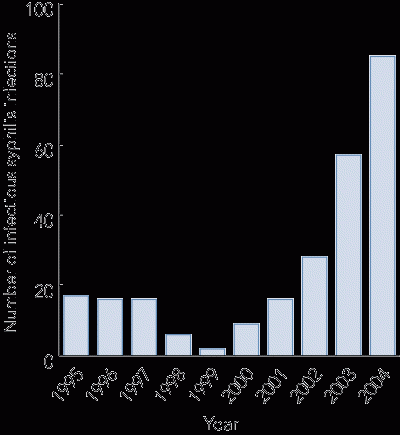
To the Editor: In Victoria, notifications of infectious syphilis infection (primary, secondary and early latent [< 2 years’ duration]), reported by the Department of Human Services, have increased more than fivefold in the past decade, from 16 in 1995 to 85 in 2004 (Box). An increase in notifications has also been observed in Sydney.1 Whereas previously in Victoria, very few infectious syphilis notifications were reported among men who have sex with men (1 of 16 cases in 1995), in 2004, 63 of a total of 85 cases (74%) were in this group (68% of these were acquired in Victoria).
The Victorian Infectious Diseases Reference Laboratory (VIDRL) conducts testing for sexually transmitted infections (STI) and HIV for three Melbourne sexual health clinics with a high proportion of patients who are men who have sex with men. In 2004, 62 male patients tested positive for infectious syphilis, and 40% of these were HIV-positive. This is similar to the situation in Sydney, where in 2003, 54% of infectious syphilis cases were reported among HIV-positive men who have sex with men.1
Syphilis outbreaks among men who have sex with men have been reported elsewhere in recent years. There was an outbreak of syphilis in this group in Greater Manchester; between 1999 and 2002, and 37% of cases were in HIV-positive men.2 In this population, syphilis infection was associated with unprotected oral sex with high numbers of partners, seeking sexual partners at venues (darkrooms, cruising areas and saunas) and use of drugs (GHB [gamma hydroxybutyrate] and poppers [amyl nitrate]).3 A San Fransisco study in 2000, performed in response to a syphilis outbreak among men who have sex with men, reported that meeting sexual partners through use of the Internet was a factor significantly associated with syphilis infection.4
It is likely that some or all of the factors reported in these outbreaks overseas are contributing to the sustained increased in infectious syphilis notifications in Victoria, but it is important to have local data to ensure interventions are targeted appropriately and cost effectively. In Victoria, responses to the increase in syphilis notifications have already included an alert to general practitioners to encourage men who have sex with men to have syphilis testing and individual counselling, and syphilis testing of men who have sex with men at a popular sex-on-premises venue over a 4-week period. Depending on further studies in this population in Victoria, other responses could include enhancing outreach at Internet chat rooms, intensive counselling of HIV-positive men who have sex with men, and education interventions such as peer-led community-based strategies for countering unsafe sex and substance-use behaviours. Finally, it is vital that interventions are multidisciplinary, collaborative and evidence-based.
Competing interests
None identified.
References
- Jin F, Prestage GP, Kippax SC, et al. Epidemic syphilis among homosexually active men in Sydney. Med J Aust 2005; 183: 179-183. <eMJA full text>
- Ashton M, Sopwith W, Clark P, et al. An outbreak no longer: factors contributing to the return of syphilis in Greater Manchester. Sex Transm Infect 2003; 79: 291-293. 0_i1091556
- Bellis MA, Cook P, Clark P, et al. Re-emerging syphilis in gay men: a case-control study of behavioural risk factors and HIV status. J Epidemiol Community Health 2002; 56: 235-236. 0_i1091558
- Klausner JD, Wolf W, Fischer-Ponce L, et al. Tracing a syphilis outbreak through cyberspace. JAMA 2000; 284: 447-449. 0_i1091560
Costs of Delivering the Hep B PAST Model of Care in Remote Australia: A Retrospective Pre–Post Study
Hoa Nguyen, Anh Le Tuan Nguyen, Paula Binks, Melita McKinnon, Emily Vintour-Cesar, Karen Wills, Nicola Stephens, Benjamin Cowie, Joshua S. Davis, Yuejen Zhao, Peter Nihill, Julie A. Campbell, Andrew J. Palmer, Jane Davies, Barbara de Graaff
Buruli Ulcer Acquired From Ringtail Possum Rescue
Daniel P. O'Brien, Naomi Clarke, Sara Bonnici, Mohammad A. Hussain
Q Fever Visceral Abscesses After Contact With Native Australian Marsupials
Samantha J. Laws, Enzo Binotto, James Stewart, Jennifer Ho, Trent Yarwood, Josh Hanson, Simon Smith
Hospital-Admitted Injection-Related Infections Among Incarcerated People Who Inject Drugs in Australia: A Retrospective Cohort Study
Andrew Palmer, Matthew Carter, Jeremy Yeo, Cecilia Shim, Jason Connor, Jeremy Hayllar, Gerald Holtmann, Naomi Moy, Elliott G. Playford, Naomi Runnegar, Paul J. Clark
The Live Attenuated Influenza Vaccine in Australia: An Additional Tool for Influenza Prevention
Cyra Patel, Alexis Pillsbury, Tran Nguyen, Xia Wang, Helen E. Quinn, Clayton K. Chiu, Allen C. Cheng, Katie L. Flanagan, Zhicheng Wang
Reflex Testing for Hepatitis D Infection: A Unique Opportunity to Reduce Hepatitis D-Related Chronic Liver Disease Deaths in Australia
Jessica Howell, Lauren Andersson, Miriam T. Levy, James O'Beirne, Leon Adams, Katharine Irvine, Avik Majumdar, Golo Ahlenstiel, Kathy Jackson, Krispin Hajkowicz, Joseph Doyle, Jane Davies, Sarah Cherian, Wayne Dimech, Alexander J. Thompson