




Volume 182 - Issue 12
Staphylococcal toxic shock syndrome: still a problem
Authors: Christopher M MacIsaac, Mark A Page, Beverley-Ann Biggs and Kumar Visvanathan
Med J Aust 2005; 182 (12): 651-652. || doi: 10.5694/j.1326-5377.2005.tb06858.x
Published online: 20 June 2005
Published online: 20 June 2005
Christopher M MacIsaac,* Mark A Page,† Beverley-Ann Biggs,‡ Kumar Visvanathan§
* Associate Intensivist, † Registrar, ‡ Associate Professor, The Royal Melbourne Hospital, Grattan Street, Melbourne, VIC 3050; § Senior Research Fellow, Murdoch Children’s Research Institute, Melbourne, VIC. Christopher.macisaacATmh.org.au
To the Editor: We report a recent case of toxic shock syndrome associated with menstruation which illustrates that this syndrome still occurs, even when tampons are used appropriately. A potential diagnostic test for the syndrome is also discussed.
An 18-year-old woman presented with a 1-day history of fever, chills and severe back pain, with no other focal symptoms. On examination, she was febrile with a blood pressure of 75/40 mmHg, and had begun vomiting.
She was treated empirically with intravenous ceftriaxone and flucloxacillin and resuscitated with intravenous fluids. Over several hours, the back pain resolved, and a widespread erythrodermic rash developed, centred mainly on the trunk. Further questioning revealed that the patient had removed a tampon shortly before presentation, as she had just ceased menstruating. Renal ultrasound examination, chest x-ray and blood cultures were non-diagnostic. She was treated with intravenous antibiotics for 4 days and discharged home with a further 10-day course of oral amoxycillin and clavulanic acid. At outpatient follow-up 3 weeks after admission, she reported desquamation of the skin of her palms and soles.
Toxic shock syndrome was first described in 1978,1 and a strong association with Staphylococcus aureus, menstruation and tampon use was established in 1980.2 Toxic shock syndrome toxin-1 (TSST-1), a protein secreted by S. aureus, was the first of many toxins associated with the syndrome to be identified. The term “superantigen” was adopted to describe the ability of these toxins to cause a remarkable expansion of T lymphocytes displaying specific β chain variable regions of the T-cell antigen receptor. Superantigens bypass normal antigen presentation and can stimulate over 20% of all T cells, whereas a conventional antigen stimulates only in the order of 1 in 10 000 T cells. The signature feature of superantigen activity is the expansion of lymphocyte populations bearing the particular Vβ chains that bind the superantigen. In the case of TSST-1, this is Vβ2.3
Our patient consented to blood being sampled to investigate the Vβ profile of her T cells at follow-up. This investigation was part of a broader study on superantigens in sepsis that was approved by the Ethics Committee of the Royal Melbourne Hospital. The blood was stained with monoclonal antibodies against 24 Vβ families4 and analysed by flow cytometry. This showed a massive expansion of Vβ2 cells, which accounted for 28% of all CD4 lymphocytes (Box).
Currently, there is no diagnostic test for toxic shock syndrome. Toxin production from cultured organisms can be established in vitro by some laboratories, but does not confirm toxin production in vivo. Detection of a “skewed” Vβ repertoire is a potential diagnostic test. Clearly, the sensitivity and specificity of the assay would need to be established before general application. To date, we have found skewed Vβ T-cell profiles in six independent cases of toxic shock syndrome.
This patient had used tampons appropriately, including replacing tampons at least every 4 hours and not using them overnight, but nevertheless developed a life-threatening disease. The incidence of toxic shock syndrome peaked in the United States in 1980 and has since fallen substantially, as a result of factors including changed tampon absorbency. However, the incidence may be now increasing.5 Our case serves to remind us all to be vigilant for toxic shock syndrome in association with menstruation, and to consider the diagnosis in all patients with severe sepsis.
Vβ profile of the T-cell antigen receptor of CD4 lymphocytes in a patient with toxic shock syndrome
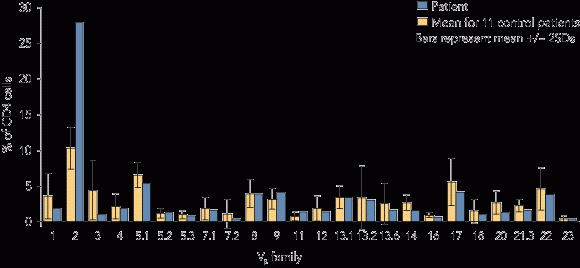
Vβ profile of CD4 cells from a patient 21 days after onset of toxic shock syndrome compared with the mean profile from 11 adult intensive-care patients with no evidence of infection. Note the massive expansion of cells carrying Vβ 2, for which toxic shock syndrome toxin-1 has known affinity.
References
- Todd J, Fishaut M, Kapral F, et al. Toxic-shock syndrome associated with phage-group-I staphylococci. Lancet 1978; 2: 1116-1118. BABJDJGI
- Davis JP, Chesney PJ, Wand PJ, et al. Toxic-shock syndrome: epidemiologic features, recurrence, risk factors, and prevention. N Engl J Med 1980; 303: 1429-1435. i1085789
- Marrack P, Kappler J. The staphylococcal enterotoxins and their relatives. Science 1990; 248: 1066. i1085791
- MacIsaac C, Curtis N, Cade J, et al. Rapid analysis of the Vbeta repertoire of CD4 and CD8 T lymphocytes in whole blood. J Immunol Methods 2003; 283: 9-15. i1085793
- Schlievert PM, Tripp TJ, Peterson ML. Reemergence of staphylococcal toxic shock syndrome in Minneapolis-St Paul, Minnesota, during the 2000-2003 Surveillance Period. J Clin Microbiol 2004; 42: 2875-2876. i1085795
Rhabdomyolysis After COVID-19
Navya Kataria, Abel Devadass, Lana Sundac, Laura De Souza, Nabeel Sheikh, Samantha Ng, Scott Campbell, Yishen Wang, Ross S. Francis
Technological advances in the search for a CURE for asthma
Sara Quon, Timothy M Johanson, Ridhima Wadhwa, Alen Faiz, Anthony Flynn, Gary P Anderson, Amanda J Cox, Nicholas P West, Michael P Menden, Rhys S Allan
The CURE Asthma roadmap
Gary P Anderson, Anthony Flynn, Phil G Bardin, John D Blakey, Shyamali C Dharmage, Paul Foster, Peter G Gibson, Adam Jaffe, Alan James, Christine R Jenkins, Sundram Sivamalai, Peter D Sly, Guy B Marks, Vanessa M McDonald, Judy Wetttenhall
The first live term birth following uterus transplantation in Australia
Rebecca Deans, Brigitte Gerstl, Antonia W Shand, Sarah Lyons, Aaron Budden, Helen L Barrett, Grant Luxton, Mangalee Fernando, Kenneth Yong, Karen Keung, Kaushalya Arulpragasam, Henry Pleass, King Man Wan, Eva Kehag, Jana‐Emily Pittman, Mianna Lotz, Maria Fenn, Erin Nesbitt‐Hawes, Lily Byun, Katrina Tang, Mats Brannstrom, Jason Abbott
The public health impacts of mining in Australia
Javier Cortes‐Ramirez, Ruby N Michael, Leisa‐Maree Toms, Melissa Haswell
Lingual Raynaud phenomenon
Michael Taggart, Mina John