





Volume 181 - Issue 4
A medicopolitical whodunit
Author: Martin B Van Der Weyden
Med J Aust 2004 || doi: 10.5694/j.1326-5377.2004.tb06226.x
Published online: 28 April 2004
Published online: 28 April 2004
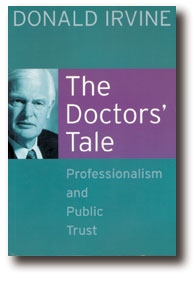
The doctors' tale. Professionalism and public trust. Donald Irvine.
Oxford: Radcliffe Medical Press, 2003 (ix + 247 pp). ISBN 1 85775 977 X
Irvine had been elected to the presidency on a reform agenda. Before his ascendancy, reform had been pursued through blueprints for medical education (Tomorrow's doctors: recommendations on undergraduate medical education. London: GMC, 1993) and for professionalism in practice (Duties of a doctor: good medical practice. London: GMC, 1995). But reform had moved at a snail's pace and remained impervious to societal changes.
However, all this became history following the well-publicised events in paediatric cardiac surgery at the Bristol Royal Infirmary. Public trust in doctors' abilities to self-regulate and ensure clinical competence evaporated almost overnight. Politicians and the public perceived the GMC as no longer in control. Further shocks followed with the revelation of the medical murders by Harold Shipman; the gross professional misbehaviour of gynaecologists Rodney Ledward and Richard Neave; and the arrogance displayed in the Alder Hey affair.
But the Bristol case, which is central to Irvine's theme, was to become the epicentre for reform and restoration of public trust. The second half of his book covers the post-Bristol efforts to advance revalidation of the profession and to achieve GMC change.
There are other subplots: the politics involving the British Medical Association, the National Health Service and the Medical Colleges, and the measured relationship between Irvine and the UK Secretary of State for Health. In the details of these interactions lies the book's only drawback -- it all seems so gentlemanly, without passion or heat!
The book is easy to read. It is divided into four parts: Irvine's formative years in general practice and its Royal College; his time as a member of the GMC; his seven years as GMC President; and finally his afterthoughts. It is well referenced, with helpful glossaries and appendices.
All doctors interested in medical reform and politics should read The doctors' tale, especially those in our health departments and medical boards. I recommend it for anyone who enjoys a good political whodunit.
Martin B Van Der WeydenEditor, The Medical Journal of Australia Sydney, NSW
Capturing the Benefits of Clinical Quality Registries
Taryn Bessen, Stephen McDonald
Medical Colleges Have an Obligation to Ensure Full Participation in Clinical Quality Registries
Thomas J. Hugh
Getting on the Same Page: Why Australia Needs a National Maternity Early Warning System (MEWS) Chart
Briony A. Cutts, Lucy Bowyer, Nisha Khot, Sandra Lowe, Stefan C. Kane
Data for Equity: Can Linked Administrative Data Inform Pathways to More Equitable Child Health?
Sarah Gray, Shuaijun Guo, Meredith O'Connor, Elodie O'Connor, Katrina Williams, Hannah Badland, Susan Woolfenden, Josie Dickerson, Gerry Redmond, Marnie Downes, Sharon R. Goldfeld
Specialty College Selection: Why Change is Critical to Support a Future Rural Workforce
Matthew R. McGrail, Jenny May AM, Katherine Logan
Differentiated and simplified oral HIV pre‐exposure prophylaxis (PrEP) models hold the key to virtually eliminating HIV transmission in Australia by 2030
Tyson Arapali, Sarah Warzywoda, Anthony K J Smith, Curtis Chan, Timothy R Broady, Erin Sullivan, Catherine MacPhail, Mohamed A Hammoud, Alexander Dowell‐Day, Benjamin R Bavinton