




Volume 180 - Issue 9
El Niño Southern Oscillation and the transmission of hepatitis A virus in Australia
Authors: Wenbiao Hu, Anthony J McMichael and Shilu Tong
Med J Aust 2004; 180 (9): 487-488. || doi: 10.5694/j.1326-5377.2004.tb06041.x
Published online: 3 May 2004
Published online: 3 May 2004
Wenbiao Hu,* Anthony J McMichael,† Shilu Tong‡
* PhD candidate, Centre for Health Research, Queensland University of Technology; † Director, National Centre for Epidemiology and Population Health, Australian National University, Canberra; ‡ NHMRC Senior Research Fellow, School of Public Health, and Centre for Health Research, Queensland University of Technology, Kelvin Grove, QLD 4059. s.tongATqut.edu.au
To the Editor: We examined the possible association between the Southern Oscillation Index (SOI) and the occurrence of hepatitis A in Australia using a Seasonal AutoRegressive Integrated Moving Average (SARIMA) regression model.1 Our results indicate that the SOI is statistically significantly associated with the transmission of hepatitis A.
We obtained data on the monthly counts of hepatitis A cases in Australia and the monthly SOI between 1 January 1991 and 31 December 2000 from the Commonwealth Department of Health and Ageing and the Australian Bureau of Meteorology, respectively. Data on population sizes were obtained from the Australian Bureau of Statistics. Cross-correlations were used to compute a series of correlations between SOI and the incidence of hepatitis A over a range of time lags (defined as the time span between the SOI and the incidence of hepatitis A).
A SARIMA model was used to estimate the independent contribution of SOI in our study. We adjusted for seasonality by “seasonally differencing” (ie, replacing each observation by the difference between it and the observation from the previous year). In the modelling process, attention was paid to observations well outside the main body of the data (outliers) and the only outlier was excluded in the final SARIMA model. We used the SARIMA [1,0,0] [1,1,0]12 model (ie, first-order autoregressive combined, first-order seasonal autoregressive, after adjustment for first-order seasonal integration) to assess the association between SOI and the incidence of hepatitis A.
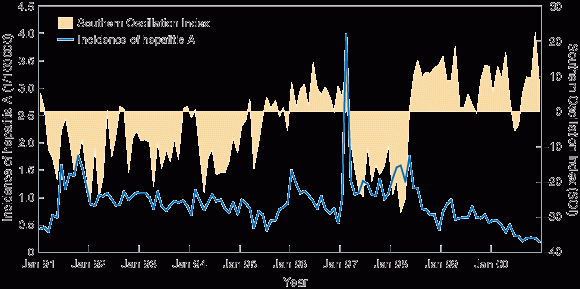
We found that a decrease in the SOI (ie, warmer and drier conditions) was statistically significantly associated, at a lag of 1 month, with an increase in the monthly incidence of hepatitis A (β = − 0.01; P = 0.001). Two El Niño events (1991–92 and 1997–98) were also clearly associated with an increased incidence of hepatitis A (Box).
The results suggest that there was an increase of about 360 cases per year in Australia for an, on average, interquartile range decrease in the SOI. The residuals in the model fluctuated randomly around zero, and there was no apparent autocorrelation between residuals at different lag times (data are available from the corresponding author).
These results indicate that the model fitted the data well, with no violation of assumptions. The significant association between SOI and the incidence of hepatitis A remained when the outlier was included in the model (β = − 0.013; P = 0.001).
El Niño Southern Oscillation (ENSO) has been found to be related to various health outcomes, including waterborne disease, vectorborne disease, and natural disaster-related deaths (eg, floods, bushfires and cyclones).2-4 Our study adds further evidence of ENSO-related health effects. Infectious diseases are, in general, sensitive to climate variability, as climate can influence the development and transmissibility of pathogens, and can also affect people’s behaviour.3,5 If the relationship between ENSO and hepatitis A is confirmed by other studies, these findings may facilitate the development of early warning systems for controlling and preventing this widespread communicable disease.
References
- Helfenstein U. Box-Jenkins modelling in medical research. Stat Methods Med Res 1996; 5: 3-22. CBBBACFJ
- Kovats R, Bouma M, Hajat S, et al. El Niño and health. Lancet 2003; 362: 1481-1489. CBBJAFGG
- McMichael AJ, Campbell-Lendrum D, Ebi K, et al, editors. Climate change and human health: risks and responses. Geneva: WHO, 2003: 79-102. CBBEEIAI
- Nicholls N. El Niño-southern oscillation and vectorborne disease. Lancet 1993; 342: 1284-1285. i1083068
- Mbithi J, Springthorpe V, Sattar S. Effect of relative humidity and air temperature on survival of hepatitis A virus on environmental surfaces. Appl Environ Microbiol 1991; 57: 1394-1399. i1083070
Costs of Delivering the Hep B PAST Model of Care in Remote Australia: A Retrospective Pre–Post Study
Hoa Nguyen, Anh Le Tuan Nguyen, Paula Binks, Melita McKinnon, Emily Vintour-Cesar, Karen Wills, Nicola Stephens, Benjamin Cowie, Joshua S. Davis, Yuejen Zhao, Peter Nihill, Julie A. Campbell, Andrew J. Palmer, Jane Davies, Barbara de Graaff
Buruli Ulcer Acquired From Ringtail Possum Rescue
Daniel P. O'Brien, Naomi Clarke, Sara Bonnici, Mohammad A. Hussain
Q Fever Visceral Abscesses After Contact With Native Australian Marsupials
Samantha J. Laws, Enzo Binotto, James Stewart, Jennifer Ho, Trent Yarwood, Josh Hanson, Simon Smith
Hospital-Admitted Injection-Related Infections Among Incarcerated People Who Inject Drugs in Australia: A Retrospective Cohort Study
Andrew Palmer, Matthew Carter, Jeremy Yeo, Cecilia Shim, Jason Connor, Jeremy Hayllar, Gerald Holtmann, Naomi Moy, Elliott G. Playford, Naomi Runnegar, Paul J. Clark
The Live Attenuated Influenza Vaccine in Australia: An Additional Tool for Influenza Prevention
Cyra Patel, Alexis Pillsbury, Tran Nguyen, Xia Wang, Helen E. Quinn, Clayton K. Chiu, Allen C. Cheng, Katie L. Flanagan, Zhicheng Wang
Reflex Testing for Hepatitis D Infection: A Unique Opportunity to Reduce Hepatitis D-Related Chronic Liver Disease Deaths in Australia
Jessica Howell, Lauren Andersson, Miriam T. Levy, James O'Beirne, Leon Adams, Katharine Irvine, Avik Majumdar, Golo Ahlenstiel, Kathy Jackson, Krispin Hajkowicz, Joseph Doyle, Jane Davies, Sarah Cherian, Wayne Dimech, Alexander J. Thompson