




Volume 180 - Issue 8
Parallel infusion of hydrocortisone ± chlorpheniramine bolus injection to prevent acute adverse reactions to antivenom for snakebites
Author: Indika B Gawarammana
Med J Aust 2004; 180 (8): 428-429.
Published online: 19 April 2004
Published online: 19 April 2004
S Abeysingha M Kularatne,* Indika B Gawarammana†
* Senior Lecturer, † Lecturer, Department of Medicine, Peradeniya University, Sri Lanka. samkulATsitnet.lk
In reply: Brown has pointed out some interesting observations about antihistamines and mediators such as histamine, released during anaphylactic reactions.
First, we must address the statistical issues. We are grateful to Brown for detecting an important error in Box 3 of our article.1 When we were asked to calculate confidence intervals for the percentages, we used a formula recommended by Spiegel.2 As this formula was not available in our software packages, we programmed it ourselves. We made an error in our programming and we apologise for this. (See Correction, page 428.)
For the difference in reaction rates for the treatment regimens, we used the following calculation.
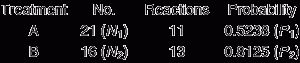
The difference P1 – P2 = − 0.2887
To calculate the confidence interval, we calculated the standard error (SE) of the difference by the following formula.
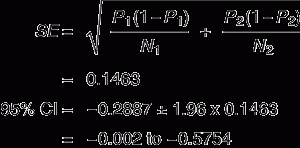
This interval does not include 0, so Brown’s P value of 0.14 is not reasonable. We do accept that the statistical significance is marginal.
We agree that antihistamine is ineffective as a prophylactic agent in anaphylaxis. This was observed in studies in Sri Lanka and Brazil, where chlorpheniramine and promethazine, respectively, were used to prevent reactions to antivenom.3,4 However, we defended the observed reduction of mild to moderate acute reactions to antivenom in our study by highlighting the counter-effect of antihistamine on released histamine after mast-cell degranulation.1
Our study was to test the usefulness of an established practice in Sri Lanka, where steroid infusion is used to counter reactions to antivenom. The crux of the problem is the highly antigenic antivenom preparations used in Sri Lanka, despite ever-increasing reaction rates, because of the lack of facilities for developing purified antivenom.
The proposal of using intravenous adrenaline infusion to reduce allergic reactions is novel and exciting. This should be tested by randomised controlled trials.
References
- Gawarammana IB, Kularatne SAM, Dissanayake WP, et al. Parallel infusion of hydrocortisone ± chlorpheniramine bolus injection to prevent acute adverse reactions to antivenom for snakebites. Med J Aust 2003; 180: 20-23. <eMJA full text>
- Spiegel MR. Schaum’s outline of theory and problem of statistics. Metric edition. Singapore: McGraw-Hill, 1981; 162. i1083091
- Kularatne SAM. Reaction to snake venom antisera: study of pattern, severity and management at General Hospital, Anuradhapura. Sri Lanka J Med 2000; 9: 8-13. i1083093
- Fan HW, Marcopito LF, Cardoso JLC, et al. Sequential randomized and double blind trial of promethazine prophylaxis against early anaphylactic reaction to antivenom for bothrops snake bite. BMJ 1999; 318: 1451-1452. i1083095
Interpreting Australian Stillbirth Rate Trends: Implications for Surveillance and Continuous Quality Improvement
Aleena M. Wojcieszek, Kirstine Sketcher-Baker, Christine Andrews, Michael Coory, Imogen Kettle, Melissa Malivoire, David Ellwood, Vicki Flenady
Paracetamol in Pregnancy: Uncertain Evidence, Certain Consequences
David J. Tunnicliffe, Miranda Cumpston, Debra Kennedy, Margie Danchin, Armando Teixeira-Pinto
Fatty Liver Disease in Australia: A Narrative Review on the Epidemiology, Natural History, Prognostication and Management in People With Metabolic Dysfunction
Karl Vaz, Daniel Clayton-Chubb, William W. Kemp, Stuart K. Roberts, Ammar Majeed
Birth prevalence, clinical sequelae, and management of congenital cytomegalovirus infections in Australia, 1999–2023: a national prospective study
Ece Egilmezer, Suzy M Teutsch, Carlos Nunez, Stuart T Hamilton, Adam W Bartlett, Pamela Palasanthiran, Elizabeth J Elliott, William D Rawlinson
The number of cancer‐related deaths that could be attributable to spatial disparities in survival in Australia, 2010–2019: a retrospective population‐based cohort study
Charlotte K Bainomugisa, Jessica Cameron, Paramita Dasgupta, Peter Baade
Mandatory research projects during medical specialist training in Australia and New Zealand
Paulina Stehlik, Caitlin Brandenburg, David A Henry