




Volume 180 - Issue 7
Health through behaviour change
Author: James F P Black
Med J Aust 2004 || doi: 10.5694/j.1326-5377.2004.tb05957.x
Published online: 9 February 2004
Published online: 9 February 2004
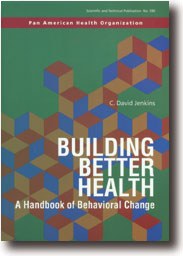
Building better health. A handbook of behavioural change.
C David Jenkins. Washington DC: Pan American Health Organisation, 2003 (Available free, xvii + 378 pp). ISBN 92 75 11590 7.
The disappointing aspect is what he does not include, given the role of the World Health Organization in such radical rethinking of health strategies as the Declaration of Alma Ata and the Ottowa Charter. The authors of those statements would be disappointed — health promotion is much more than just behaviour change.
Despite the history of Latin American radicalism throughout the 20th century, Professor Jenkins charts a rather safe and conservative course. Tackling "hunger epidemics", he suggests better methods of food storage and handling, the introduction of new crops, cooking classes, and more productive fertilisers. All well and good, but what of the basic problem of landlessness throughout the Americas? Why no mention of people like Paulo Freire, who used basic literacy work to enhance political awareness in precisely the way that this book does not? Jenkins suggests reducing firearms-related injuries by keeping guns locked away, to add "cooling-down" time to the process readying them for use. He never mentions what might seem obvious to everyone outside the United States — limiting ownership of firearms by the citizenry in the first place.
I would recommend this book to the health workers and community members who are its target audience — but with the proviso that they do not read only this book, and that they use it for reference and not as their primary inspiration.
James F P BlackHead of Epidemiology Victorian Infectious Diseases ServiceMelbourne, VIC
Dousing the burning inequity of global warming for people experiencing homelessness
Timothy English, Alejandro Vásquez Hernández, Glenn Miller, Nuala Fogarty, Charles Cosgrove, Paul Rosenthal, Matthew Larkin, Jon Swain, Danielle Austin, Jo River
The contribution of evidence‐based practice and the practice‐based evidence approaches to contemporary Australian psychology: implications for culturally safe practice
Paul Gray (Wiradjuri), Dawn Darlaston‐Jones, Pat Dudgeon AM (Bardi), Kate Derry, Joanna Alexi, William Smith (Wiradjuri and Wemba Wemba), Tanja Hirvonen (Jaru and Bunuba), David Badcock, Shraddha Kashyap, Belle Selkirk (Noongar)
Explaining risk in chronic conditions: the Yolŋu science of signs
Emma Haynes, Alison Mitchell, Minitja Marawili (Yolŋu), Dawn C Bessarab (Bardi)
Is it time to retire the label “CALD” in public health research and practice?
Sabine Allida, Della Maneze
What do Aboriginal people in the Northern Territory value during the operation journey? A qualitative study
Edith B Waugh, Marita Hefler, Sophie Pascoe, Mark Mayo, Matthew JL Hare, David A Story, Neil Wilkshire, Peter Henwood, David Croker, Jampijinpa Ross
Fulfilling First Nations health, cultural safety and equity accreditation standards in primary medical education: reflections from a First Nations desktop review team
Paul Saunders, Nicole Mercer, Maria Mackay, Ian Lee, Madelyne Hudson‐Buhagiar, Miriam Cavanagh, Emma Milliss, Melody Muscat, Kathleen Martin, Adam Shipp, Melissa Johnson, Belinda Gibb