




Volume 180 - Issue 3
Special health care for gays and lesbians: a queer idea?
Author: Gary D Rogers
Med J Aust 2004 || doi: 10.5694/j.1326-5377.2004.tb05822.x
Published online: 15 December 2003
Published online: 15 December 2003
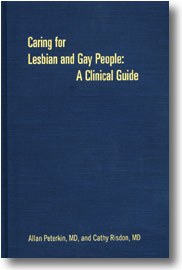
Caring for lesbian and gay people: a clinical guide.
Allan Peterkin, Cathy Risdon. Toronto: University of Toronto Press, 2003 (xii + 378 pp). ISBN 0 8020 4857 9.
Peterkin is a psychiatrist and Risdon a family physician (an unfortunate term alienating to many gays and lesbians). They are part of a welcome movement that is dismantling this myth and recognising that lesbian, gay, bisexual and transgendered people, like members of other persecuted groups, may require special consideration in redressing the health consequences of social disadvantage.
Their book is clinically practical, well researched and a reliable guidebook for the primary health care practitioner. It is inclusive of the issues of people who are multiply disadvantaged, although it betrays its North American origins in the section focusing specifically on the concerns of gay and lesbian Native Americans. This is only partially applicable to the care of gay Indigenous Australians.
Bisexuals might find the book's title exclusive. The authors could also be criticised for uncritically accepting an "identity" view of sexual diversity that ignores the last 20 years of academic writing on "queer theory", and the social construction of homosexuality. Its main purpose, however, is a desktop guide for clinicians, which it does very well.
Gary D RogersDirector, Health in Human Diversity Unit Department of General Practice University of Adelaide, SA
1. Dr Evelyn Hooker was an American psychiatrist who published the first empirical research to challenge the then prevailing psychiatric assumption that homosexuality was a mental illness. Her groundbreaking work ultimately led to the removal of "homosexuality" from the Diagnostic and Statistical Manual of Mental Disorders.
Awareness, Usage and Perceptions of Doxycycline Post-Exposure Prophylaxis (doxyPEP) for Prevention of Sexually Transmitted Infections in Australia: Insights From a National Cross-Sectional Survey
Catriona S. Bradshaw, Dash Heath-Paynter, Benjamin Riley, Daniel Grace, Fabian Y. S. Kong, Eric P. F. Chow
How Can We Ensure Access to Sexual and Reproductive Health Information for Adolescents in Light of Australia's Social Media Restrictions?
Olena Ivanova, Anisa R. Assifi, Danielle Mazza
Differentiated and simplified oral HIV pre‐exposure prophylaxis (PrEP) models hold the key to virtually eliminating HIV transmission in Australia by 2030
Tyson Arapali, Sarah Warzywoda, Anthony K J Smith, Curtis Chan, Timothy R Broady, Erin Sullivan, Catherine MacPhail, Mohamed A Hammoud, Alexander Dowell‐Day, Benjamin R Bavinton
An autoethnographic critique of a past report of inpatient psychiatric treatment for gender diverse children
Jayne McFadyen, Timothy W Jones, Rowena Koek, Fintan Harte, Brendan Jansen, Megan Galbally, Warren Kealy‐Bateman, Catherine Wall, Quinnehtukqut McLamore, Anja Ravine
Cass Review does not guide care for trans young people
Julia K Moore, Cate Rayner, S Rachel Skinner, Katie Wynne, Blake S Cavve, Brodie Fraser, Uma Ganti, Claire McAllister, Gideon Meyerowitz‐Katz, Tram Nguyen, Anja Ravine, Brian Ross, Darren B Russell, Liz A Saunders, Aris Siafarikas, Ken C Pang
Motivations, barriers and enablers for medical and forensic examiners in New South Wales sexual assault services: a qualitative interview study
Natalie Edmiston, Sam Sperring, Rosalie Power, Samantha Ryan, Kathryn Evans, Jane Ussher, Ellie Freedman