





Volume 180 - Issue 10
Essentials for the travel doctor
Author: Robert B Kass
Med J Aust 2004 || doi: 10.5694/j.1326-5377.2004.tb06044.x
Published online: 17 May 2004
Published online: 17 May 2004
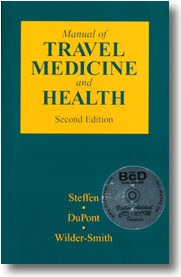
Manual of travel medicine and health. 2nd ed.
Robert Seffen, Herbert L DuPont, Annelies Wilder-Smith. Hamilton, ONT: B C Decker, 2003 (xii + 628 pp + CDROM). ISBN 1 55009 227 8.
Like the first edition, this book focuses on the more common travel health problems. There is more information on special-risk groups such as senior travellers, pregnant women, children and the immunocompromised, and new sections on bioterrorism and migration medicine. Information on deep vein thrombosis and pulmonary embolus, as it relates to travel, has been updated. There is a very useful, short bibliography after most sections and many of the articles are from the authoritative Journal of travel medicine.
The book is organised in a logical reading manner and the authors obviously understand the needs of the practitioner working at the clinical coalface. In general, the information is well presented and educative rather than cookbook style, and the authors are constantly reinforcing the message that many travel health problems, such as foodborne and waterborne diseases and insectborne diseases, cannot be prevented by vaccination.
The section on the major infectious diseases includes a brief paragraph on Risk to travellers for each disease which puts the real risk into perspective. The major topics of malaria and travellers diarrhoea are dealt with in depth. Common non-infectious health risks and their prevention are discussed. Topics include jet lag, altitude sickness, motion sickness and diving medicine.
There is also brief coverage of the health problems of the returned traveller. In a book of this size it would be impossible to cover this fully; however, the major concerns — fever, persistent diarrhoea, eosinophilia and sexually transmitted diseases — are all included.
In summary, the Manual of travel medicine and health, as a resource for travel medicine physicians, is as good as one can find in a book of this size. A quality assurance audit on any travel medicine practice should check whether this book is present on the bookshelf.
Robert B KassChief Medical Advisor The Travel Doctor Group (TMVC) Adelaide, SA