




Volume 171 - Issue 4
Dehydroepiandrosterone and sport
Med J Aust 1999; 171 (4): 206-208.
Published online: 16 August 1999
Published online: 16 August 1999
|
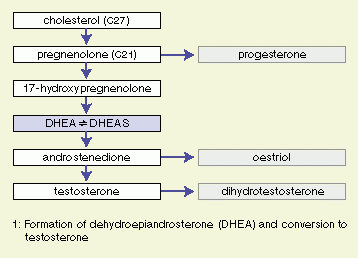
Sports Medicine Dehydroepiandrosterone and sport Dehydroepiandrosterone (DHEA) is a weak androgen, but is one of the main precursors of testosterone. Athletes use it for its androgenic and anticatabolic effects and it has been described as a "wonder drug", although there is little evidence to support these claims. There are no published studies of the long term effects of taking DHEA, particularly in the large doses used by athletes, or of its possible interactions with other agents. A Brian Corrigan
MJA 1999; 171: 206-208 Introduction -
Physiology -
DHEA and exercise -
Medical use -
Use by athletes -
Screening for DHEA use -
Long term effects -
Acknowledgements -
References -
Authors' details
| ||||||||||||||||||||||||||||||||||||||||||||||
References
- Williams JD. Textbook of endocrinology. Williams JD, Foster DW, editors. 8th ed. Philadelphia: WB Saunders, 1992; 579-581.
- Greenspan FS. Basic and clinical endocrinology. 3rd ed. New Jersey: Prentice-Hall, 1991; 469-471.
- Dehennin L, Ferry M, Lafarge P, et al. Oral administration of dehydroepiandrosterone to healthy men: alteration of the urinary androgen profile and consequences for the detection of abuse in sport by gas chromatography-mass spectrometry. Steroids 1998; 63: 80-87.
- Bird CE, Masters V, Clark AF. Dehydroepiandrosterone sulfate: kinetics of metabolism in normal young men and women. Clin Invest Med 1984; 7: 119-122.
- Haning RV Jr, Carlson IH, Flood CA, et al. Metabolism of dehydroepiandrosterone sulfate (DS) in normal women and women with high DS concentrations. J Clin Endocrinol Metab 1991; 73: 1210-1215.
- Herbert J. The age of dehydroepiandrosterone [editorial]. Lancet 1995; 345: 1193-1194.
- Labrie F, Belanger A, Simard J, et al. DHEA and peripheral androgen and estrogen formation: intracrinology. Ann N Y Acad Sci 1995; 774: 16-28.
- Kent S. DHEA: "miracle" drug? Geriatrics 1982; 37: 157-161.
- Skolnick AA. Scientific verdict still out on DHEA. JAMA 1996; 276: 1365-1367.
- Kreeger KY. Researchers ponder the benefits of DHEA on many fronts. The Scientist 1997; 11(9): 11,14.
- Dehydroepiandrosterone (DHEA). Med Lett Drugs Ther 1996; 38: 91-92.
- Young J, Couzinet B, Nahoul K, et al. Panhypopituitarism as a model to study the metabolism of dehydroepiandrosterone (DHEA) in humans. J Clin Endocrinol Metab 1997; 82: 2578-2585.
- Longcope C. Dehydroepiandrosterone metabolism. J Endocrinol 1996; 150 Suppl: S125-S127.
- Ebeling P, Koivisto VA. Physiological importance of dehydroepiandrosterone. Lancet 1994; 343: 1479-1481.
- Liu CH, Laughlin G, Fischer U, et al. Marked attenuation of ultradian and circadian rhythms of dehydroepiandrosterone in postmenopausal women: evidence for a reduced 17,20-desmolase enzymatic activity. J Clin Endocrinol Metab 1990; 71: 900-906.
- Baulieu EE. Dehydroepiandrosterone (DHEA): a fountain of youth? J Clin Endocrinol Metab 1996; 81: 3147-3151.
- Nestler JE, Kahwash Z. Sex-specific action of insulin to acutely increase the metabolic clearance rate of dehydroepiandrosterone in humans. J Clin Invest 1994; 94: 1484-1489.
- Nestler JE, Barlascini CO, Clore JN, et al. Dehydroepiandrosterone reduces serum low density lipoprotein levels and body fat but does not alter insulin sensitivity in normal men. J Clin Endocrinol Metab 1988; 66: 57-61.
- Regelson W, Loria R, Kalimi M. Dehydroepiandrosterone (DHEA) -- the "mother steroid". I. Immunologic action. Ann N Y Acad Sci 1994; 719: 553-563.
- Arlt W, Justl H-G, Callies F, et al. Oral dehydroepiandrosterone for adrenal androgen replacement: pharmacokinetics and peripheral conversion to androgens and estrogens in young healthy females after dexamethasone suppression. J Clin Endocrinol Metab 1998; 83: 1928-1932.
- Keizer H, Janssen GM, Menheere P, Kranenburg G. Changes in basal plasma testosterone, cortisol, and dehydroepiandrosterone sulfate in previously untrained males and females preparing for a marathon. Int J Sports Med 1989; 10 Suppl 3: S139-S145.
- Velardo A, Pantaleoni M, Valerio L, et al. Influence of exercise on dehydroepiandrosterone sulphate and delta 4-androstenedione plasma levels in man. Exp Clin Endocrinol 1991; 97: 99-101.
- Milani RV, Lavie CJ, Barbee RW, Littman AB. Lack of effect of exercise training on dehydroepiandrosterone-sulfate. Am J Med Sci 1995; 310: 242-246.
- Johnson LG, Kraemer RR, Haltom R, et al. Effects of estrogen replacement therapy on dehydroepiandrosterone, dehydroepiandrosterone sulfate, and cortisol responses to exercise in postmenopausal women. Fertil Steril 1997; 68: 836-843.
- Barrett-Connor E, Goodman-Gruen D. The epidemiology of DHEAS and cardiovascular disease. Ann N Y Acad Sci 1995; 774: 259-270.
- Bulbrook RD, Hayward JL, Spicer CC, et al. Relation between urinary androgen and corticoid excretion and subsequent breast cancer. Lancet 1971; 2: 395-398.
- Clore JN. Dehydroepiandrosterone and body fat. Obes Res 1995; 3 Suppl 4: 613S-616S.
- Morales AJ, Nolan JJ, Nelson JC, et al. Effects of replacement dose of dehydroepiandrosterone in men and women of advancing age. J Clin Endocrinol Metab 1994; 78: 1360-1367.
- Yen SSC, Morales AJ, Khorram O. Replacement of DHEA in aging men and women. Ann N Y Acad Sci 1995; 774: 128-142.
- Lifrak ET, Parker LN. Analysis of nonprescription capsules purported to contain an adrenal androgen. Am J Hosp Pharm 1985; 42: 587-589.
- Sturmi JE, Diorio DJ. Anabolic agents. Clin Sports Med 1998; 17: 261-282.
- Welle S, Jozefowicz R, Statt M. Failure of dehydroepiandrosterone to influence energy and protein metabolism in humans. J Clin Endocrinol Metab 1990; 71: 1259-1264.
- Loria RM. Antiglucocorticoid function of androstenetriol. Psychoneuroendocrinology 1997; 22 Suppl 1: S103-S108.
- Kalimi M, Shafagoj Y, Loria R, et al. Anti-glucocorticoid effects of dehydroepiandrosterone (DHEA). Mol Cell Biochem 1994; 131: 99-104.
- Regelson W, Kalimi M. Dehydroepiandrosterone (DHEA) -- the multifunctional steroid. II. Effects on the CNS, cell proliferation, metabolic and vascular, clinical and other effects. Mechanism of action? Ann N Y Acad Sci 1994; 719: 564-575.
- Fleshner M, Pugh CR, Tremblay D, et al. DHEA-S selectively impairs contextual-fear conditioning: support for the antiglucocorticoid hypothesis. Behav Neurosci 1997; 111: 512-527.
- Bosy TZ, Moore KA, Poklis A. The effect of oral dehydroepiandrosterone (DHEA) on the urine testosterone/epitestosterone (T/E) ratio in human male volunteers. J Anal Toxicol 1998; 22: 455-459.
- Bowers LD. Oral dehydroepiandrosterone supplementation can increase the testosterone/epitestosterone ratio. Clin Chem 1999; 45: 295-297.
- Baulieu EE. Neurosteroids of the nervous system, by the nervous system, for the nervous system. Recent Prog Horm Res 1997; 52: 1-32.
- Khorram O. DHEA: a hormone with multiple effects. Curr Opin Obstet Gynecol 1996; 8: 351-354.
- Dubrovsky B. Natural steroids counteracting some actions of putative depressogenic steroids on the central nervous system: potential therapeutic benefits. Med Hypotheses 1997; 49: 51-55.
- Corrigan AB. Anabolic steroids and the mind. Med J Aust 1996; 165: 222-226.
- Miller RA. DHEA -- brass ring or red herring? [editorial]. J Am Ger Soc 1977; 45: 1402-1403.
- Wang C, Alexander G, Berman N, et al. Testosterone replacement therapy improves mood in hypogonadal men -- a clinical research center study. J Clin Endocrinol Metab 1996; 81: 3578-3583.
- Imamura M, Prasad C. Modulation of GABA-gated chloride ion influx in the brain by dehydroepiandrosterone and its metabolites. Biochem Biophys Res Commun 1998; 243: 771-775.
- Magnay J. Days numbered for testosterone cheats. Sydney Morning Herald 1999; 16 July: 12.
- Armsey TD, Green GA. Nutrition supplements: science vs hype. Phys Sportsmed 1997; 25: 77-92.
- Dorgan JF, Stanczyk FZ, Longcope C, et al. Relationship of serum dehydroepiandrosterone (DHEA), DHEA sulfate and 5-androstene-3b,17b-diol to risk of breast cancer in postmenopausal women. Cancer Epidemiol Biomarkers Prev 1997; 6: 177-181.
Mild traumatic brain injury and concussion and persisting post‐concussion symptoms: new guidelines to support evidence‐based assessment and management in Australia and Aotearoa New Zealand
Karen M Barlow, Jennie L Ponsford, Alice Theodom, Gill Cowen, Gavin A Davis, Vicki Anderson, Franz E Babl, David Cole, Jennifer Cullen, Stuart R Dalziel, Melinda Fitzgerald, Howard Flavell, Caroline Yates, Rebecca Kimble, John H Olver, Rhonda Orr, Mark Ralfe, Michael Rose, Nick Rushworth, Julia Treleaven, Gary Browne, Nathan Delang, Sarah Harris, Gary Mitchell, Sean Tweedy
Physical activity interventions to prevent and manage type 2 diabetes in Aboriginal and Torres Strait Islander people: a systematic review
Raymond J Kelly, Rona Macniven, Leonid Churilov, Margaret J Morris, David O'Neal, Elif I Ekinci
The economics of a national anterior cruciate ligament injury prevention program for amateur football players: a Markov model analysis
Andrew Ross, Joosup Kim, Marnee McKay, Evangelos Pappas, Natalie Hardaker, Matt Whalan, Kerry Peek
Concussion in Aboriginal and Torres Strait Islander peoples: what is the true epidemiology?
Jonathan Bullen, Trish Hill‐Wall, Elizabeth Thomas, Richard Norman, Gill Cowen
Chronic traumatic encephalopathy in Australia: the first three years of the Australian Sports Brain Bank
Catherine M Suter, Andrew J Affleck, Maggie Lee, Alan J Pearce, Linda E Iles, Michael E Buckland