




Volume 167 - Issue 11
From shunned to shining: doctors, madness and psychiatry in Australian and New Zealand cinema
Authors: Alan Rosen and Garry Walter
Med J Aust 1997; 167 (11): 640-644.
Published online: 8 December 1997
Published online: 8 December 1997
From shunned to shining: doctors, madness and psychiatry in Australian and New Zealand cinema
Alan Rosen, Garry Walter, Tom Politis and
Michael Shortland
The histories of psychiatry and the cinema are eerily intertwined
MJA 1997; 167: 640-644
Introduction - A psychiatrist's perspective - Films and psychiatric stigma - Conclusions - Acknowledgements - References - Authors' details
-
-
-
©MJA1997
Introduction
The motion picture industry has had a long-standing interest in doctors and medicine generally and with psychiatry in particular. Cinema's fascination with modern psychiatry has been intense, with the two fields emerging at about the same time -- movies were first demonstrated publicly by the Lumière brothers, Edison and others in 1895, the same year that Freud wrote Project for a scientific psychology, the prototype of his later theories.1 In 1924, the producer Samuel Goldwyn was keen to exploit the association between sex and psychoanalysis on screen and tried unsuccessfully to enlist Freud's help in making a film with an offer of $US100 000.2
Psychiatric professionals in films have been variously venerated, demonised and marginalised (classified by Schneider as, respectively, "Dr Wonderful", "Dr Evil" and "Dr Dippy"3). Hyler offers an even more elaborate and colourful classification for psychiatric patients in films: rebellious free spirit, homicidal maniac, female seductress, enlightened member of society, narcissistic parasite, and zoo specimen.4 Schneider contends that there has been a welcome shift over the years in the way film has treated madness and psychiatry, with oppressive psychiatrists and zombified victims giving way to more human encounters and ambiguous, even hopeful, outcomes.2 Arguably, however, the complete range of favourable and unfavourable stereotypes of psychiatrists and patients continues to appear -- 1991 saw the psychiatrists Dr Wonderful (Prince of Tides), Dr Evil (Silence of the Lambs ) and Dr Dippy (What about Bob?).
Although the vast majority of "psychiatric" films are American
(partly because the discipline is embedded in that country's
culture), some of the most incisive movies, especially recently,
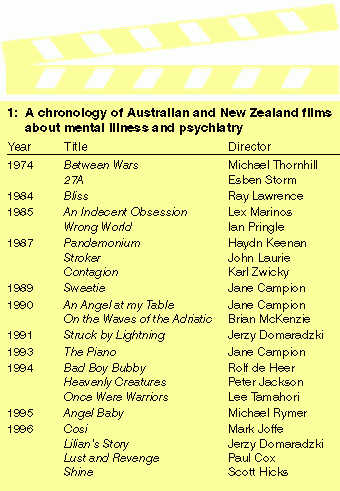
have come from Australia and New Zealand. A chronology of antipodean
films with psychiatric themes is shown in Box 1.
 While doctors and nurses have long been represented in antipodean
films (e.g., Sister Kenny [1946]), the "psychiatric" film
made its début only in 1974 with Between Wars. Michael
Thornhill's first feature, a pioneer in the revival of Australian
cinema, Between Wars traces the career of Dr Edward Trenbow
(played by Corin Redgrave), who becomes a well-respected Sydney
psychiatrist. In the 1920s, he takes up residence at Callan Park
Asylum. The film touches on issues of psychoanalysis and physical
treatments, such as fever treatment. In another 1974 release, 27A
, a middle-aged "metho" drinker joins Alcoholics Anonymous and
undergoes a psychiatric examination. As a consequence, he is
committed to a hospital for the criminally insane, to be detained
indefinitely under the notorious Section 27A of the Queensland
Mental Health Act . Nevertheless, apart from these two films, the
psychiatrist figure receives scant attention in the 1970s. When it
appears, it is usually as either a peripheral character or a
stereotype.
While doctors and nurses have long been represented in antipodean
films (e.g., Sister Kenny [1946]), the "psychiatric" film
made its début only in 1974 with Between Wars. Michael
Thornhill's first feature, a pioneer in the revival of Australian
cinema, Between Wars traces the career of Dr Edward Trenbow
(played by Corin Redgrave), who becomes a well-respected Sydney
psychiatrist. In the 1920s, he takes up residence at Callan Park
Asylum. The film touches on issues of psychoanalysis and physical
treatments, such as fever treatment. In another 1974 release, 27A
, a middle-aged "metho" drinker joins Alcoholics Anonymous and
undergoes a psychiatric examination. As a consequence, he is
committed to a hospital for the criminally insane, to be detained
indefinitely under the notorious Section 27A of the Queensland
Mental Health Act . Nevertheless, apart from these two films, the
psychiatrist figure receives scant attention in the 1970s. When it
appears, it is usually as either a peripheral character or a
stereotype.
The 1980s saw some clichéd psychiatric themes. For example, in An Indecent Obsession (1985) Sister Honour Langtree, in charge of a military hospital for psychiatric patients, transgresses boundaries by developing a sexual attraction for a new patient. Wrong World (1985) has the almost mandatory escape from a psychiatric hospital, and Contagion (1987) features a homicidal person with schizophrenia. The 1980s also saw the emergence of a film category which has been called "the company of eccentrics".5 Perversely non-conformist, it often foregrounded quirky protagonists and against-the-grain themes. For example, the hero in John Laurie's Stroker (1987) is "a kind of mad, Chelmsford psychologist", 5 and all the central characters in Bliss (1984) and Pandemonium (1987) seem in dire need of psychiatric evaluation. Some of Jane Campion's films also thrive on borderline heroines (e.g., the volatile Dawn in Sweetie [1989]). These eccentric personalities paved the way for the more stigmatised protagonists in the films of the next decade.
An Angel at my Table (1990) depicts the life story of the award-winning novelist Janet Frame. The image of an apparently hopeless mental patient shimmers with that of a somewhat odd creative genius. Similarly, Heavenly Creatures (1994), about the relationship of two New Zealand girls who murder one of their mothers, provides a counterpoint between eccentricity and premeditated evil. Bad Boy Bubby (1994) also extends the "eccentric cinema's" preoccupation with idiosyncratic characters and offbeat themes. Except for the "soft" ending, it is totally uncompromising -- about an "uncivilised" innocent, Bubby, and his mother, who have been caught in an incestuous, symbiotic web for 35 years. On the return of his estranged father, Bubby is freed into a world which he cannot comprehend, a contemporary society which he views through an unsocialised, childlike perspective. Although there is no psychiatric intervention in Bad Boy Bubby and in other 1990s films such as The Piano (1993) and Once Were Warriors (1994), the relentless playing out of dark psychopathology might nevertheless be included in the "psychiatric" film category.
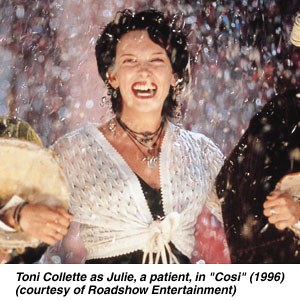
Common to Australian and New Zealand "psychiatric" films in the 1990s is the more compassionate, sensitive handling of many types of intellectual and psychiatric disability,6 as illustrated by Domaradzki's Struck by Lightning and McKenzie's On the Waves of the Adriatic (named for the ancient Greek custom of casting mentally ill people adrift in boats on the Adriatic Sea). There is also a greater emphasis on more realistic, character-driven studies of madness -- Angel Baby, Cosi, Lilian's Story and Shine all strive for the narrative/dramatic depiction of alienated or troubled people for human interest. For example, Michael Rymer, the director of Angel Baby (about two people with psychoses, Harry and Kate, who fall in love), states that his film "is not about crazy people. It's about people who have an illness". 7
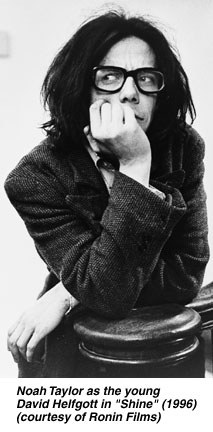
Cosi, based on Louis Nowra's play8 about a group of patients in an asylum who rehearse for and perform Mozart's Cos" fan tutte, has its American parallel in One Flew Over the Cuckoo's Nest (1975). We warm to many of the patients in both. Lilian's Story and Shine were inspired by real-life personalities supposedly driven mad by aggressive, possessive fathers. Lilian's Story is based loosely on the life of legendary eccentric Bea Miles, who recited Shakespeare for a dollar on the streets of Sydney and rode taxis for a sonnet. In Shine, Geoffrey Rush's portrayal of the pianist David Helfgott endears him to us, and the character ultimately triumphs in both his personal and professional life.
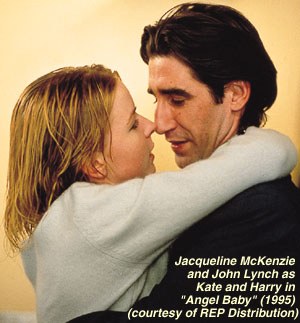 Angel Baby, Cosi, Lilian's Story and
Shine are not centrally critiques of institutions, but, rather,
reinforcements of humanism and faith. The ambiguity of Angel Baby
's ending, in which we are unsure whether the hero suicides, is
both tragic and potentially uplifting. Even so, we are left with a
nagging feeling that this film missed its chance to instil hope
because of the assumption that real-life mental illness must end in
tragedy.
Angel Baby, Cosi, Lilian's Story and
Shine are not centrally critiques of institutions, but, rather,
reinforcements of humanism and faith. The ambiguity of Angel Baby
's ending, in which we are unsure whether the hero suicides, is
both tragic and potentially uplifting. Even so, we are left with a
nagging feeling that this film missed its chance to instil hope
because of the assumption that real-life mental illness must end in
tragedy.
Unfortunately, alongside the greater humanism and faith depicted in
recent Australian and New Zealand "psychiatric" films, negative
stereotypes about people with mental illness persist. These include
the "homicidal maniac" (Doug, to staff member Lewis, in Cosi :
"Hope you've made out your will, Lewis . . . you're mine"), "female
seductress" (Cherry, in Cosi, also to Lewis: "I really like
you", as she leans forward to kiss him), and the "zoo specimen" (Kate,
in Angel Baby, resembles a feral animal as she hisses
to frighten off shoppers at a mall). In addition, An Angel at my
Table and Shine link madness with creative genius. While
the general public may see this as instilling hope, or even as
inspirational, people with mental illness may conclude that someone
with a mental illness needs an exceptional creative talent to be
accepted.
A psychiatrist's perspective
 How accurately have films portrayed mental illness in terms of
presentation, aetiology and treatment? From a psychiatrist's
perspective, it is gratifying that the most recent Australian and New
Zealand "psychiatric" films (Cosi, Angel Baby,
Lilian's Story and Shine) have dealt with psychoses,
which need better public understanding. However, better
understanding is also needed for a range of stereotypically less
bizarre disorders, such as depression and anxiety disorders, that
are seemingly harder for film-makers to dramatise.
How accurately have films portrayed mental illness in terms of
presentation, aetiology and treatment? From a psychiatrist's
perspective, it is gratifying that the most recent Australian and New
Zealand "psychiatric" films (Cosi, Angel Baby,
Lilian's Story and Shine) have dealt with psychoses,
which need better public understanding. However, better
understanding is also needed for a range of stereotypically less
bizarre disorders, such as depression and anxiety disorders, that
are seemingly harder for film-makers to dramatise.
Nevertheless, psychopathology has been displayed creatively and vividly in the recent films, including:
- auditory
hallucinations (a tormented Harry clutching his head in Angel
Baby);
- pressure of speech and flight of ideas (David Helgott, at a frantic
pace in Shine : "I remember Margaret. She called me a pig. All
very complicated; complicato in Israel, a battleground. A war zone, a
war; what a bore it's a war . . . war");
- delusions of reference (Kate, in Angel Baby, watching
Wheel of Fortune on television, suggests that "Astral [on the
television] sends me messages no-one else can understand");
- poor social skills (Kate again, on first meeting Harry's family,
flicks a whole chicken leg onto her dress and later suggests to Harry's
sister-in-law, whom she has just met: "[Harry's the] best lay I've
ever had . . . [he's got] a side manoeuvre from hell"); and
- lack of insight (Kate again: "I don't hang around with psychos -- I'm
not psycho"; on the other hand, it could be seen as very sensible not to
associate with stigmatised people if you wish to avoid being
stigmatised yourself).
The cinema imputes both genetic and environmental factors in the development of mental illness, consistent with current belief, but tends to emphasise environment. In Angel Baby, when Kate becomes pregnant she is advised by her doctor that "there's a chance that the child will inherit your illness". In contrast, Shine suggests that David's harsh upbringing contributed to his psychiatric illness, an oversimplification of the underlying themes and contribution of David's father. Nevertheless, while parenting practices are no longer thought to be instrumental in the later expression of psychoses, there is validity in the notion that stress can precipitate relapses and takes a toll on all family members.
A range of treatments, both physical and psychological, have been portrayed. Lust and Revenge (1996) draws parallels between psychotherapists, religious gurus and market forces in the arts and, in the process, satirises all three. There is ambivalence about physical treatments. In Cosi, a patient about to perform in the opera reassures its director: "I'll be on top of it . . . I purposely didn't take my medication." In contrast, Kate, in Angel Baby, begs: "I want my Stelazine." However, psychotropic medication is also depicted as society's means of controlling undesirable behaviour and individuals, as attested by the comments of head nurse Errol Greer in Cosi : "The patients are on varying degrees of medication . . . don't let that worry you -- just worry about the ones who aren't."
Electroconvulsive therapy (ECT) is represented neutrally in Shine but negatively in Cosi, where smoke billows from the ECT machine, and the patients are threatened: "Start making our sets [for the opera] or else it's back to shock treatment." Involuntary admission or sedation is also depicted. In Lilian's Story, the heroine is incarcerated for 20 years on the word of her sexually abusive father, and in Cosi the wrong person ("normal" Lewis) is injected with a tranquilliser without adequate assessment or consent.
The community psychiatry movement has been discussed only briefly but disparagingly. Errol, in Cosi, states: "Half-way houses, community care . . . come on, the Government cuts the cost and chucks them [the patients] on the street." This negative misrepresentation of contemporary, integrated 24-hour community and hospital care can be partly explained by Nowra having drawn on his early work experiences in a psychiatric hospital in 1971. While this is made explicit in the introduction to the play, the film fudges the historical time frame so that the audience can easily assume this is current practice.
Films and psychiatric stigma
Recently, the National Mental Health Policy9 and the Burdekin Report10 have highlighted the need for attention to psychiatric stigma, and community surveys have revealed many public misconceptions about people with mental illness.11 Does the cinema influence psychiatric stigma, or is stigma so deeply ingrained in society that films cannot make a difference either way? Do film makers have a responsibility to teach or to change attitudes, or should we resign ourselves to the fact that films are essentially entertainment? Possible consequences of cinema depictions of mental illness and psychiatry (positive and negative) are shown in Box 2.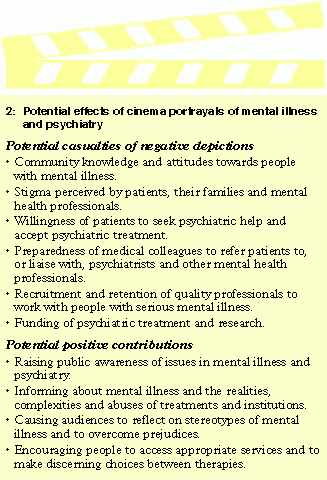 Disturbing findings from the Glasgow Media Group12 show that public attitudes to
mental illness are influenced more by media accounts of mental
illness, which instil fear, rather than by direct contact with people
with mental illness. Mindful that films and other media often depict
people with mental illness as unpredictably violent, the Royal
College of Psychiatrists organised a petition (signed by 3000
members) asking the media to alter their practices in the portrayal of
mental illness and to develop guidelines.12 However, the response from
producers and media managers was a deafening silence.
Disturbing findings from the Glasgow Media Group12 show that public attitudes to
mental illness are influenced more by media accounts of mental
illness, which instil fear, rather than by direct contact with people
with mental illness. Mindful that films and other media often depict
people with mental illness as unpredictably violent, the Royal
College of Psychiatrists organised a petition (signed by 3000
members) asking the media to alter their practices in the portrayal of
mental illness and to develop guidelines.12 However, the response from
producers and media managers was a deafening silence.
So, is there any good news in film psychiatry? The relatively large number and appeal of recent "psychiatric" films from Australia and New Zealand is encouraging, as are the new messages of hope, resilience, rebellion, self-determination and triumph. In the most recent films, not only are people with mental illness portrayed as real characters capable of expressing the gamut of human emotions, but also a positive stereotype appears to have emerged -- the patient as hero or role model. The recognition of Janet Frame as a great writer in An Angel at my Table and David Helfgott's relationship with Gillian and celebrated return to the concert stage in Shine are a far cry from Kate in Angel Baby, who, sedated, make-up running and generally looking worse for wear, attracts the comment from her nurse: "She looks cute, doesn't she?". Moreover, An Angel at my Table and Shine show that mentally ill people can be examples for the community at large in how to persevere and transform adversity.
Film makers and actors may assume that with the gradual improvements in psychiatric settings and treatments, which are becoming more sensitive to the individual, less intrusive and less disruptive to life, psychiatry will not offer sufficiently dramatic screen images. However, as Simon Champ, chair of the Australian Mental Health Consumer Network, pointed out (at a School on Psychiatry and the Cinema at the University of Sydney, New South Wales, in April 1997): "There is plenty enough drama available if you care to accurately tune into the subjective experience of an individual or family who has survived mental illness."
Doctors, psychiatrists and other mental health professionals can help promote positive depictions of mental illness and psychiatry (see Box 3). Further, if there is some truth in the negative depictions of psychiatry in film, we can only hope that mental health professionals, rather than muttering darkly and dismissing the images, will reflect thoughtfully and use this as a stimulus to change their practice.
Conclusions
Ignored for so long, psychiatry and mental illness are now the subject of many films produced in Australia and New Zealand. These films should not be rejected simply as "quirky" or "harmless fun", but should be critically appraised to ascertain attitudes to patients, their families, their doctors and mental health professionals. Speaking in a Hippocratic vein, if a "psychiatric" film does no undeserved harm to these stakeholders and also entertains and has artistic merit, this is for the good. If the film is also accurate and informative, challenges prevailing attitudes and transforms your life, so much the better.Acknowledgements
References
- Schneider I. Images of the mind: psychiatry in the commercial film. Am J Psychiatry 1977; 134: 613-620.
- Shortland M. Screen memories: towards a history of psychiatry and psychoanalysis in the movies. Br J Hist Sci 1987; 20: 421-452.
- Schneider I. The theory and practice of movie psychiatry. Am J Psychiatry 1987; 144: 996-1002.
- Hyler SE, Gabbard GO, Schneider I. Homicidal maniacs and narcissistic parasites: stigmatisation of mentally ill persons in the movies. Hosp Community Psychiatry 1991; 42: 1044-1048.
- Dermody S, Jacka E (editors). The imaginary industry: Australian film in the late 1980s. Sydney: Australian Film, Television and Radio School, 1988: 132-154.
- Hall S. Method in the madness. The Bulletin 1996 May 28: 80-81.
- Urban A. Angel baby. Cinema Papers 1995; 104: 12.
- Nowra L. Cosi. Sydney: Currency Press, 1992.
- Australian Health Ministers. National Mental Health Policy. Canberra: AGPS, 1992.
- Human Rights and Equal Opportunity Commission. Human rights and mental illness: report of the national inquiry into the human rights of people with mental illness. Canberra: AGPS, 1993.
- Commonwealth Department of Health and Family Services. Community attitudes to mental illness: qualitative research report. Canberra: AGPS, 1993.
- Philo G. Changing media representations of mental health. Psychiatr Bull 1997; 21: 171-172.
- Walter G, Rosen A. Psychiatric stigma and the role of the psychiatrist. Australas Psychiatry 1997; 5: 72-74.
(Received 12 Sep, accepted 28 Oct, 1997)
Authors' details
Royal North Shore Hospital and Community Mental Health Services, Sydney, NSW.Alan Rosen, FRANZCP, MRCPsych, Director; Associate Professor, University of Wollongong; and Senior Clinical Lecturer, University of Sydney.
Central Sydney Area Health Service, Sydney, NSW.
Garry Walter, FRANZCP, Staff Specialist Psychiatrist and Inpatient Director, Rivendell Unit; and Clinical Lecturer, Department of Psychological Medicine, University of Sydney.
WEA Film Study Group, Sydney, NSW.
Tom Politis, President.
University of Sydney, Sydney, NSW.
Michael Shortland, PhD, Associate Professor of History of Science.
Reprints: Dr G Walter, Psychiatric Stigma Study Group, Rivendell Unit, Hospital Road, Concord West, NSW 2138.
- ©MJA 1997
Readers may print a single copy for personal use. No further reproduction or distribution of the articles should proceed without the permission of the publisher. For permission, contact the Australasian Medical Publishing Company
Journalists are welcome to write news stories based on what they read here, but should acknowledge their source as "an article published on the Internet by The Medical Journal of Australia <http://www.mja.com.au>".
<URL: http://www.mja.com.au/> © 1997 Medical Journal of Australia.
Reorienting Allied Health Into Community-Based Care for People Experiencing Trauma and Social Disadvantage
Simon Rosenbaum, Grace McKeon, Gulsah Kurt, Oscar Lederman, Kemi Wright, Sabuj Kanti Mistry, Jackie E. Curtis, Philip B. Ward, Zachary Steel, Hamish Fibbins, Rachel Morell, Melissa C. Eaton, Andrew Watkins, Ben Harris-Roxas, Brendan Goodger, Eleanor Beck, Megan Teychenne, Joseph Firth, Davy Vancampfort, David Burns, Russell Roberts, Tristan Favaloro, Danielle Weber, Rosanna Barbero, Vasili Maroulis, Melissa Holmes, Stefan Mackenzie, Chiara Mastrogiovanni, Afsana Anwar, Uzma Choudhry, Catherine Sherrington, Jane Currie, Thomas Gadsden, Scott Teasdale
Stigmatising Attitudes Towards People With Depression, Bipolar Disorder, Borderline Personality, ADHD and Early and Long-Term/Untreated Schizophrenia: Representative Survey of Australian Adults
Amy J. Morgan, Anna M. Ross, Gayle McNaught, Rachel Green, Nicola J. Reavley
Psychosocial Hazards for Healthcare Workers: Supporting the Second Victim Also Helps the Primary Victims
Sarah Michael
Supporting Population Mental Health in the Wake of Mass Tragedies
Susan J. Rees, Derrick M. Silove
In the Wake of the National Suicide Prevention Strategy 2025–2035: Suicide Prevention in Type 1 Diabetes
Rigel Paciente, Keely Bebbington, Alix Woolard, Helen Milroy