




Volume 167 - Issue 11
Faith healing or Russian roulette?
Authors: Paul E Roffey, Leo C Freney and Anthony J Ansford
Med J Aust 1997; 167 (11): 649.
Published online: 8 December 1997
Published online: 8 December 1997
Faith healing or Russian roulette?
MJA 1997; 167: 649
|
To the Editor: In 1995, a Brisbane woman visited a renowned faith healer in Manila for treatment of chronic tinnitus. The treatment involved the removal of what appeared to be a clot of blood from below her left ear and also one from her abdomen. The operation was performed seemingly by way of incisions at those sites without instruments or anaesthetic and using bare hands. During both procedures, blood was released which spilled onto her skin and stained her clothing. The woman's husband and brother-in-law, who witnessed and photographed the proceedings in close proximity, were convinced that what they had seen was genuine. However, following treatment her condition remained unchanged. To explore the facts more closely, the woman brought her bloodstained clothing to the Forensic Biology Laboratory in Brisbane. Examination of the clothing confirmed the presence of splashes and stains of human blood, but most appeared diluted. These findings were corroborated by photographs which showed the blood to be far less viscous than usual (Figure).
Hundreds of people are treated by this faith healer every day. He is revered in the Philippines and people travel from all over the world to attend his "clinic". He also claims to travel frequently to other countries to perform his services. His healing power appears to be based on illusion. No doubt, the wellbeing of patients can be influenced by their confidence in their physician ("the placebo effect"). Judging by this man's reputation, it would seem that many have felt that they benefited from his treatment. However, it is a serious health concern that he uses blood to "convince" people that his practice is authentic, considering the number of people that he treats and the diversity of their backgrounds. The possible transmission of diseases such as hepatitis B and HIV to Australian citizens during these procedures would be of interest to Australian health authorities. Paul E Roffey
Leo C Freney
Anthony J Ansford
|
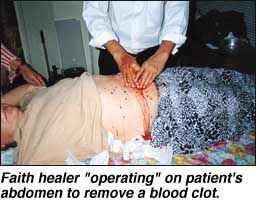 Blood samples taken from her clothing were examined using three
independent genetic tests: HLA DQA1, D1S80, and HUMTH01. These tests
are commonly used in forensic practice to identify the origins of
biological materials and stains such as blood, hair, saliva and
semen; they distinguish individuals based on their genetic make-up.
The results unequivocally showed that the blood on her clothing was
not her own but a mixture of blood from at least two other individuals.
As a precaution, she was tested for HIV and hepatitis B antibodies,
both of which were negative after three months.
Blood samples taken from her clothing were examined using three
independent genetic tests: HLA DQA1, D1S80, and HUMTH01. These tests
are commonly used in forensic practice to identify the origins of
biological materials and stains such as blood, hair, saliva and
semen; they distinguish individuals based on their genetic make-up.
The results unequivocally showed that the blood on her clothing was
not her own but a mixture of blood from at least two other individuals.
As a precaution, she was tested for HIV and hepatitis B antibodies,
both of which were negative after three months.
-
©MJA 1997
Readers may print a single copy for personal use. No further reproduction or distribution of the articles should proceed without the permission of the publisher. For permission, contact the Australasian Medical Publishing Company
Journalists are welcome to write news stories based on what they read here, but should acknowledge their source as "an article published on the Internet by The Medical Journal of Australia <http://www.mja.com.au>".
<URL: http://www.mja.com.au/> © 1997 Medical Journal of Australia.