




Volume 222 - Issue 3
Genetic counsellors: facilitating the integration of genomics into health care
Authors: Tatiane Yanes, Eliza Courtney, Mary‐Anne Young, Amy Pearn, Aideen McInerney‐Leo and Jodie Ingles
Med J Aust 2025 || doi: 10.5694/mja2.52568
Published online: 3 February 2025
Published online: 3 February 2025
A discussion on challenges in implementing genomic medicine in Australia and the role of genetic counsellors, their training and relevant skill sets. Evidence for their impact on patient care, clinicians and health services is also reviewed, with barriers to widespread facilitation.
Genomic testing is integral across all areas of health care and is a cornerstone of modern medicine. Beyond diagnosing rare conditions, genomic testing is routinely used to inform reproductive and prenatal care, augment risk assessments, guide therapies and inform management at the individual and public health level. There are over 25 conditions with federally funded Medicare Benefits Schedule (MBS) item numbers to deliver germline diagnostic genomic testing, including cancers, cardiac conditions, renal conditions and childhood hearing loss. Additional genomic testing is funded by state and territory public health departments and private out‐of‐pocket payments. The exponential growth of genomics knowledge and use in health care is likely to continue. Given its clinical value, genomic testing is increasingly offered by clinicians who do not have genetics subspecialty qualifications (referred to as non‐genetics clinicians), which has necessitated further education and upskilling of these clinicians. Although mainstreaming has been successful in some settings,1 most health services and clinicians are insufficiently prepared or resourced to address the complexities of genomic medicine.2,3
Genomic health care: maximising opportunities and mitigating risk
Despite well reported clinical, personal and health system benefits, genomic testing uptake has remained low in Australia, even with eligibility for MBS rebates.3,4 For conditions where early intervention can significantly improve health outcomes (eg, familial hypocholesterolemia, Lynch syndrome and hereditary breast and ovarian cancer), there have been low levels of genomic testing.5,6 Missed opportunities for genomic testing can result in risks to health services and to patients, including failure to identify patients and at‐risk family members, delayed diagnosis, and inappropriate treatments or screening. Delivery of genomic medicine in the absence of adequate support and training can also result in harm to patients and families, inadequate informed consent, inappropriate genomic test selection, and misconceptions about variant interpretation with consequential incorrect, and potentially invasive management decisions (Box 1).7,8 Patient needs after genomic testing are frequently overlooked, including the psychological impact of a genetic diagnosis and risk management (eg, implications for prognosis, carrier or survivor guilt, and family planning implications), support for family communication and cascade testing, and pursuit of appropriate variant classification review. Internationally, poorly executed genomic practices have resulted in medical malpractice suits9,10 and have been the focus of public and media attention.11,12
Genetic counsellors are central to genomic health care
Several genomics implementation programs have been successfully delivered in Australia and internationally to maximise genomic testing benefits while mitigating the associated risks. Such programs have recognised the contextual factors (eg, health care systems, clinician, patient and family, and social determinants) that influence the implementation of genomic medicine into mainstream care and the need for targeted interventions. Key to program success is delivery of targeted genomics education,2 multidisciplinary team meetings,13 and national collaborations.1 However, in many cases mainstreaming services continue to rely on support from genetic clinicians, with one Australian study noting that 93% of patients undergoing genomic testing required genetic counsellor input to facilitate testing delivery and follow‐up.13 Such findings highlight the central role of genetic counsellors in genomic health care.
Genetic counsellors are highly specialised allied health professionals who integrate clinical genomic knowledge, health communication, and counselling skills to identify and meet the clinical, informational, and psychological needs of patients (Box 2). Being at the forefront of genomic medicine has necessitated that genetic counsellors be flexible, adaptable and dynamic in response to the changing genomic landscape, while prioritising patients’ and families’ needs, wellbeing and safety.14 The true value of the profession lies in genetic counsellors’ unique combination of knowledge and skills, which empower families and clinicians to maximise the utility of genomic medicine.15 This expertise and the requisite time for quality care and delivery, cannot be easily absorbed into the workload of other clinicians.
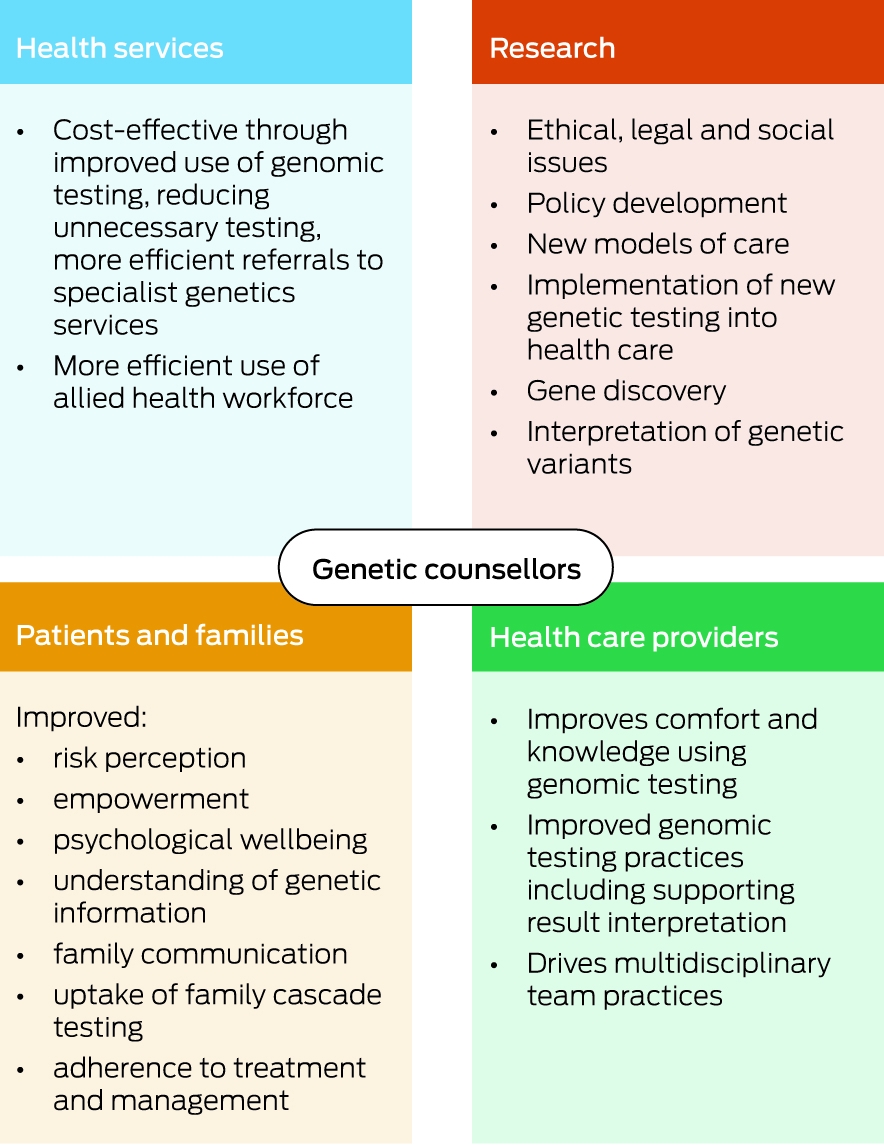
There is a wealth of evidence demonstrating the benefits of genetic counselling for patients and families, clinicians, and health services (Box 3). For patients and families, genetic counselling is associated with improved comprehension of genetic information, enhanced psychological wellbeing, family communication, increased uptake of family cascade testing, adaptation to genetic diagnosis, and adherence to treatment and medical management.16,17,18,19 Genetic counselling also provides benefits in settings with limited genetic testing, such as psychiatry.20 On a clinician and system level, embedding genetic counsellors in health services enhances the identification of patients suitable for genomic testing, reduces unnecessary testing, facilitates genomics education of non‐genetic clinicians and offers economic benefits in terms of workforce and testing efficiencies.19,21,22,23 Compared with non‐genetic clinicians, genetic counsellors are also significantly less likely to make errors when disclosing genomic test results.24 Genetic counsellors in Australia have been at the forefront of informing evidence‐based genomic practice, conducting research ranging from gene discovery and variant interpretation, to innovative models of care, and addressing the ethical, legal and social implications of genomics.23,25,26,27
Identifying challenges and looking to the future
Despite the growing need for genetic counsellors, there are several challenges preventing access to the profession in Australia (Box 4). Workforce shortage is frequently cited as a primary barrier to recruitment. A 2023 voluntary census of Human Genetics Society of Australasia (HGSA) registered genetic counsellors in Australasia estimated that 66% of the participants held a clinical position, compared with 97% of clinical geneticists.29,30 However, registered genetic counsellors are more likely to be working in clinical roles compared with individuals who are not registered, and therefore the census is likely to be an overestimate. Despite increasing numbers of new graduates, the overall proportion of professionals working in clinical practice remained unchanged over the past five years.30 The lack of professionals in the clinical workforce reflects the limited funded roles for genetic counsellors, a lack of professional autonomy and recognition of expertise, limited administrative support, and importantly, inadequate career pathways where most counsellors reach maximum career progression within five to seven years after graduation. Consequently, genetic counsellors frequently move to alternative career pathways in academia, industry, policy and education. Many of these factors also contribute to the high risk of burnout and compassion fatigue seen the profession.31
Funding for genetic counselling services remains a significant problem preventing access to services. Within the public health system, access to genetic counsellors has been limited to specialised genetic services, which often have lengthy waitlists and restrictive referral criteria. Genetic counsellor time is typically block funded, or more commonly through activity‐based funding. It was only in 2024 that the Independent Health and Aged Care Pricing Authority, which sets prices and costing for delivery of activity‐based funding, introduced a class of funding for genetic counsellors that can be applied to specialist clinics (class 40.66 Genetic counselling). Although it is unclear how this funding applies to genetic services, it is nonetheless a significant step forward in supporting the embedding of genetic counsellors in non‐genetic services. This new service model will necessitate consideration of how genetic counselling practices can best be adapted to non‐genetic services, and development of new policies for services that have not previously employed genetic counsellors (eg, professional and operational supervision, career progression, and opportunities for continued professional development).
Unlike many allied health professions, such as psychology, physiotherapy and other self‐regulated professions (eg, speech pathology), there is currently no Medicare funding or private health insurance rebates available for services provided by genetic counsellors. Genetic counsellors are also ineligible to request any of the genomic tests included in the MBS. Although genomic testing MBS item numbers stipulate the need for pre‐ and post‐test genetic counselling (PN.0.23), remuneration of genetic counselling is also beyond the scope of these items. Therefore, funding is available for testing, without provision for the workforce to deliver it. More recently, an application to the MBS Review Advisory Committee for an MBS item number for genetic counselling was unsuccessful. Although the committee acknowledged the importance of the genetic counselling workforce, concerns were raised about uncertain financial impact to the MBS, the possibility of “low‐value service”, driving of the workforce from the public to private sector, and a possible disconnect within the health care pathway without supporting evidence.32 The final decision on the MBS item number now sits with the Commonwealth Minister for Health and Aged Care. Any further review of this item number must consider the high levels of training, professionalism, robust professional regulation, and benefits that autonomous genetic counsellors can provide to patients, families and the health system more broadly.
In Australia, there is no statutory title protection to prevent unqualified individuals from using the title of genetic counsellors. Professional oversight is provided by the HGSA as a member of the National Alliance of Self Regulating Health Professions, which also includes a registry of qualified genetic counsellors. However, the HGSA does not have legal authority to enforce restrictions on the use of the genetic counsellor title or enforce professional standards (Box 2). Internationally, title protection is available in several jurisdictions, including in the United States where there is licensure in over 30 states.33,34 The lack of protection presents an ongoing risk from unqualified and unregulated individuals delivering services without the necessary qualifications, training or supervision. Title protection is essential to support expansion of the genetic counselling workforce, while equally protecting the public from the well reported risks and harm associated with genomic medicine.9,10,11,12 Currently, there is clear title certification and registration processes governed by the HGSA for genetic counsellors. Pending statutory regulation, funding models should ensure that remuneration is limited to HGSA‐registered genetic counsellors.
Many medical clinicians working with genetic counsellors are appreciative of their input to multidisciplinary teams. In our experience, the voices of these medical colleagues have been key to ensuring that genetic counsellors’ full potential is recognised. We therefore call on the medical community to advocate for their genetic counselling colleagues. Equally, genetic counsellors need to remain adaptable to change, recognise varied needs of mainstream clinics, and accept new service models, while supporting the health care workforce to deliver genomic medicine. As an allied health profession, empowering genetic counsellors to work to the full scope of their practice will enhance the capacity of health systems to meet patient needs and fully realise the benefits of genomic medicine.
Box 1 – Genetic counselling considerations along the genomic testing continuum
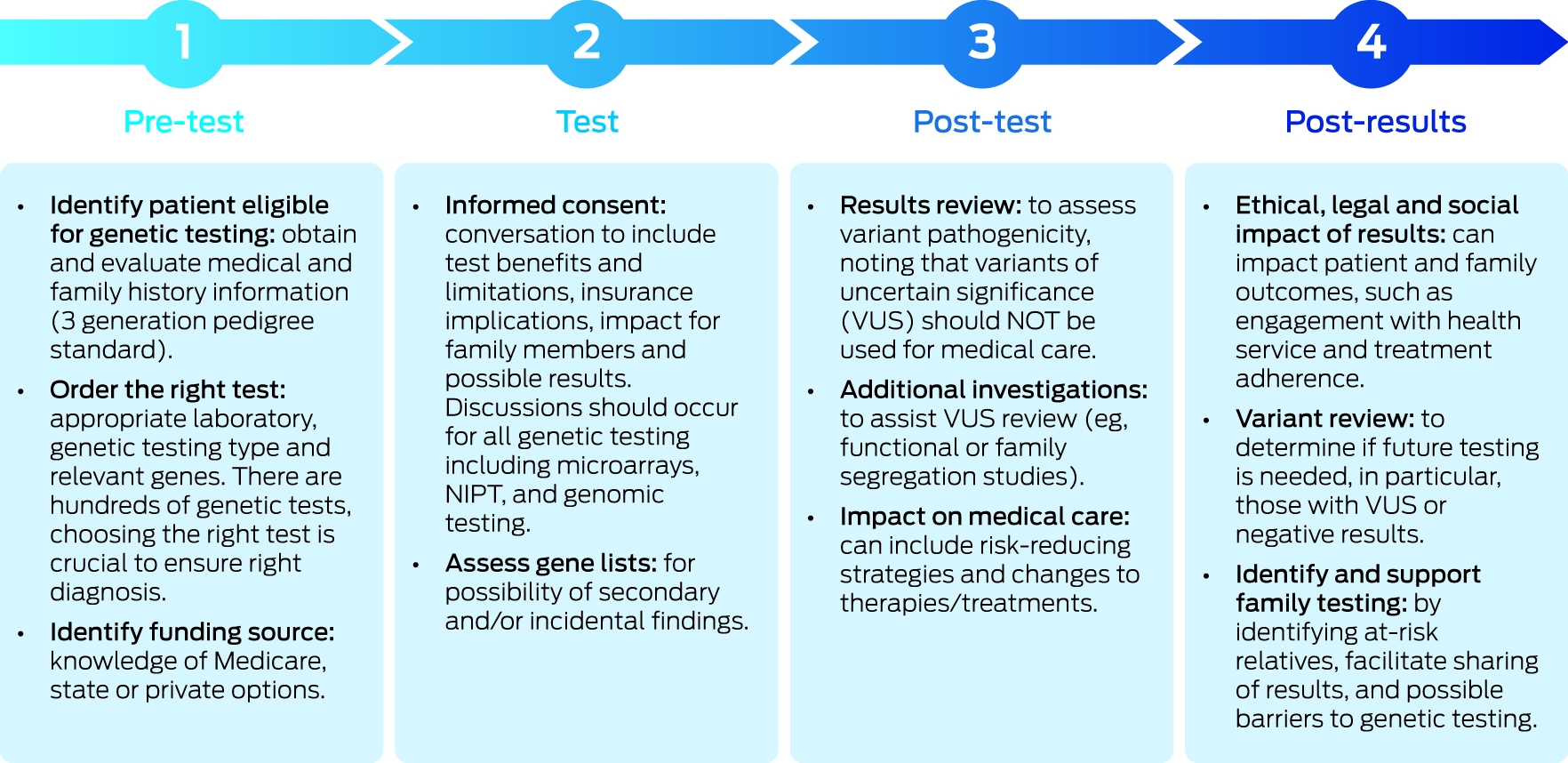
NIPT = non‐invasive prenatal testing.
Box 2 – Summary of genetic counselling training and professional oversight in Australia28
- Postgraduate qualifications: Two‐year Master of Genetic Counselling degree composed of: (i) coursework covering human and clinical genetics, counselling, principles of public health, and relevant ethical, legal and social challenges; (ii) clinical placements (minimum 74 days) and clinical practice‐related activities (minimum 100 hours); and (iii) a research project. On graduation, genetic counsellors are eligible to apply for the title of Member of the Human Genetics Society of Australasia (HGSA) (MHGSA Genetic Counselling).
- Professional oversight and regulation: Provided by the HGSA as a member of The National Alliance of Self‐Regulating Health Professions, with the latter being an independent body providing a regulatory framework for self‐regulating allied health profession in Australia, such as speech pathologists and dietitians. The HGSA defines professional scope of practice, accreditation of Master of Genetic Counselling programs, continued professional development, professional supervision and complaints processes.
- Clinical certification: Following completion of the Master of Genetic Counselling degree, individuals need to demonstrate knowledge, skills and competency required for clinical practice. Certification includes long cases, practice logbooks, reflective essays on genetic counselling sessions, and supervisor reports. On certification, genetic counsellors can apply for the title of Fellow of the HGSA (FHGSA Genetic Counselling).
- Supervision: All genetic counsellors, regardless of area of practice, are required to undertake a minimum of one hour per month of clinical genetic counselling supervision. MHGSA genetic counsellors require an additional four hours (pro‐rata) of genetic counselling supervision and four hours (pro‐rata) of case review, which can be achieved via multidisciplinary team meetings or intake meetings.
- Continued professional development: All genetic counsellors require a minimum of 25 hours per year that reflect the competencies and standards of the profession.
Box 3 – Evidence‐based benefits of genetic counsellors for patients and families, clinicians, health care services and evidence‐based practice
Box 4 – Recommendations to increase access to genetic counsellors and drive the delivery of genomic medicine in the Australian health care system
We recommend that genetic counsellors be integrated into mainstream health care. To achieve this goal, the following concerns should be addressed as a priority:- Improved funding models are essential to facilitate integration of genetic counsellors throughout the health care system. A Medicare Benefits Schedule item number and the ability of genetic counsellors to request appropriate genomic tests will empower genetic counsellors to practise in diverse settings, thereby increasing accessibility for patients without overburdening non‐genetics clinicians. The recently introduced activity‐based funding class will further accelerate embedded models of practice in public health.
- Statutory title protection should be implemented to protect the public from the potential risks and harms associated with delivery of genetic counselling from unqualified individuals. Statutory title protection will further align genetic counsellors with other allied health providers and advance the profession through recognition of professional standards and scope of practice.
- Empowering genetic counsellors to ensure effective and efficient use of their skills, including recognition of qualifications, and capacity to practice at the top of their scope. Genetic counsellors and professional organisations should work together with health services to develop new service models embedding genetic counsellors in non‐genetic services. There should be adequate career progression pathways established to reduce burnout and improve retention of experienced staff, ensuring a ready and sustainable workforce.
Competing interests
No relevant disclosures.
References
- Jayasinghe K, Biros E, Harris T, et al. Implementation and evaluation of a national multidisciplinary kidney genetics clinic network over ten years. Kidney Int Rep 2024; 9: 2372‐2385.
- Crellin E, McClaren B, Nisselle A, et al. Preparing medical specialists to practice genomic medicine: education an essential part of a broader strategy. Front Genet 2019; 10: 789.
- O'Shea R, Ma AS, Jamieson RV, Rankin NM. Precision medicine in Australia: now is the time to get it right. Med J Aust 2022; 217: 559‐563. https://www.mja.com.au/journal/2022/217/11/precision‐medicine‐australia‐now‐time‐get‐it‐right
- Mordaunt DA, Dalziel K, Goranitis I, Stark Z. Uptake of funded genomic testing for syndromic and non‐syndromic intellectual disability in Australia. Eur J Hum Genet 2023; 31: 977‐979.
- Watts GF, Sullivan DR, Hare DL, et al. Integrated guidance for enhancing the care of familial hypercholesterolaemia in Australia. Heart Lung Circ 2021; 30: 324‐349.
- Morrow A, Steinberg J, Chan P, et al. In person and virtual process mapping experiences to capture and explore variability in clinical practice: application to genetic referral pathways across seven Australian hospital networks. Transl Behav Med 2023; 13: 561‐570.
- Shaw T, Fok R, Courtney E, et al. Missed diagnosis or misdiagnosis: common pitfalls in genetic testing. Singapore Med J 2023; 64: 67‐73.
- Farmer MB, Bonadies DC, Pederson HJ, et al. Challenges and errors in genetic testing: the fifth case series. Cancer J 2021; 27: 417‐422.
- Ackerman JP, Bartos DC, Kapplinger JD, et al. The promise and peril of precision medicine: phenotyping still matters most. Mayo Clin Proc 2016: S0025‐6196(16)30463‐3.
- Ray T. Genetic testing challenges in oncology: immigrant mislabeled as BRCA‐Positive, regrets ovary removal. May 2021. Precision Medicine Online. https://www.precisionmedicineonline.com/molecular‐diagnostics/genetic‐testing‐challenges‐oncology‐immigrant‐mislabeled‐brca‐positive (viewed Oct 2024).
- Bhatia A, Kliff S. When they warn of rare disorders, these prenatal tests are usually wrong. The New York Times, 1 Jan 2022. https://www.nytimes.com/2022/01/01/upshot/pregnancy‐birth‐genetic‐testing.html (viewed Oct 2024).
- Bennett C. Ambiguous genetic test results can be unsettling. Worse, they can lead to needless surgeries. The Washington Post, 7 Feb 2021. https://www.washingtonpost.com/health/genetic‐tests‐uncertain‐results/2021/02/05/80a06d9a‐65a2‐11eb‐8468‐21bc48f07fe5_story.html (viewed Oct 2024).
- Ma A, Newing TP, O'Shea R, et al. Genomic multidisciplinary teams: a model for navigating genetic mainstreaming and precision medicine. J Paediatr Child Health 2024; 60: 118‐124.
- Kohut K, Limb S, Crawford G. The changing role of the genetic counsellor in the genomics era. Current Genetic Medicine Reports 2019; 7: 75‐84.
- Austin J. 2020 Vision: genetic counselors as acknowledged leaders in integrating genetics and genomics into healthcare. J Genet Couns 2016; 25: 1‐5.
- Smerecnik CM, Mesters I, Verweij E, et al. A systematic review of the impact of genetic counseling on risk perception accuracy. J Genet Couns 2009; 18: 217‐228.
- Rutherford S, Zhang X, Atzinger C, et al. Medical management adherence as an outcome of genetic counseling in a pediatric setting. Genet Med 2014; 16: 157‐163.
- Athens BA, Caldwell SL, Umstead KL, et al. A systematic review of randomized controlled trials to assess outcomes of genetic counseling. J Genet Couns 2017; 26: 902‐933.
- Kentwell M, Dow E, Antill Y, et al. Mainstreaming cancer genetics: a model integrating germline BRCA testing into routine ovarian cancer clinics. Gynecol Oncol 2017; 145: 130‐136.
- Semaka A, Austin J. Patient perspectives on the process and outcomes of psychiatric genetic counseling: an “empowering encounter”. J Genet Couns 2019; 28: 856‐868.
- Miller CE, Krautscheid P, Baldwin EE, et al. Genetic counselor review of genetic test orders in a reference laboratory reduces unnecessary testing. Am J Med Genet A 2014; 164A: 1094‐1101.
- Haidle JL, Sternen DL, Dickerson JA, et al. Genetic counselors save costs across the genetic testing spectrum. Am J Manag Care 2017; 23: Sp428‐Sp430.
- Yanes T, Sullivan A, Barbaro P, et al. Evaluation and pilot testing of a multidisciplinary model of care to mainstream genomic testing for paediatric inborn errors of immunity. Eur J Hum Genet 2023; 31: 1125‐1132.
- Coleman TF, Pugh J, Kelley WV, et al. Errors in genome sequencing result disclosures: a randomized controlled trial comparing neonatology non‐genetics healthcare professionals and genetic counselors. Genet Med 2024; 26: 101198.
- McInerney‐Leo AM, Schmidts M, Cortés CR, et al. Short‐rib polydactyly and Jeune syndromes are caused by mutations in WDR60. Am J Hum Genet 2013; 93: 515‐523.
- Tiller J, Bakshi A, Dowling G, et al. Community concerns about genetic discrimination in life insurance persist in Australia: a survey of consumers offered genetic testing. Eur J Hum Genet 2024; 32: 286‐294.
- Leslie F, Avis SR, Bagnall RD, et al. The New South Wales Sudden Cardiac Arrest Registry: a data linkage cohort study. Heart Lung Circ 2023; 32: 1069‐1075.
- Human Genetics Society of Australasia. Genetic counselling training and accreditation 2024 [website]. https://hgsa.org.au/Web/Web/ET/Genetic‐Counselling.aspx?hkey=975b23ce‐fa8e‐485a‐a7ee‐fc88aab9a60d (viewed July 2024).
- Nisselle A, Macciocca I, McKenzie F, et al. Readiness of clinical genetic healthcare professionals to provide genomic medicine: an Australian census. J Genet Couns 2019; 28: 367‐377.
- Kanga‐Parabia A, Mitchell L, Smyth R, et al. Genetic counseling workforce diversity, inclusion, and capacity in Australia and New Zealand. Genetics in Medicine Open 2024; 101848.
- Caleshu C, Kim H, Silver J, et al. Contributors to and consequences of burnout among clinical genetic counselors in the United States. J Genet Couns 2022; 31: 269‐278.
- Medicare Benefits Schedule (MBS) Review Advisory Committee. Genetic Counselling Final Report 2022. https://www.health.gov.au/sites/default/files/2023‐04/mbs‐review‐advisory‐committee‐genetic‐counselling‐final‐report_0.pdf (viewed July 2024).
- Hoskins C, Gaff C, McEwen A, et al. Professional regulation for Australasian genetic counselors. J Genet Couns 2021; 30: 361‐369.
- Patrinos D, Ghaly M, Al‐Shafai M, Zawati MH. Legal approaches to risk of harm in genetic counseling: perspectives from Quebec and Qatar. Front Genet 2023; 14: 1190421.
Provenance: Not commissioned; externally peer reviewed.
Newborn Screening: Equity for Aboriginal and Torres Strait Islander Families in the Context of Emerging Genomics
Gail Garvey, Sarah Norris, Joanne Scarfe, Louise Lyons
When ‘Liver Enzymes’ Are Not Hepatic: Late-Onset Pompe Disease
Shauna Madigan, Georgina England, Wayne Rankin
Genomic Newborn Screening: Verdict From an Australian Citizens’ Jury
Emma Frost, Zornitza L. Stark, Kristen Nowak, Louise Healy, Sarah Norris, Stacy M. Carter
Genomic Testing Access for Hearing Loss Must Catch Up to the Evidence
Emma McGonigal, Andrew V. White, Valerie Sung, Karen Liddle, Lilian Downie, Emily Shepard
Population-Based Melanoma Screening Using Integrated Risk Scores in Australia: A Narrative Review to Determine Readiness
Courtney K. Wallingford, Chloe Mighton, Tamara Dawson, Anne Cust, H. Peter Soyer, Yvonne Bombard, Tatiane Yanes, Aideen McInerney-Leo
Genomic Newborn Screening: Commodity or Public Good?
Christopher Gyngell, Sebastian Lunke, Danya Vears, Zornitza L. Stark