




Volume 218 - Issue 9
General practice and melanoma management in Australia: controversies and implications for generalist GP training
Authors: Cliff Rosendahl and Simon Clark
Med J Aust 2023; 218 (9): 397-398. || doi: 10.5694/mja2.51928
Published online: 15 May 2023
Published online: 15 May 2023
Australians should be confident that their generalist GP is trained to an acceptable level of competence in skin cancer diagnostics
Australians should be confident that their generalist GP is trained to an acceptable level of competence in skin cancer diagnostics
In this issue of the MJA, Pandeya and colleagues report their study of a sample of 1683 Queensland adults diagnosed with first melanomas between 2011 and 2019.1 Their article provides an authoritative insight into who treats melanoma in Queensland and how they treat it.
The authors found that 77.1% of first melanomas were treated in general practice, compared with 14.8% by dermatologists.1 Their finding confirms other reports of the prominent role of general practice in melanoma management in Australia, particularly in Queensland.2 This role has increased over the past two decades as general practitioners move into this area because of the relatively low numbers of dermatologists in Australia. However, a recent study found that general practice registrars do not use dermatoscopy as often as they should, concluding there was a “need for dermoscopy training to be a standard element of general practice training.”3 This problem has led to diverse providers offering training,4 with options ranging from certificate courses, including awards from the Skin Cancer College Australasia,5 to an Australian Qualification Framework‐compliant online masters’ degree at the University of Queensland.6 Consequently, highly trained GPs with a special interest in skin cancer now work in this area alongside generalist GPs.
Differences between medical specialties in the management of melanoma are notable. Australian guidelines recommend elliptical excision biopsy as the preferred diagnostic procedure, citing the higher incidence of involved margins after alternative approaches.7 While Pandeya and colleagues found that plastic surgeons, surgeons, and GPs undertook excision biopsy for 54% of patients, dermatologists did so for only 27%, preferring shave biopsy in 56% of cases. In a recent prospective study, a group of Queensland dermatologists reported no positive deep margins for 50 melanomas biopsied with the “intent to remove the lesion in toto”, but conceded that there was peripheral margin involvement in thirteen cases.8 Any positive margin can lead to recurrence, which in turn can result in an adverse outcome.7 Another reason to prefer excisional biopsy is that patient safety is maximised in the event of a false negative histological finding. Pandeya and colleagues report that punch biopsy was used for 10.6% of procedures resulting in melanoma diagnoses (including 12.3% of those diagnosed by GPs). These apparent deviations from the guidelines,7 which cite evidence for the risk of adverse outcomes following false negative findings using this procedure, may reflect training deficiencies, at least for some clinicians.
Is the increasing dominance of melanoma management by GPs leading to overdiagnosis of melanoma in Australia? Some critics regard the early diagnosis of melanomas never destined to cause harm as constituting overdiagnosis,9 but indolent and more serious lesions cannot be reliably distinguished. According to the Australian Cancer Atlas, the melanoma diagnosis rate is highest in coastal southeast Queensland and northeast New South Wales, but the excess mortality attributed to melanoma is lowest in these areas (Box).10 This correlation, unique to melanoma, has prompted speculation, including by Queensland epidemiologist, David Whiteman, that “‘overdiagnosis’ is [currently] a price paid to improve survival.”11
Is there other evidence that higher diagnostic rates are influencing melanoma‐related mortality? The precise reasons for the recent 27% decline in age‐standardised melanoma‐specific mortality in Australia, from 6.2 at its 2011 peak to 4.5 per 100000 population in 2019,12 are unclear. Attributing it to more advanced therapies is dubious; in New Zealand, for example, age‐standardised melanoma mortality among men declined by more than 21% during 2011–2016, before public subsidisation made the immune checkpoint inhibitors nivolumab and pembrolizumab widely available.13 Other factors probably contribute to improved melanoma survival in Australia, as well as in New Zealand — including early detection.
Given the high prevalence of skin cancer and melanoma, every Australian should be able to be confident that their generalist GP is trained to an acceptable level of competence in skin cancer diagnostics, including dermatoscopy. Training the trainers has been proposed as the solution to overcoming deficiencies in traditional GP training in this regard.3 Although alternative training avenues are available, they are limited, self‐selected options. As the clinicians of first contact in Australia, GPs (particularly generalist GPs) are ideally positioned for the increasing role they are assuming in skin cancer and melanoma management. In the interests of GP confidence and patient safety, we appeal to those responsible for GP education to respond to the need for specific training in this area.
Box – Population ratios of melanoma diagnosis and excess melanoma deaths, Australia, 2007–2016
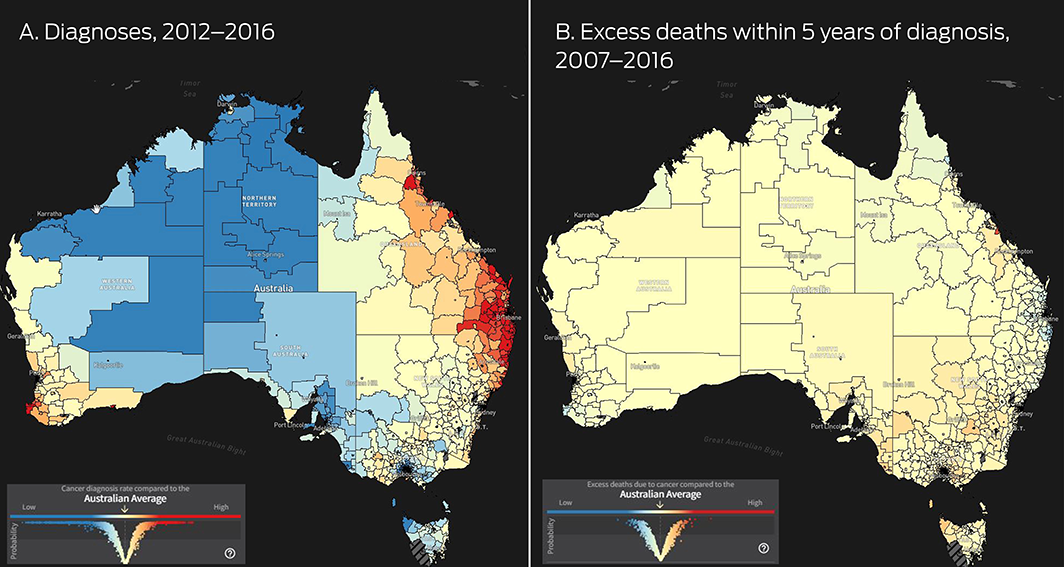
Source: Australian Cancer Atlas.10
Competing interests
No relevant disclosures.
References
- Pandeya N, Olsen CM, Shalit MM, et al. The diagnosis and initial management of melanoma in Australia: findings from the prospective, population‐based QSkin study. Med J Aust 2023; 218: 402‐407.
- Wu A, Rosen R, Selva D, Huilgol SC. Proportion of melanoma excisions performed by different specialties in Australia. Australas J Dermatol 2018; 59: 243‐245.
- Whiting G, Stocks N, Morgan S, et al. General practice registrars’ use of dermoscopy: prevalence, associations and influence on diagnosis and confidence. Aust J Gen Pract 2019; 48: 547‐553.
- Rosendahl C, Hansen C, Cameron A, et al. Measuring performance in skin cancer practice: the SCARD initiative. Int J Dermatol 2011; 50: 44‐51.
- Skin Cancer College Australasia. Fellowship. 2022. www.skincancercollege.org/fellowship (viewed Mar 2023).
- University of Queensland. Master of Medicine. 2022. https://study.uq.edu.au/study‐options/programs/master‐medicine‐5398 (viewed Mar 2023).
- Kelly J, Teddy L, Beer T, et al. Cancer Council Australia Melanoma Guidelines Working Party. Clinical question: What type of biopsy should be performed for a suspicious pigmented skin lesion? In: Clinical practice guidelines for the diagnosis and management of melanoma. Updated 17 May 2018. https://wiki.cancer.org.au/australiawiki/index.php?oldid=186215 (viewed Mar 2023).
- Shao E, Blake T, Po‐Chao F, et al. Prospective study of pigmented lesions managed by shave excision with no deep margin transection of melanomas. Australas J Dermatol 2020; 61: 269‐272.
- Welch HG, Mazer BL, Adamson AS. The rapid rise in cutaneous melanoma diagnoses. N Engl J Med 2021; 384: 72‐79.
- Cancer Council Queensland, Queensland University of Technology, Cooperative Research Centre for Spatial Information. Australian Cancer Atlas; version 09‐2018. https://atlas.cancer.org.au (viewed Mar 2023).
- Rosendahl C Whiteman D. Is overdiagnosis a price worth paying in melanoma? AusDoc, 11 Mar 2020. https://www.ausdoc.com.au/dermoscopy/overdiagnosis‐price‐worth‐paying‐melanoma (viewed Mar 2023).
- Australian Institute of Health and Welfare. General Record of Incidence of Mortality (GRIM) books. Updated 9 June 2022. https://ncci.canceraustralia.gov.au/outcomes/cancer‐mortality/cancer‐mortality (viewed Mar 2023).
- International Agency for Research on Cancer, World Health Organization. Age‐standardized rate (world) per 100000, mortality, males and females. Melanoma of skin: Australia, New Zealand. Cancer Over Time, 2023. https://gco.iarc.fr/overtime/en/dataviz/trends?populations=3600_55400&sexes=1_2&types=1&multiple_populations=1&cancers=12&scale=linear&min_zero=1&smoothing=0 (viewed Mar 2023).
Provenance: Commissioned; not externally peer reviewed.
From Ambition to Action: Closing Policy, Equity and Implementation Gaps in the Australian Cancer Plan's ‘Enhanced Consumer Experience’
Carla Thamm, Elise Button, Oluwaseyifunmi A. Agbejule, Reegan Knowles, Karen van Gorp, Mark B. Pinkham, Meinir Krishnasamy, Alexandra L. McCarthy, Raymond J. Chan
Sovereignty and Survival: Understanding Lung Cancer Outcomes for Aboriginal and Torres Strait Islander People in Australia, a Case–Control Study
Alice R. T. Bergin, Luc te Marvelde, Roger L. Milne, Benjamin J. Solomon, Kris Ivanova, Peter Savas, Stephen J. Luen, Jay Hamann, Andrea Casey, Nicole Watt, Sue M. Evans, Gail Garvey, Sherene Loi
The Changing Indications for Adult Liver Transplantation in Australia: A Narrative Review
Fadak Mohammadi, Alan J. Wigg, Ken Liu, Simone I. Strasser
Uneven Ground: Survival Differences Among Victorian Lung Cancer Patients by Location of Residence (2011–2023): A Retrospective Cohort Study
Evangeline Samuel, Eldho Paul, Mike Lloyd, Sanuki Tissera, Craig Underhill, Sagun Parakh, Phillip Parente, Inger Olesen, Javier Torres, Katharine See, Gavin M. Wright, David Langton, Thomas John, Matthew Conron, James Bartlett, Nicola Atkin, Nikolajs Zeps, Susan V. Harden, Wasek Faisal, John R. Zalcberg, Rob G. Stirling
Early-Onset Colorectal Cancer With Liver-Only Metastases: A Retrospective Cohort Study Integrating Prospectively Collected Real-World Clinical and Molecular Data From an Australian National Database (2009–2024) to Guide Treatment Planning
Savio G. Barreto, Christos S. Karapetis, Shahid Ullah, Matthew Burge, Susan Caird, Angus Campbell, Azim Jalali, Ross Jennens, Muhammad A. Khattak, Belinda Lee, Stephanie H. Lim, Shehara Mendis, Louise Nott, Timothy J. Price, Jeremy D. Shapiro, Jeanne Tie, Javier Torres, Colin Williams, Rachel Wong, Vanessa Wong, Peter Gibbs
Australian Pathways for Specialist Pain Management and Early Palliative Care for People With Pancreatic Cancer: Developed Using a Community Consensus Approach
Jennifer Philip, Melanie R. Lovell, Kylee Bellingham, Gail Garvey, Gregory B. Crawford, Nicole M. Rankin, Kara Burns, Isabel Young, Vivienne Milch, Dorothy Keefe, Katrina Anderson, James Lawson, Meinir Krishnasamy