




Volume 216 - Issue 2
Uncontrolled blood pressure in Australia: a call to action
Authors: Aletta E Schutte, Ruth Webster, Garry Jennings and Markus P Schlaich
Med J Aust 2022; 216 (2): 61-63. || doi: 10.5694/mja2.51350
Published online: 6 December 2021
Published online: 6 December 2021
A national commitment to improved blood pressure control would lead to significant health and economic gains
A national commitment to improved blood pressure control would lead to significant health and economic gains
Globally, the leading risk factor for death is widely acknowledged as being raised blood pressure (BP).1 The Global Burden of Disease study found that a systolic BP of 110 mmHg and above accounted for 10.8 million deaths in 2019.1 This constitutes one in every five deaths,1 mainly due to coronary heart disease and cerebrovascular disease. A report on deaths in Australia2 confirmed that also here the leading cause of death is coronary heart disease, followed by dementia and cerebrovascular disease — with coronary disease, vascular dementia and cerebrovascular disease sharing a common risk factor: raised BP. Australian data have shown raised BP to be responsible for 43% of coronary heart disease, 41% of stroke, 65% of the burden of hypertensive heart disease, 38% of chronic kidney disease, 32% of atrial fibrillation and flutter, and 3.6% of dementia.3,4
The linchpin in reducing the risk for these cardiovascular outcomes would logically be to reduce BP and improve BP control, which is defined as systolic BP of < 140 mmHg and diastolic BP of < 90 mmHg.5 In the United States, the Office of the Surgeon General came to the same conclusion after BP control rates regressed from 54% to 44% from 2014 to 2018, leading to a call to action in 2020 and a national roadmap to “make hypertension control a national priority”.6 Their goal is to achieve 70% control commensurate with Canada’s outstanding achievements in this area. Screening for raised BP in adults remains key.6,7 A meta‐analysis of data for 344 716 participants from 48 trials found that a 5 mmHg systolic BP reduction was associated with a 10% reduction in major cardiovascular events irrespective of the baseline BP level in those with and without previous cardiovascular disease.8 Although absolute risk based approaches are gaining traction, less than half of those at highest risk are receiving all recommended therapies,9 and the particular importance of high BP as an independent and modifiable risk factor should not be overlooked.
With a control rate of 44% in the US sparking a national commitment,6 the question could be asked as to why Australia is not prioritising BP control. In 2017–18, the Australian Institute of Health and Welfare reported that control rates were only 32%, implying that 68% of people with raised BP in Australia are not controlled (whether using medication or not).4 Alarmingly, this situation has not improved since 2011–12.4 In a sample of patients with hypertension in general practices, the proportion of controlled BP was reported as 54.9% in 2017.10
A 2020 Australian report acknowledged BP as a biological factor and determinant of health, and listed hypertension as a potentially modifiable condition which leads to hospitalisation, while reiterating coronary heart disease as the leading cause of death.11 Unfortunately, there seems to be no urgency or priority to address BP control in Australia.
In 2019, the NCD Risk Factor Collaboration compared hypertension awareness, treatment and control rates across 12 high income countries with national health examination survey data at several timepoints.12 Although in the most recent surveys, Australia had among the lowest prevalence of hypertension compared with other high income countries, in terms of BP control in women, Australia (38%) lagged behind Germany (58%), Canada (50%) and the US (54%) but was comparable to the United Kingdom (37%). For men, the control rate in Australia (28%) was substantially lower than in Germany (48%), Canada (68%), the US (49%) and the UK (37%).12 Noteworthy is that Australia had similar rates of hypertension awareness and treatment to the US in the 1990s, but over the past decades this has gradually declined, along with a plateauing of control rates (Box).13
We are falling behind
Not only has Australia fallen behind on the number of people with high BP who are aware, treated and controlled, but we also feel that a significant degree of complacency has arisen in both cardiovascular research and the public health agenda regarding the need to improve BP control. Despite Australia having an acknowledged focus on cardiovascular disease through the Medical Research Future Fund Cardiovascular Health Mission (https://www.health.gov.au/initiatives‐and‐programs/cardiovascular‐health‐mission), there is very little discussion on risk factor management to prevent cardiovascular disease, with the attention predominantly focused on better management of established disease. While the latter is undoubtedly important, a major public health impact is likely to be achieved most effectively by improving awareness of and screening for elevated BP and improving control rates.
In this context, the Lancet Commission on hypertension advised on several key strategies to reduce BP at a population level to the benefit of current and future generations.14 A central focus of the report was a life course approach in preventing raised BP among the larger population, including creating widespread population awareness in order for every adult to know their BP.14 In Australia, this is not the case. In the May Measurement Month global BP awareness campaign in 2018, less than half of Australians with hypertension were aware of it.7
With raised BP leading to major cardiovascular outcomes, improving these conditions in Australia is not only critical but also possible, but only if improved health literacy, accompanied by better awareness, treatment and control of raised BP, is made a national priority.
The way forward
The evidence is compelling and speaks for itself. Uncontrolled BP is costing us not only lives but also workforce productivity. Raised BP should be front and centre on the national health agenda in Australia. We should look to examples that have focused attention on the issue, where a multifaceted plan has resulted in vastly improved hypertension control rates. For example, Canada in the late 1980s had hypertension control rates of around 13%, which triggered the formation of a coalition of non‐government and government organisations (ultimately known as the Canadian Hypertension Education Program).15 Over several decades, the Canadian program refined its focus and strategic activities, culminating in the late 1990s with the creation of a range of taskforces, community initiatives, and public health and health policy initiatives outputting regular consensus recommendations around lifestyle approaches, assessment of BP, improving adherence to both lifestyle measures and medications, use of home BP devices, as well as regular guideline updates on both treatment algorithms and BP devices. Diagnosis of high BP improved from 57% to 84%, treatment rates from 35% to 80%, and BP control from 13% to 68%.15 These improvements in turn led to large reductions in death and hospitalisation from cardiovascular disease, heart failure and stroke.
These same tools are accessible in Australia. However, the first step is critical — which is to acknowledge the size of the problem and prioritise key steps. Without national commitment, positive change is unlikely to occur.
We propose the following as a roadmap to tackle this burden:
- ▪ Creation of a national taskforce with a remit to improve BP control in Australia to at least 70%, which is a doubling of the current control rates. Representation on this taskforce should include a broad range of stakeholders, with a focus on primary care (with nearly 37 000 general practitioners in Australia, compared with 1200 cardiologists, the focus on management of high BP in the community must include primary care practitioners, pharmacists, remote health care workers and nurses).
- ▪ Increasing the amount of funding for BP research, which is currently under‐represented in major funding bodies’ priority research areas. A focus should be on the implementation and scaling up of proven strategies to improve BP management and control across the life course.
Specific actions include (also for research):
- ▪ Creating wide‐scale opportunities for population‐based screening and raised awareness of the “silent killer”.
- ▪ Promoting population‐based measures such as salt and sugar reduction, increased fibre intake, smoking cessation, and reduced alcohol consumption.
- ▪ Adopting lifestyle approaches, including intersectoral approaches to increasing capacity and opportunity for physical activity (parks and green spaces, with a particular focus in remote areas and low socio‐economic environments).
- ▪ Providing affordable and validated BP devices alongside training to encourage home BP monitoring.
- ▪ Improving training on the measurement and management of elevated BP in clinical practice, including strategies to overcome clinician inertia. Data from 400 530 patients diagnosed with hypertension in Australia10 found that after 5 years, 37% remained untreated, contrary to the advice from the latest guidelines5 and leaving patients at significant risk.
- ▪ Providing refresher courses and educating GPs on emerging evidence‐based best practice. This includes use of single pill combination therapy early in the treatment algorithm as per international guidelines,5 based on clear evidence that it improves adherence and BP control.
If we could achieve a 25% reduction in the current prevalence of hypertension (34%)4 through population‐based approaches, we could save 37 000 lives and return $34.3 billion in gross domestic product to the Australian economy.16 Adequately treating and managing people currently living with hypertension would save 83 000 lives over the working lifetime and save $91.6 billion in gross domestic product.16 This is an outstanding return on investment, and we have the tools required to achieve it. What remains is to take the first step.
Box – Trends in awareness, treatment and control rates for people with hypertension in Australia and the United States
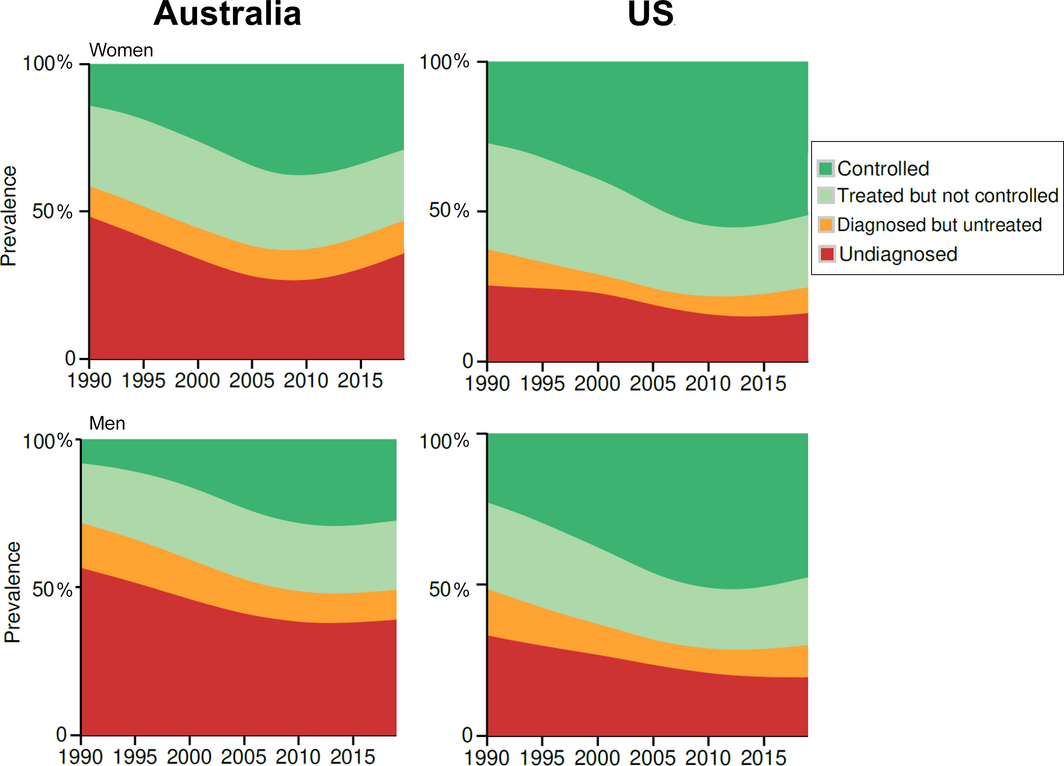
Reproduced with permission from NCD Risk Factor Collaboration.13
Competing interests
Aletta Schutte is Immediate Past President of the International Society of Hypertension. Garry Jennings is the Chief Medical Advisor of the Heart Foundation of Australia. Markus Schlaich is President of the HBPRCA.
Acknowledgements
This article is endorsed by the High Blood Pressure Research Council of Australia (HBPRCA). We thank the members of the HBPRCA Executive Committee (Audrey Adji, Bradley Broughton, Quynh Nhu Dinh, Genevieve Gabb, Gavin Lambert, Francine Marques, Anastasia Mihailidou, Jonathan Mynard, Mark Nelson, Rachel Climie, Martin Schultz, Michael Stowasser) for their critical review of the manuscript.
References
- GBD 2019 Risk Factors Collaborators. Global burden of 87 risk factors in 204 countries and territories, 1990‐2019: a systematic analysis for the Global Burden of Disease Study 2019. Lancet 2020; 396: 1223–1249.
- Australian Institute of Health and Welfare. Deaths in Australia (Cat. No. PHE 229). Canberra: AIHW, 2021. https://www.aihw.gov.au/reports/phe/229/deaths/deaths‐in‐australia/contents/leading‐causes‐of‐death (viewed Nov 2021).
- Australian Institute of Health and Welfare. Australian Burden of Disease study: impact and causes of illness and death in Australia 2015 (Cat. No. BOD 22). Canberra: AIHW. 2021. https://www.aihw.gov.au/reports/burden‐of‐disease/burden‐disease‐study‐illness‐death‐2015/summary (viewed Nov 2021).
- Australian Institute of Health and Welfare. High blood pressure (Cat. No. PHE 250). Canberra: AIHW, 2019. https://www.aihw.gov.au/reports/risk‐factors/high‐blood‐pressure/contents/high‐blood‐pressure (viewed Nov 2021).
- Unger T, Borghi C, Charchar F, et al. 2020 International Society of Hypertension global hypertension practice guidelines. Hypertension 2020; 75: 1334–1357.
- US Department of Health and Human Services. The Surgeon General’s call to action to control hypertension. Washington, DC: US Department of Health and Human Services, Office of the Surgeon General, 2020. https://www.ncbi.nlm.nih.gov/books/NBK567645/pdf/Bookshelf_NBK567645.pdf (viewed Nov 2021).
- Carnagarin R, Fonseca R, Brockman D, et al. May Measurement Month 2018: an analysis of blood pressure screening results from Australia. Eur Heart J Suppl 2020; 22 (Suppl H): H17–H19.
- Adler A, Agodoa L, Algra A, et al. Pharmacological blood pressure lowering for primary and secondary prevention of cardiovascular disease across different levels of blood pressure: an individual participant‐level data meta‐analysis. Lancet 2021; 397: 1625–1636.
- Banks E, Crouch SR, Korda RJ, et al. Absolute risk of cardiovascular disease events, and blood pressure‐ and lipid‐lowering therapy in Australia. Med J Aust 2016; 204: 320. https://www.mja.com.au/journal/2016/204/8/absolute‐risk‐cardiovascular‐disease‐events‐and‐blood‐pressure‐and‐lipid
- Roseleur J, Gonzalez‐Chica DA, Bernardo CO, et al. Blood pressure control in Australian general practice: analysis using general practice records of 1.2 million patients from the MedicineInsight database. J Hypertens 2021; 39: 1134–1142.
- Australian Institute of Health and Welfare. Australia’s health 2020: data insights (Australia’s Health Series No.17; Cat. No. AUS 231). Canberra: AIHW, 2020. https://www.aihw.gov.au/getmedia/be95235d‐fd4d‐4824‐9ade‐34b7491dd66f/aihw‐aus‐231.pdf.aspx?inline=true (viewed Nov 2021).
- NCD Risk Factor Collaboration. Long‐term and recent trends in hypertension awareness, treatment, and control in 12 high‐income countries: an analysis of 123 nationally representative surveys. Lancet 2019; 394: 639–651.
- NCD Risk Factor Collaboration. Worldwide trends in hypertension prevalence and progress in treatment and control from 1990 to 2019: a pooled analysis of 1201 population‐representative studies with 104 million participants. Lancet 2021; 398: 957–980.
- Olsen MH, Angell SY, Asma S, et al. A call to action and a lifecourse strategy to address the global burden of raised blood pressure on current and future generations: the Lancet Commission on hypertension. Lancet 2016; 388: 2665–2712.
- Schiffrin EL, Campbell NR, Feldman RD, et al. Hypertension in Canada: past, present, and future. Ann Glob Health 2016; 82: 288–299.
- Hird TR, Zomer E, Owen AJ, et al. Productivity burden of hypertension in Australia. Hypertension 2019; 73: 777–784.
Linked content
-
MJA Podcast: Professor Alta Schutte and Professor Markus Schlaich
-
MJA Letter: Uncontrolled blood pressure in Australia: a call to action
-
MJA Letter: In reply
-
InSight+: Australian blood pressure control rates “atrocious”: call to action
Fatty Liver Disease in Australia: A Narrative Review on the Epidemiology, Natural History, Prognostication and Management in People With Metabolic Dysfunction
Karl Vaz, Daniel Clayton-Chubb, William W. Kemp, Stuart K. Roberts, Ammar Majeed
Sex Differences in Management and Outcomes of People With ST-Elevation Myocardial Infarction, New South Wales, 2011–2020: A Retrospective Cohort Study
Adam C. Livori, Jedidiah I. Morton, Dianna J. Magliano, Jonathan E. Shaw
Rethinking Rheumatic Fever Diagnosis: Progress, Pitfalls and the Path Towards a Definitive Test
Anna P. Ralph, Rachel Webb, Tom Parks, Nicole J. Moreland, Asha C. Bowen, Benjamin Jones, Emma Ndagire, Andrea Z. Beaton
Sex Differences in Management and Outcomes of People With ST-Elevation Myocardial Infarction, New South Wales, 2011–2020: A Retrospective Cohort Study
Samia Kazi, Simone Marschner, Clara K. Chow
Distribution of Cardiovascular Disease Risk Based on the Updated 2023 Guideline-Recommended Australian Cardiovascular Disease Risk Algorithm and Comparison With the 2012 Algorithm: An Observational Study
Nina Lazarevic, Meghana Bhat, Grace Joshy, Danielle C. Butler, Mark Woodward, Anushka Patel, Rod T. Jackson, Garry Jennings, Rosemary Wyber, Ellie Paige, Emily Banks
They Brought the Hospital to Me
Hugh N. Burrill