




Medical education
Lessons from practice
Volume 215 - Issue 6
Paroxysmal nocturnal haemoglobinuria: an easily missed entity
Authors: Muhajir Mohamed and Jeanette Koay
Med J Aust 2021; 215 (6): 254-256.e1. || doi: 10.5694/mja2.51232
Published online: 20 September 2021
Published online: 20 September 2021
A 27-year-old man presented with right upper quadrant abdominal pain which had gradually worsened in the previous week
Clinical record
A 27‐year‐old man presented to the emergency department of our hospital in June 2016 with right upper quadrant abdominal pain which had gradually worsened in the previous week. He reported fatigue, exertional dyspnoea and intermittent abdominal pain in the past 2 years, which impaired his work and quality of life. He also provided a history of passing dark‐coloured urine in the mornings intermittently during this period, and for all these symptoms, he made a few visits to his general practitioner. As the abdominal computed tomography scans were non‐diagnostic at that time, he was treated as having recurrent abdominal infections with antibiotics. It was also noted that his haemoglobin and ferritin levels were low, for which he was started on iron supplements. After some improvement, his symptoms recurred after a few months. He had no significant family history.
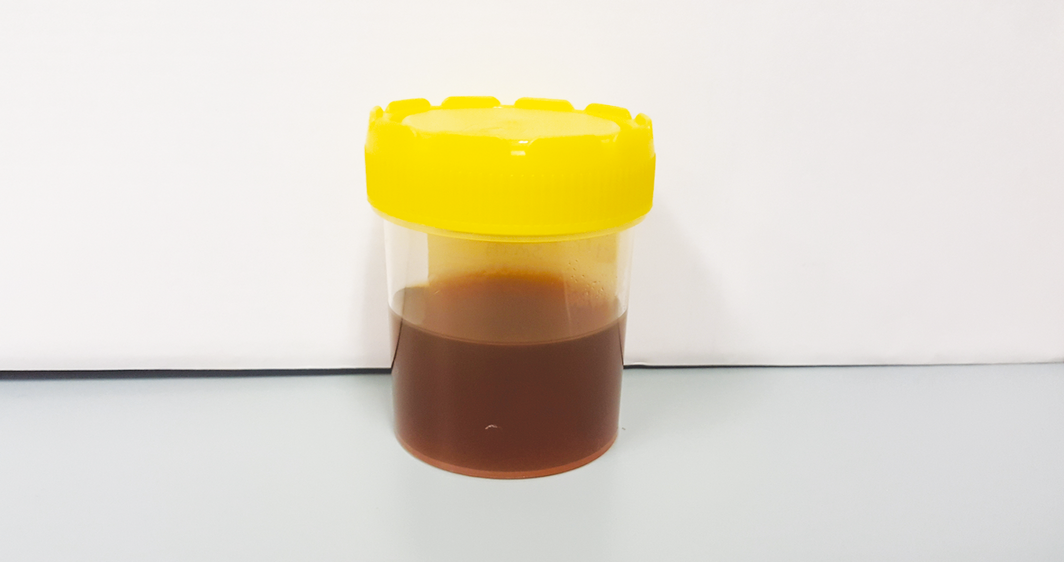
Clinical examination revealed tenderness in his right upper quadrant with an enlarged liver. Initial blood investigations showed a low haemoglobin level of 81 g/L (reference interval [R1], 130–180 g/L), white cell count of 12.9 × 10⁹/L (RI, 4.0–11.0 × 10⁹/L), neutrophil count of 10.2 × 10⁹/L (RI, 2.0–7.5 × 10⁹/L) and platelet count of 225 × 109/L (RI, 150–400 × 109/L), with blood film showing normocytic normochromic red blood cells and polychromasia. Further tests revealed a high reticulocyte count (239 × 109/L; RI, 20–100 × 109/L), an elevated unconjugated bilirubin level (45 µmol/L; RI, 2–20 µmol/L), an elevated lactate dehydrogenase level (939 U/L; RI, 120–250 U/L), undetectable haptoglobin levels (< 0.01 g/L; RI, 0.3–2.0 g/L) and a negative direct antiglobulin test result. His serum ferritin level was low (25 µg/L; RI, 30–110 µg/L). Liver enzymes were mildly deranged and renal parameters were within normal range. His urine was dark brown in colour in the mornings (Box 1), which showed positive blood on dipstick; however, urine microscopy was normal. This picture was consistent with haemoglobinuria caused by intravascular haemolysis. Blood tests for viral serology and autoimmune screen results were negative. A repeat computed tomography scan of the abdomen revealed hepatomegaly with heterogenous appearance of liver parenchyma as well as non‐visualisation of the hepatic veins, typical of Budd–Chiari syndrome. The combination of intravascular haemolytic anaemia and hepatic vein thrombosis in our patient was highly suggestive of paroxysmal nocturnal haemoglobinuria (PNH).
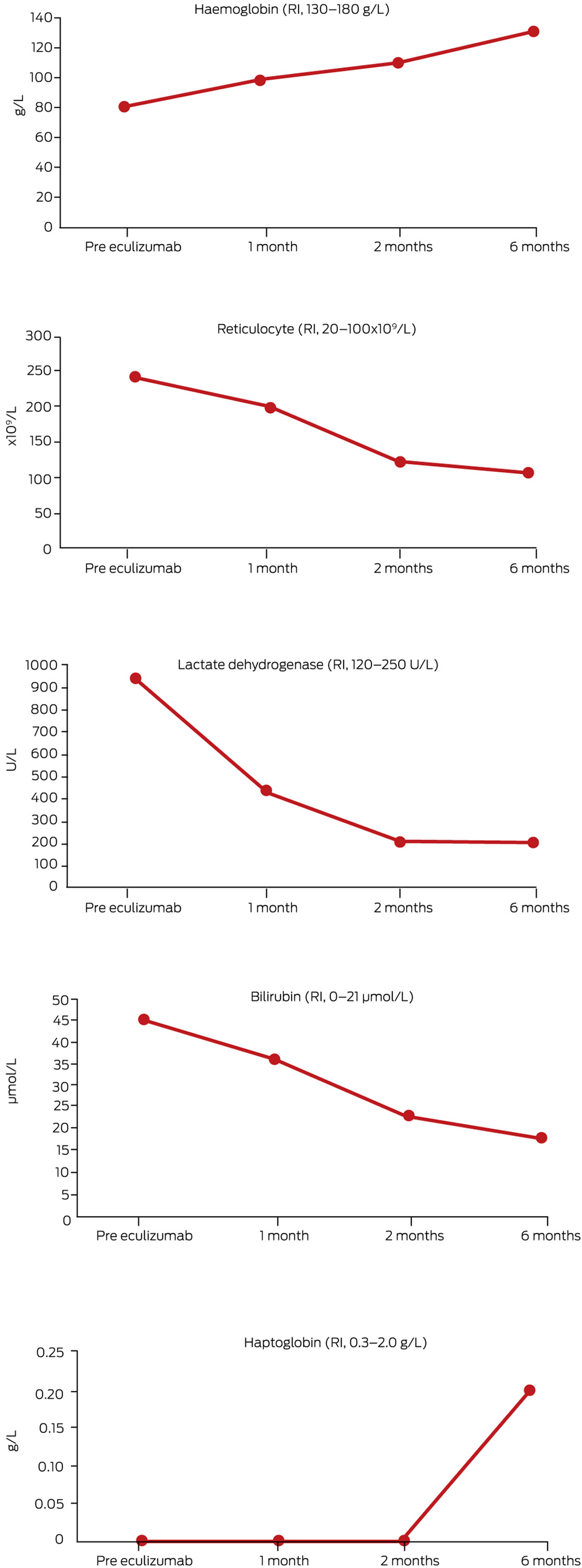
On further testing, flow cytometry of peripheral blood revealed 47% of red blood cells with reduced expression of CD59, 98% of neutrophils showed reduced expression of CD24 and fluorescein‐labelled proaerolysin, and 87% of monocytes showed reduced expression of CD14 and fluorescein‐labelled proaerolysin, which confirmed the diagnosis of PNH. Soon after the diagnosis, our patient was started on eculizumab (humanised monoclonal antibody against complement protein C5) treatment, which led to improvement of his symptoms. He was also commenced on warfarin for hepatic vein thrombosis. On continuation of eculizumab, haemoglobin and haemolytic parameters improved gradually and normalised after 6 months (Box 2). He subsequently returned to full‐time work without any medical issues.
Discussion
PNH is a rare clonal haematopoietic stem cell disorder that originates from an acquired somatic mutation in the phosphatidylinositol glycan anchor biosynthesis class A (PIGA) gene. This results in the deficiency of glycosylphosphatidylinositol‐anchored proteins — CD55 and CD59 on the surface of red blood cells, CD24 on neutrophils, and CD14 on monocytes — leading to complement‐mediated intravascular haemolysis as well as leucocyte and platelet activation. The prevalence of PNH is estimated at 13 per million population,1 and it can occur in all age groups, with the median age of onset of disease in the 30s.2
PNH is characterised by chronic intravascular haemolysis and thrombosis at unusual sites such as hepatic, portal, mesenteric and cerebral veins. Patients may manifest with episodes of dark brown urine in early morning void, which is secondary to haemolysis during night, giving the disorder its name.3 Some patients, however, do not report this symptom.2 Patients often experience symptoms of fatigue, dyspnoea, abdominal pain, erectile dysfunction, headache and dysphagia, which are non‐specific and hence may not raise clinical suspicion.2 PNH may also be associated with bone marrow failure syndromes, such as aplastic anaemia or myelodysplastic syndrome, resulting in pancytopenia.2 Due to such varied presentations, the clinical diagnosis of PNH can be challenging. If left untreated, PNH is associated with significant morbidity and mortality, particularly due to thrombosis.2
The typical findings of PNH are normocytic anaemia, elevated reticulocyte count, elevated lactate dehydrogenase and unconjugated bilirubin levels, low haptoglobin levels and negative direct antiglobulin test results, along with presence of haemoglobin and/or haemosiderin in urine. Pancytopenia can occur due to bone marrow failure syndromes in PNH. The confirmatory test for PNH is flow cytometry testing of peripheral blood using monoclonal antibodies against glycosylphosphatidylinositol‐anchored proteins (CD55 and CD59 on red blood cells, CD24 on neutrophils and CD14 on monocytes), as well as fluorescein‐labelled proaerolysin staining on neutrophils and monocytes. The diagnosis of PNH is confirmed on the basis of reduced expression of specific glycosylphosphatidylinositol‐anchored proteins on two or more cell lineages (eg, red and white blood cells).4
Patients manifesting with persistent headaches or abdominal pain will require prompt radiographical imaging to identify the location and extent of thrombosis. A bone marrow biopsy should be performed in patients with pancytopenia.4
The mainstay in the treatment of PNH is eculizumab, a novel complement inhibitor that blocks the cleavage of the terminal complement protein C5 to C5a and C5b. Eculizumab is highly effective in reducing intravascular haemolysis and thrombotic episodes, with significant improvement in quality of life and prolongation of survival in patients with PNH.5 Eculizumab is generally well tolerated, and the side effects include headache, nausea and nasopharyngitis, which are usually mild. However, there is an increased risk of life‐threatening meningococcal infection secondary to inhibition of terminal complement protein C5b. All patients should therefore receive meningococcal vaccine at least 2 weeks before the first dose of eculizumab. In situations where eculizumab needs to be administered urgently, meningococcal vaccine with concurrent antibiotic cover for initial 2 weeks is recommended.4
Eculizumab has markedly reduced the need for allogenic bone marrow transplantation in patients with PNH, although bone marrow transplantation remains the only form of treatment that can provide a cure for PNH.4 Owing to the substantial risk of morbidity and mortality, bone marrow transplantation is currently only indicated in patients with bone marrow failure syndromes.4
Patients who manifest with venous thromboses should receive therapeutic anticoagulation. Supportive treatment such as blood transfusions, and folic acid and iron supplements may be required in some patients.4,5
A diagnosis of PNH can easily be delayed or missed because of its non‐specific symptoms and varied presentations. A high degree of clinical suspicion and awareness are therefore required for prompt diagnosis, and early treatment with eculizumab will be lifesaving.
Lessons from practice
- Paroxysmal nocturnal haemoglobinuria (PNH) should be suspected in patients with direct antiglobulin test‐negative haemolytic anaemia, thrombosis at atypical sites, and/or bone marrow failure syndrome.
- Awareness of the clinical features and a high index of clinical suspicion is important for early diagnosis of PNH.
- In patients diagnosed with PNH, prompt treatment with eculizumab helps prevent morbidity and mortality, and leads to significant improvement in quality of life.
- Allogeneic bone marrow transplantation is indicated only in patients with bone marrow failure syndromes.

Competing interests
No relevant disclosures.
References
- Jalbert JJ, Chaudhari U, Zhang H, et al. Epidemiology of PNH and real‐world treatment patterns following an incident PNH diagnosis in the US. Blood 2019; 134: 3407.
- Schrezenmeier H, Muus P, Socié G, et al. Baseline characteristics and disease burden in patients in the International Paroxysmal Nocturnal Hemoglobinuria Registry. Haematologica 2014; 99: 922–929.
- Schwartz RS. Black mornings, yellow sunsets – a day with paroxysmal nocturnal hemoglobinuria. N Engl J Med 2004; 350: 6.
- Patriquin CJ, Kiss T, Caplan S, et al. How we treat paroxysmal nocturnal hemoglobinuria: a consensus statement of the Canadian PNH Network and review of the national registry. Euro J Haematol 2019; 102: 36–52.
- Hillmen P, Young NS, Schubert J, et al. The complement inhibitor eculizumab in paroxysmal nocturnal hemoglobinuria. N Engl J Med 2006; 355: 1233–1243.
Provenance: Not commissioned; externally peer reviewed.
Splenic injury in severe cases of the zoonoses Q fever and rickettsial infection: diagnostic challenges
Ashleigh Drury, Philippa Harrison, Aiveen Bannan
Health and economic benefits of improving pre‐hospital identification of stroke in Australian women: a modelling study
Thomas Gadsden, Lei Si, Emily R Atkins, Cheryl Carcel, Xia Wang, Stephen Jan, Mark Woodward, Laura E Downey
Updating the diagnosis and management of elevated serum ferritin levels in the era of routine ferritin testing of blood donors by Australian Red Cross Lifeblood
Gary D Zhang, James Chen, Daniel M Johnstone, Martin B Delatycki, Katie Allen, John K Olynyk
Early cardiovascular collapse after envenoming by snakes in Australia, 2005–2020: an observational study (ASP‐31)
Geoffrey K Isbister, Katherine Z Isoardi, Angela L Chiew, Shane Jenkins, Nicholas A Buckley
Updated recommendations for warfarin reversal in the setting of four‐factor prothrombin complex concentrate
Danielle Robinson, James McFadyen, Eileen Merriman, Chee Wee Tan, Ross Baker, Huyen Tran
Updating the diagnosis and management of iron deficiency in the era of routine ferritin testing of blood donors by Australian Red Cross Lifeblood
Gary D Zhang, Daniel Johnstone, Michael F Leahy, John K Olynyk