




Volume 208 - Issue 6
Providing a holistic background to the practicalities of retrieval medicine
Author: Noel R Eatough
Med J Aust 2018; 208 (6): 252. || doi: 10.5694/mja17.00717
Published online: 2 April 2018
Published online: 2 April 2018
Retrieval medicine
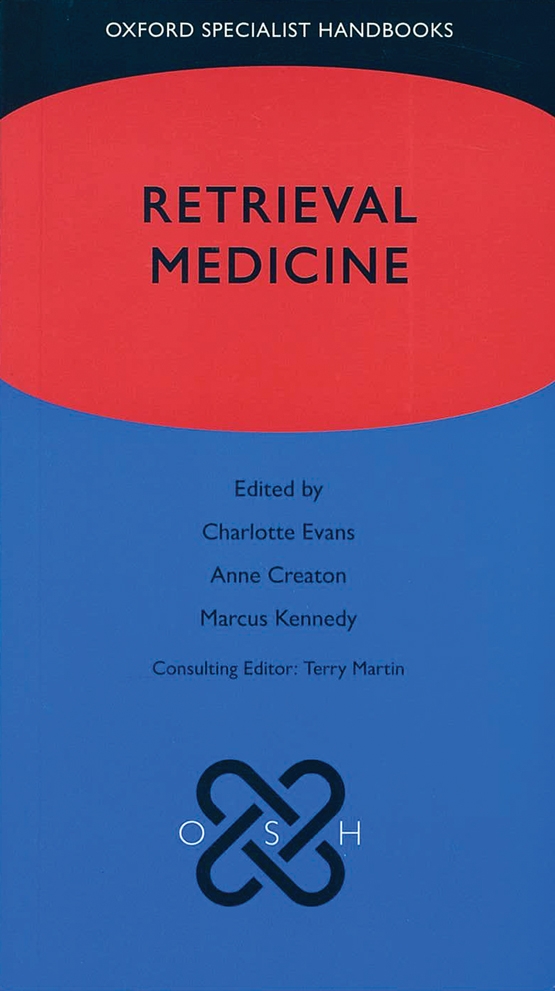
Retrieval medicine. Evans C, Creaton A, Kennedy M; editors. Oxford University Press; 2016 (£34.99; 704 pp). ISBN 9780198722168
Retrieval medicine is part of the Oxford Specialist Handbooks series, continuing their excellent, portable, quick reference guides. With very few alternative retrieval medicine texts to compete with, the editors have engaged predominantly Australian experts to put together a handbook broadly based on an academic retrieval medicine diploma program. The target readership comprises mainly those aspiring to do some form of post-graduate aeromedical education, registrars doing a retrieval term or retrieval physicians themselves.
From describing the generic retrieval systems, discussing various models (eg, centralised v decentralised) and observing different international systems, Retrieval medicine moves onto an excellent in-depth section on clinical governance. The complexities of retrieval coordination, platforms (eg, rotary or fixed wing aeromedical evacuation, and road), equipment and monitoring are outlined as best possible, covering the most common elements of each.
The handbook also includes some of the most common, acute conditions that need retrieval, with key messages outlined and emphasised. Retrieval medicine assumes the reader has a good underlying level of critical care knowledge, and covers important areas of retrievals, such as those patients with obstetric and gynaecological, behavioural or bariatric problems. There is also an in-depth and helpful section on neonatal and paediatric retrieval, which is possibly overemphasised relative to other areas such as primary (or pre-hospital) and international retrievals. In addition, the book includes some useful action checklists and common drug concentrations, but these need to be confirmed for applicability to the reader’s context.
For the non-retrieval practitioner, this handbook is of limited use as, when attempting to organise a retrieval, it is far more important to know one’s own retrieval system — how it works, how to access it and how to make things happen. However, for the intended audience, the handbook provides a wide, holistic and thorough background to the practicalities of working in this challenging environment, and, for this reason, I think it is well worth the money.
Competing interests
No relevant disclosures.
Capturing the Benefits of Clinical Quality Registries
Taryn Bessen, Stephen McDonald
Medical Colleges Have an Obligation to Ensure Full Participation in Clinical Quality Registries
Thomas J. Hugh
Getting on the Same Page: Why Australia Needs a National Maternity Early Warning System (MEWS) Chart
Briony A. Cutts, Lucy Bowyer, Nisha Khot, Sandra Lowe, Stefan C. Kane
Data for Equity: Can Linked Administrative Data Inform Pathways to More Equitable Child Health?
Sarah Gray, Shuaijun Guo, Meredith O'Connor, Elodie O'Connor, Katrina Williams, Hannah Badland, Susan Woolfenden, Josie Dickerson, Gerry Redmond, Marnie Downes, Sharon R. Goldfeld
Specialty College Selection: Why Change is Critical to Support a Future Rural Workforce
Matthew R. McGrail, Jenny May AM, Katherine Logan
Differentiated and simplified oral HIV pre‐exposure prophylaxis (PrEP) models hold the key to virtually eliminating HIV transmission in Australia by 2030
Tyson Arapali, Sarah Warzywoda, Anthony K J Smith, Curtis Chan, Timothy R Broady, Erin Sullivan, Catherine MacPhail, Mohamed A Hammoud, Alexander Dowell‐Day, Benjamin R Bavinton