




Book/Media/App review
Volume 206 - Issue 4
Theory, history and contemporary topics for medical education scholars
Author: Victoria A Brazil
Med J Aust 2017; 206 (4): 160. || doi: 10.5694/mja16.01254
Published online: 6 March 2017
Published online: 6 March 2017
Oxford textbook of medical education
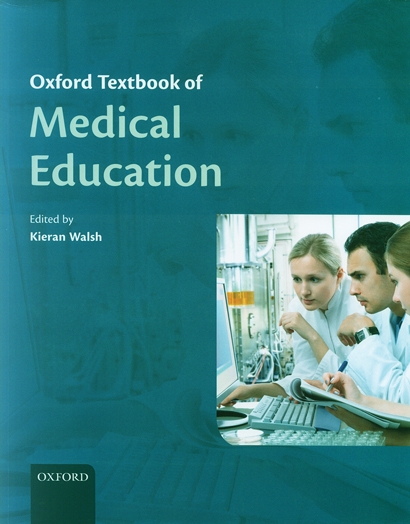
Oxford textbook of medical education.
Kieran Walsh, editor. Oxford University Press, 2013 (784 pp, £207.50). ISBN 9780199652679
The Oxford textbook of medical education is a serious tome, appealing mainly to the professional and academic medical educator. Kieran Walsh, Clinical Director of BMJ Learning, has drawn together an impressive array of international, diverse and well credentialed contributors across the breadth of medical education.
At over 700 pages of heavy text format, it is not a light read. There are few illustrations and only occasional black and white photos. The book is strong on theoretical underpinnings and the history of medical education practice, which suits some readers more than others. For example, the chapter on curriculum offers 15 definitions of the term, dating back to 1918.
The overall structure would be familiar to readers working in medical education, with sections on curriculum, delivery, supervision, selection and assessment. There are interesting chapters on contemporary topics, such as global medical education, technology, concept maps, interprofessional education and patient involvement, which would not have been included in a similar text 20 years ago. Each chapter is well researched and covers the breadth of traditional literature in the area. For the educational scholar or the reader looking for a head start on a topic literature review, this is the text. However, the average clinician educator is likely to find the format too dense for day-to-day application.
Not including social media in medical education left the text lacking in an area rapidly growing in educational practice.1 Likewise, the references in each chapter are almost exclusively based on traditional journal sources, even in areas where there are many excellent online resources.
This is perhaps symptomatic of a larger concern of a lack of visual appeal or instructional design in the presentation of the book. When talking about medical education, surely “the medium [should be] the message,”2 and dissemination formats such as heavy textbooks may not be leading by example for educators at the coalface.
References
- Nickson CP. Hacking medical education with FOAM. Australian Medical Student Journal. http://www.amsj.org/archives/5437 (accessed Nov 2016).
- McLuhan M. The medium is the message. Sydney: ABC Radio National Network; 1979. https://www.youtube.com/watch?v=ImaH51F4HBw (accessed Oct 2016).