




Volume 204 - Issue 9
A campaign to improve the mental health of medical students
Authors: Jessica M Dean, Edward R Scheffer Cliff, Karen Freilich and Molly Gilfillan
Med J Aust 2016; 204 (9): 346. || doi: 10.5694/mja15.01338
Published online: 16 May 2016
Published online: 16 May 2016
Australian medical students are striving to improve the mental health of all tertiary students
Australian medical students responded swiftly and effectively to the increased burden of mental illness in the medical profession, which was highlighted by the 2013 beyondblue National Mental Health Survey.1 In 2012, medical student representatives from Australia’s 20 medical schools passed a health and wellbeing policy,2 then in 2013, voted student mental health as a top advocacy priority for the Australian Medical Students’ Association (AMSA), choosing to advocate for the mental health of all tertiary students through development of the AMSA Mental Health campaign.
The four key aims of the campaign were to: (i) decrease stigma and increase awareness and mental health literacy among students; (ii) promote preventive measures to improve coping strategies and resilience; (iii) enable and empower students to look out for their peers and take positive action; and (iv) facilitate improved access to and uptake of mental health services.
Our advocacy strategy targeted the general public through broadcast and print media, the medical community through medical literature and conferences, and students through social media and on-campus events.
University campuses are geographical foci for at-risk young people and are therefore ideal sites for implementing effective preventative and early intervention strategies.
A “National Vice-Chancellor Tour” involved meetings of AMSA representatives with Vice-Chancellors (or their nominated representatives) from 12 of the 20 Australian universities housing a medical school. The purpose of these meetings was to explore the experiences and attitudes of the universities towards mental health. University mental health strategies varied greatly in their scope, complexity, student consultation, evidence base, and investment.
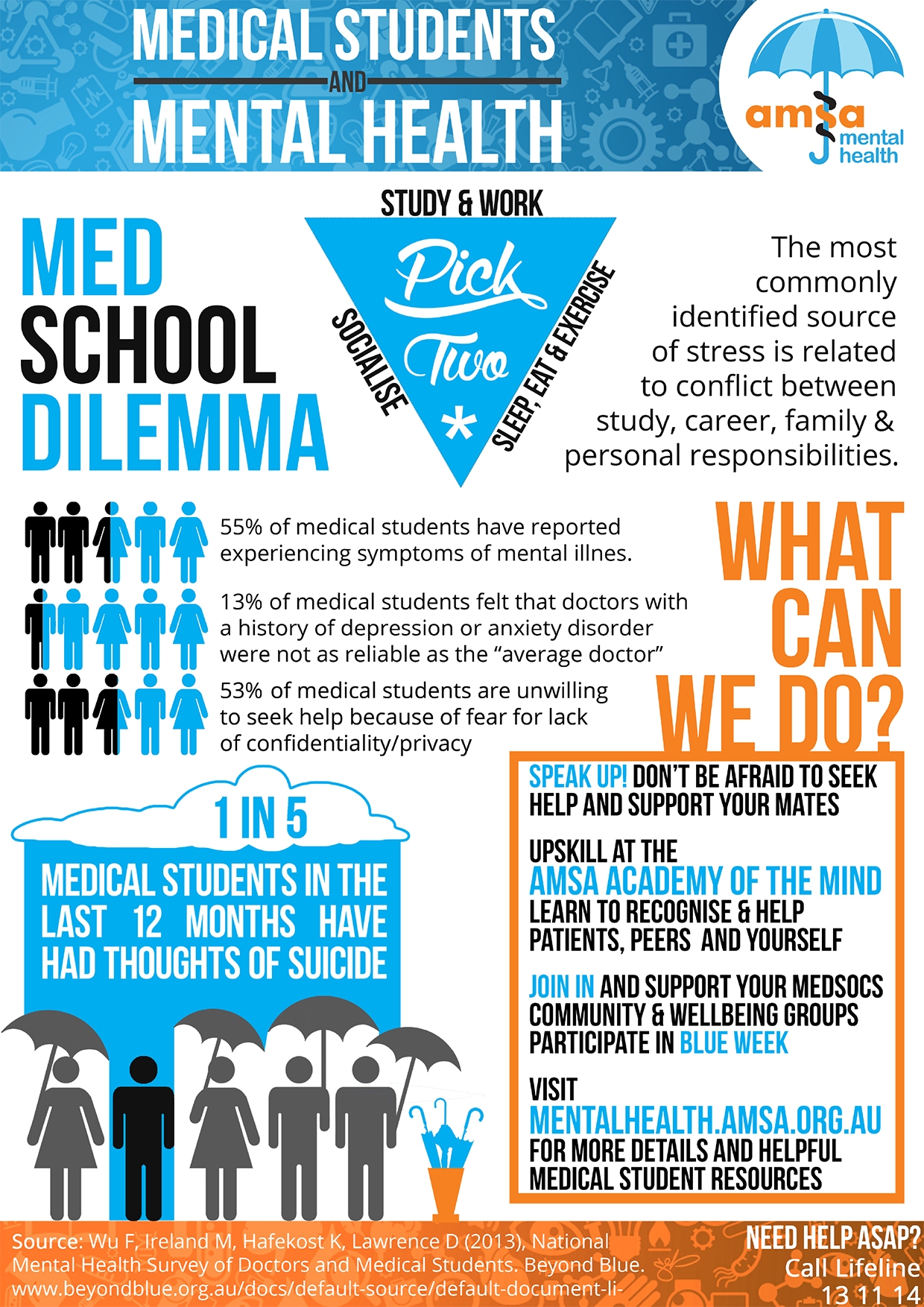
Blue Week, a grassroots component of the campaign, aimed to destigmatise and catalyse conversations about mental illness by engaging students on university campuses and in hospitals with blue-themed events and activities. In 2014, Blue Week ran at 17 medical schools, and over 5000 students participated. Activities varied, and included comedy, yoga, meditation classes, massages, guest speakers, and blue-themed parties. Although events were held throughout the year, a national online Blue Week was held during Mental Health Week (6–12 October). During this week we shared and distributed infographics, such as the poster shown in the Box, and over 200 people shared personal experiences and advice on social media. The online Blue Week reached over 90 000 people and engaged over 11 000 in at least one of its components.
AMSA also produced the second edition of the medical student wellbeing guide, Keeping your grass greener;3 coordinated the AMSA Mentor Network; ran Academy of the Mind, an online short course available to medical students internationally; and ran numerous student mental health workshops nationally and at conferences internationally.
The AMSA Mental Health website (mentalhealth.amsa.org.au/) and social media are ongoing focal points for students to access existing resources and information, blog articles,4 relevant news, and a comprehensive database of mental health services.
Although evaluation is difficult due to limited resources, the AMSA Mental Health campaign has engaged thousands of students and medical professionals in Australia and around the world. The campaign continues to grow and evolve, building momentum in the interests of student mental health.
Competing interests
Jessica Dean is currently a Director of , but was appointed in 2015, after her role in the AMSA Mental Health Campaign had concluded.
Acknowledgements
We acknowledge the hard work and dedication of the AMSA Mental Health Campaign Project Team in 2014 and 2015, specifically Ruth McLeod and Subalatha Devaraja for their work on Academy of the Mind, David Townsend for his support with the logo, branding and website, and Brian Fernandes for his work in the expansion of Blue Week. We also acknowledge the work and support of all three National Executives of the Australian Medical Students’ Association between 2013 and 2015, the major campaign partner and campaign partners , Orygen Youth Health, the Australian Medical Association, the Young and Well Cooperative Research Centre, and Medical Deans Australia and New Zealand. Other active supporters of the campaign include Jayashri Kulkarni, Patrick McGorry AO, Sally Cockburn, Mukesh Haikawel AO, Stephen Parnis and The Hon Jeff Kennett.
References
- Beyondblue. National mental health survey of doctors and medical students: final report. October 2013. https://www.beyondblue.org.au/docs/default-source/research-project-files/bl1132-report---nmhdmss-full-report_web.pdf?sfvrsn=4 (accessed Mar 2016).
- Australian Medical Students’ Association. Policy document. Mental health and wellbeing policy. Canberra: AMSA, 2015. https://www.amsa.org.au/wp-content/uploads/2015/04/5-Mental-Health-and-Wellbeing-Policy.pdf (accessed Mar 2016).
- Australian Medical Students’ Association. AMSA mental health. Keeping your grass greener. Canberra: AMSA, 2014. http://mentalhealth.amsa.org.au/keeping-your-grass-greener/ (accessed Mar 2016).
- McAlpine M. We’re going on a bear hunt. Australian Medical Students’ Association Blog. 2014: Oct 6. https://www.amsa.org.au/amsa-blog/20141006-were-going-on-a-bear-hunt/ (accessed Mar 2016).
Reorienting Allied Health Into Community-Based Care for People Experiencing Trauma and Social Disadvantage
Simon Rosenbaum, Grace McKeon, Gulsah Kurt, Oscar Lederman, Kemi Wright, Sabuj Kanti Mistry, Jackie E. Curtis, Philip B. Ward, Zachary Steel, Hamish Fibbins, Rachel Morell, Melissa C. Eaton, Andrew Watkins, Ben Harris-Roxas, Brendan Goodger, Eleanor Beck, Megan Teychenne, Joseph Firth, Davy Vancampfort, David Burns, Russell Roberts, Tristan Favaloro, Danielle Weber, Rosanna Barbero, Vasili Maroulis, Melissa Holmes, Stefan Mackenzie, Chiara Mastrogiovanni, Afsana Anwar, Uzma Choudhry, Catherine Sherrington, Jane Currie, Thomas Gadsden, Scott Teasdale
Stigmatising Attitudes Towards People With Depression, Bipolar Disorder, Borderline Personality, ADHD and Early and Long-Term/Untreated Schizophrenia: Representative Survey of Australian Adults
Amy J. Morgan, Anna M. Ross, Gayle McNaught, Rachel Green, Nicola J. Reavley
Psychosocial Hazards for Healthcare Workers: Supporting the Second Victim Also Helps the Primary Victims
Sarah Michael
Supporting Population Mental Health in the Wake of Mass Tragedies
Susan J. Rees, Derrick M. Silove
In the Wake of the National Suicide Prevention Strategy 2025–2035: Suicide Prevention in Type 1 Diabetes
Rigel Paciente, Keely Bebbington, Alix Woolard, Helen Milroy