




Volume 204 - Issue 8
Ladder-related injuries in New South Wales
Authors: Jenny Miu, Michael M Dinh, Kate Curtis and Zsolt J Balogh
Med J Aust 2016; 204 (8): 302. || doi: 10.5694/mja15.01245
Published online: 2 May 2016
Published online: 2 May 2016
Ladder-related injury imposes a significant burden on the health system
Falls from ladders are a significant cause of serious injury and have been increasing in number across Australia.1-4 While occupational injuries involving ladders are being dealt with through WorkSafe initiatives, safer use of ladders in non-occupational settings is difficult to enforce because of the variety of behavioural factors that contribute to this type of injury.4,5
In this study, data containing the International Classification of Diseases, 10th revision, clinical modification code for “Fall on and from ladder” (W11) for occupational and non-occupational injuries were extracted from the New South Wales Admitted Patients Data Collection (APDC, hospital admissions) and the NSW Trauma Registry between 1 January 2010 and 31 December 2014. The APDC collects information on hospital stay across the state while the Trauma Registry prospectively collects a minimum dataset on major trauma (injury severity score > 12 and death in hospital regardless of injury severity) from 20 NSW trauma centres. Descriptive analyses were performed separately for each dataset in SAS statistical software (SAS Institute). All results are available online in the full report (http://www.aci.health.nsw.gov.au/networks/itim/projects/ladder-safety).
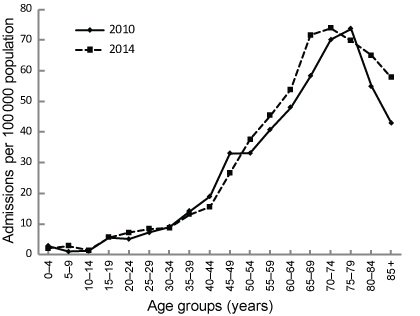
There were 8496 hospital admissions across NSW resulting from falls from ladders, giving an average of 1699 admissions annually. Peak admissions were seen in the 65–69-years age group, with 154 admissions per 100 000 persons, which is significantly higher than the crude rate of admissions due to falls from ladders in the population of 44 per 100 000 persons. The rate of admissions due to ladder-related falls is increasing in the 60–79-years age group (2.0% per annum) and in those aged 80 or more years (4.5% per annum), as illustrated in the Box. When considering only major trauma, there were 496 falls from ladders, predominantly by men aged 55 years or older, injured during non-occupational activities. Most injuries were to the thorax (36%) and head (29%), and most deaths resulted from head injuries (77% of deaths), and occurred in intensive care units (52% of deaths) or operating suites (31% of deaths). Patients were most commonly discharged home without assistance or to a rehabilitation facility. There were 51 recorded deaths following hospital admission, and 35 of these were considered due to major trauma. These findings are similar to those in Victoria.4
Hospital admission from ladder-related injuries was estimated to have cost the health system $51.8 million over the 5 years. This is based on the NSW state price, which allows calculation of the average cost of a patient’s stay per national weighted activity unit, a weighted measure of hospital activity that enables comparisons across a range of hospital settings. Use of hospital resources by patients with ladder-related injuries was high, with some 57 000 procedures being performed.
The strengths of this study include the use of two large statewide datasets with prospectively collected data. Weaknesses include the high percentage of unspecified falls and the lack of prehospital data (eg, deaths from ladder injuries before hospitalisation), which may have resulted in an underestimation of the true burden of this mechanism of injury.
Preventing ladder-related falls through safety campaigns and by providing services to older people for tasks requiring ladders is critical in ameliorating this emerging public health problem.
Competing interests
No relevant disclosures.
Acknowledgements
We thank Elvis Maio, Institute of Trauma and Injury Management Data Officer, for extracting data from the New South Wales Trauma Registry and the Admitted Patients Data Collection.
References
- Bedi HS, Goldbloom D. A review of nonoccupational ladder-related injuries in Victoria: as easy as falling off a ladder. J Trauma Injury Infect Crit Care 2008; 64: 1608-1612.
- Bradley C. Ladder-related fall injuries (AIHW Cat. no. INJCAT 105). Canberra: AIHW, 2007. http://www.aihw.gov.au/WorkArea/DownloadAsset.aspx?id=6442458805 (accessed Mar 2016).
- Cassell E, Clapperton A. Consumer product-related injury: injury related to the use of ladders. Hazard 2006; Winter (63): 1-15. http://www.monash.edu.au/miri/research/research-areas/home-sport-and-leisure-safety/visu/hazard/haz63.pdf (accessed Apr 2015).
- Oxley J, Ozanne-Smith J, O’Hern S, Kitching F. Report on the reduction of major trauma and injury from ladder falls. Melbourne: Monash University Injury Research Institute, 2014. https://www2.health.vic.gov.au/Api/downloadmedia/%7BAFDFD27A-0DD5-4688-8FF8-F672F9749B4E%7D (accessed Apr 2015).
- Ashby K, Ozanne-Smith J, Fox B. Investigating the over-representation of older persons in do-it-yourself home maintenance injury and barriers to prevention. Inj Prev 2007; 13: 328-333.
‘Once Bitten’: A Case of Tetanus Following Snakebite in Australia
Adrian A. S. Doherty, Naomi N. E. Clarke, Sarah Fletcher, Sarah Huffam, Camille V. Awburn, Eugene Athan
Epidemiology and Quality of Care for Aboriginal and Torres Strait Islander Peoples Treated by Emergency Medical Services for Stroke in Victoria, Australia: Retrospective Analysis of Linked Data
Candice Menezes, Ziad Nehme, Luke J. Burchill, Tegwyn McManamny, Angela Dos Santos, Michelle Crilly, Luke P. Dawson, Benjamin Clissold, David Anderson, Emily Nehme
Intranasal Adrenaline Use for the Management of Insect Venom-Induced Anaphylaxis
Thomas J. Young, Wilhelmina R. F. Johnson, Braydon L. Pennington, Troy Wanandy, Wun Y. Lau, Thanh-Thao A. Le
Gabapentinoid Poisoning Presentations to Victorian Emergency Departments: A 15-Year Trend Analysis
Bishaal Tej Gurung, Amy McNeilage, Angus Skeen, Tina Lam, Joanna F. Dipnall, Jane Hayman, Suzanne Nielsen, Ting Xia
They Brought the Hospital to Me
Hugh N. Burrill
Predictors of Ambulance Transport to Hospital for Older People Living in Tasmanian Aged Care Facilities: A Retrospective Cohort Study
Sharon Andrews, Pieter F. Fouche, Belinda Flanagan, Michael McDermott, Melanie Greenwood