




Volume 204 - Issue 8
Increasing incidence of type 2 diabetes in Indigenous and non-Indigenous children in Western Australia, 1990–2012
Authors: Aveni Haynes, Rachelle Kalic, Matthew Cooper, Jacqueline K Hewitt and Elizabeth Ann Davis
Med J Aust 2016; 204 (8): 303. || doi: 10.5694/mja15.00958
Published online: 2 May 2016
Published online: 2 May 2016
Children at risk of developing type 2 diabetes need early diagnosis and screening for diabetes-related complications
An increase in the incidence of childhood type 2 diabetes (T2D) has been reported in several populations worldwide, including Australia, with the highest risk being observed in children of Indigenous descent.1-3 In Western Australia, children throughout the state who are diagnosed with T2D are managed by a single multidisciplinary team at Princess Margaret Hospital, WA’s only tertiary paediatric hospital. In this study, we aimed to determine the incidence and incidence rate trends of childhood T2D in Indigenous and non-Indigenous children in WA.
We undertook a retrospective population-based cohort study of children aged less than 17 years who were diagnosed with T2D in WA between 1990 and 2012, inclusive. Data were obtained from the previously described Western Australian Children’s Diabetes Database.3 T2D was diagnosed according to current guidelines, based on both clinical and laboratory findings.4 Patients identifying themselves as being of Aboriginal and/or Torres Strait Islander descent were considered to be of Indigenous descent.
Incidence rates were calculated by age, sex and Indigenous status, per 100 000 person-years at risk, using cases of T2D as the numerator and population data obtained from the Australian Bureau of Statistics as the denominator. Incidence rate trends were analysed using Poisson regression with Stata version 13 (StataCorp).
The study was approved by the WA Health Department Human Research Ethics Committee.
Between 1990 and 2012, 135 eligible cases of T2D were identified, with a mean age at diagnosis of 13.3 years (SD, 2.0 years). Of these cases, 61% (82/135) were in girls, and 56% (76/135) were in children of Indigenous descent. At diagnosis, the mean body mass index Z score was 2.0 (SD, 0.6), with 12% of children being classified as overweight and 61% obese. Their mean glycated haemoglobin (HbA1c) level at diagnosis was 9.0% (SD, 2.8%) compared with 7.7% (SD, 2.5%) 1 year after diagnosis.
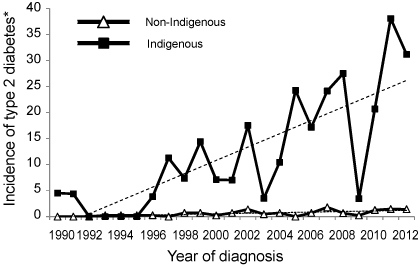
The overall mean incidence of T2D was 1.3 per 100 000 person-years (95% CI, 1.1–1.6 per 100 000 person-years), increasing from 0.2 per 100 000 person-years in 1990 to 3.1 per 100 000 person-years in 2012. The mean incidence in Indigenous children was 12.6 per 100 000 person-years (95% CI, 10.0–15.8 per 100 000 person-years) compared with 0.6 per 100 000 person-years (95% CI, 0.5–0.8 per 100 000 person-years) in non-Indigenous children. Between 1990 and 2012, the incidence increased from 4.5 to 31.1 per 100 000 person-years in Indigenous children, and from 0 to 1.4 per 100 000 person-years in non-Indigenous children (Box). The mean annual rate of increase in incidence over this period was 12.5% per year (95% CI, 8.0–17.0%) in Indigenous children and 10.9% per year (95% CI, 6.1–16.0%) in non-Indigenous children.
This population-based study provides further evidence of an increasing incidence of diagnosed childhood T2D in WA.1 Although a 20-fold higher mean incidence was observed in Indigenous children compared with non-Indigenous children, both groups had similarly high annual rates of increase. As childhood T2D may not present acutely, and population-screening programs are not routine in Australia, the incidence observed in this study is likely an underestimation of the true incidence. Furthermore, as diabetes-related complications occur early in youth with T2D,5 while the disease remains undiagnosed, diabetes-related complications may develop before clinical presentation.
The continued increase in childhood T2D reported in this study highlights the need for early diagnosis and screening for diabetes-related complications in youth at risk of developing the disease.
Competing interests
No relevant disclosures.
References
- Dabelea D, Mayer-Davis EJ, Saydah S, et al. Prevalence of type 1 and type 2 diabetes among children and adolescents from 2001 to 2009. JAMA 2014; 311: 1778-1786.
- Stone M, Baker A, Maple Brown L. Diabetes in young people in the Top End of the Northern Territory. J Paediatr Child Health 2013; 49: 976-979.
- McMahon SK, Haynes A, Ratnam N, et al. Increase in type 2 diabetes in children and adolescents in Western Australia. Med J Aust 2004; 180: 459-461.
- American Diabetes Association. Diagnosis and classification of diabetes mellitus. Diabetes Care 2013; 36: S67-S74.
- Dart AB, Martens PJ, Rigatto C, et al. Earlier onset of complications in youth with type 2 diabetes. Diabetes Care 2014; 37: 436-443.
When ‘Liver Enzymes’ Are Not Hepatic: Late-Onset Pompe Disease
Shauna Madigan, Georgina England, Wayne Rankin
Primary Hyperparathyroidism in Adults: Recent Developments in Diagnosis and Management
Elizabeth Wootton, Sunita M. C. De Sousa, Richard L. Prince, Donald S. A. McLeod, David A. Pattison, Mathis Grossmann
Severe Hypoglycaemia Secondary to Chronic Opioid-Induced Hypothalamic–Pituitary–Adrenal Axis Suppression: An Under-Recognised Phenomenon
Michael Do, Annabelle Hayes, Malgorzata Brzozowska
Rethinking diabetes care for Indigenous Australians: the need for Indigenous‐codesigned and led diabetes models of care
Natalie Nanayakkara, Sharon Atkinson‐Briggs, Alicia J Jenkins, Neale D Cohen
The first Australian evidence‐based guidelines on male infertility
Darren J Katz, Liza O’Donnell, Robert I McLachlan, Tim J Moss, Clare V Boothroyd, Veena Jayadev, Sarah R Catford