




Volume 204 - Issue 7
Rising incidence of invasive meningococcal disease caused by Neisseria meningitidis serogroup W in Victoria
Authors: Katherine A Bond, Kerrie Stevens, Dieter Bulach, Kylie Carville, Katherine S Ong and Benjamin P Howden
Med J Aust 2016; 204 (7): 265-266. || doi: 10.5694/mja15.01222
Published online: 18 April 2016
Published online: 18 April 2016
An old foe with a new disguise
Invasive meningococcal disease (IMD) caused by Neisseria meningitidis is one of the most rapidly progressive sepsis syndromes, often resulting in significant morbidity and mortality. Since the introduction of meningococcal C conjugate vaccine in 2003, IMD in Victoria has decreased from 2.5/100 000 to 0.6/100 000 population.1 Epidemiological typing of N. meningitidis isolates is by serogroup, multilocus sequence typing and finetyping.
In Victoria, from January 2014 to September 2015, the number of cases of IMD caused by N. meningitidis serogroup W (MenW) increased. Previously uncommon (< 5% of IMD overall in the period from 2008 to 2013 [n = 260]), MenW as a proportion of IMD has increased: four of 33 cases in 2014 and 12 of 41 cases in 2015 (Microbiological Diagnostic Unit, University of Melbourne, unpublished data). Over this period, the median age of cases was 55 years, compared with 19 years for serogroup B, with many non-classical presentations including pneumonia, epiglottitis, septic arthritis and pericarditis. There has been one death in a healthy young adult. No epidemiological links between cases have been observed (Victorian Government Department of Health and Human Services [DHHS], unpublished data).
Globally, MenW has been responsible for an increasing proportion of IMD since outbreaks associated with the Hajj pilgrimage in 2000.2 Large outbreaks predominantly due to MenW strain type P1.5-2: F1-1: ST11 have been reported in South America and the United Kingdom.2,3 In the UK, MenW cases doubled year on year from < 2% of IMD prior to 2009–10 to 25% in 2014–15, prompting a change in vaccination guidelines.4 Initially, almost 25% of these IMD cases were older adults with non-classical presentations.3,4
From 1 January 2014 to 30 September 2015, molecular characterisation, including whole-genome sequencing (WGS), of Victorian MenW strains was undertaken at the Microbiological Diagnostic Unit. Of the 16 MenW isolates, 11 were strain type P1.5-2: F1-1: ST11; two were ST184; one was ST22; one was a new type; and one was polymerase chain reaction-positive only and thus unable to undergo WGS. Comparison of these 11 isolates with international strains using the PubMLST Neisseria database (http://pubmlst.org/neisseria) revealed that the Victorian isolates fall within a cluster formed by UK–South American outbreak strains and are distinct from Hajj outbreak strains (Box). Within the UK–South American cluster, nine Victorian isolates appear as an exclusive group of taxa. The close genetic relationship between the nine isolates, long branch length compared with other UK–South American cluster isolates, and lack of identified epidemiological links between cases suggest that these isolates may be representative of a N. meningitidis clone arising from a single introduction event that is undergoing widespread endemic transmission in Victoria. The location of the remaining two UK–South American cluster isolates in the tree indicates independent introduction events into Victoria.
While IMD due to MenW in Victoria remains low in absolute case numbers, the rise in incidence is concerning. The Victorian DHHS has instigated enhanced surveillance measures with full molecular characterisation of future isolates to inform ongoing public health responses. National surveillance with enhanced molecular characterisation will improve understanding of the current epidemiology of meningococcus in Australia.
Box – Phylogenetic tree for Victorian and international meningococcal isolates
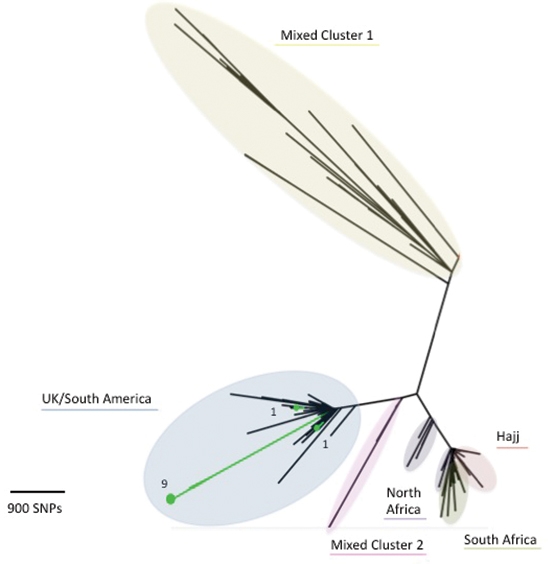
The diagram illustrates the phylogenetic relationship between isolates based on core genome single nucleotide polymorphisms (SNPs). Victorian MenW ST11 isolates demonstrate region-specific clustering, and the close relationship of Victorian MenW strains (in green) to the United Kingdom–South American cluster is shown. (Numerical values for the Victorian isolates represent the number of isolates, while the underlined description refers to geographical origin of isolates.) Note: Mixed Cluster 1 refers to isolates from the UK 1975–2007 and South Africa 2003–2013; Mixed Cluster 2 refers to isolates from UK 1996–2000, South Africa 2003–2004 and North Africa 1996–1999.
Competing interests
No relevant disclosures.
Acknowledgements
The Microbiological Diagnostic Unit is funded as a public health laboratory by the Victorian Department of Health and Human Services.
References
- Australian Government Department of Health. National Notifiable Diseases Surveillance System [website]. http://www9.health.gov.au/cda/source/cda-index.cfm
- Abad R, Lopez EL, Debbag R, Vazquez JA. Serogroup W meningococcal disease: global spread and current effect on the Southern Cone in Latin America. Epidemiol Infect 2014; 142: 2461-2470.
- Ladhani SN, Beebeejaun K, Lucidarme J, et al. Increase in endemic Neisseria meningitidis capsular group W sequence type 11 complex associated with severe invasive disease in England and Wales. Clin Infect Dis 2015; 60: 578-585.
- Campbell H, Saliba V, Borrow R, et al. Targeted vaccination of teenagers following continued rapid endemic expansion of a single meningococcal group W clone (sequence type 11 clonal complex), United Kingdom 2015. Eurosurveillance 2015; 20: doi: 10.2807/1560-7917.ES2015.20.28.21188.
Newborn Screening: Equity for Aboriginal and Torres Strait Islander Families in the Context of Emerging Genomics
Gail Garvey, Sarah Norris, Joanne Scarfe, Louise Lyons
When ‘Liver Enzymes’ Are Not Hepatic: Late-Onset Pompe Disease
Shauna Madigan, Georgina England, Wayne Rankin
Genomic Newborn Screening: Verdict From an Australian Citizens’ Jury
Emma Frost, Zornitza L. Stark, Kristen Nowak, Louise Healy, Sarah Norris, Stacy M. Carter
Genomic Testing Access for Hearing Loss Must Catch Up to the Evidence
Emma McGonigal, Andrew V. White, Valerie Sung, Karen Liddle, Lilian Downie, Emily Shepard
Population-Based Melanoma Screening Using Integrated Risk Scores in Australia: A Narrative Review to Determine Readiness
Courtney K. Wallingford, Chloe Mighton, Tamara Dawson, Anne Cust, H. Peter Soyer, Yvonne Bombard, Tatiane Yanes, Aideen McInerney-Leo
Genomic Newborn Screening: Commodity or Public Good?
Christopher Gyngell, Sebastian Lunke, Danya Vears, Zornitza L. Stark