




Lessons from practice
Volume 204 - Issue 2
Repeat exposure to active tuberculosis and risk of re-infection
Authors: Claudia C Dobler, Roujan Chidiac, Jonathan P Williamson and Peter J Jelfs
Med J Aust 2016; 204 (2): 77-78. || doi: 10.5694/mja15.00749
Published online: 1 February 2016
Published online: 1 February 2016
Re-infection with TB is possible even after preventive TB treatment
Clinical record
A 20-year-old woman of Indo-Fijian background who had lived in Australia for 10 years presented to the emergency department with a 3-day history of pain in the lower back and right hip. She had been coughing for 3 months and reported fevers and weight loss of 6 kg over the same period. Her medical history included treatment for latent (dormant) tuberculosis infection (LTBI) at 13 years of age with an unproblematic 6-month course of isoniazid 300 mg daily at a hospital chest clinic when her father, who lived in the same household, had sputum smear-positive pulmonary tuberculosis (TB). She had had a positive tuberculin skin test result of 15 mm before commencing treatment for LTBI, and had been given the BCG vaccine as a baby. Chest x-rays at the beginning and end of her treatment for LTBI had been normal. Her older sister, who also lived in the same household, was diagnosed with sputum smear-positive miliary TB 16 months after the father was diagnosed with TB (and 10 months after our patient had completed treatment for LTBI). Although our patient lived in the same household as her sister at that time, she did not receive a repeat course of preventive TB treatment. Six years after the sister was diagnosed with TB, our patient developed the symptoms described above.
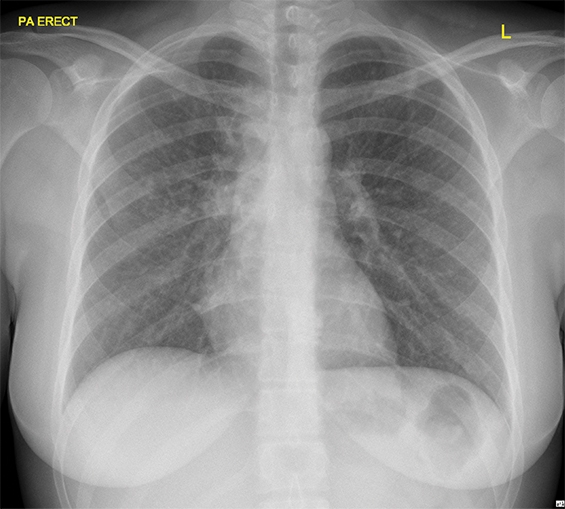
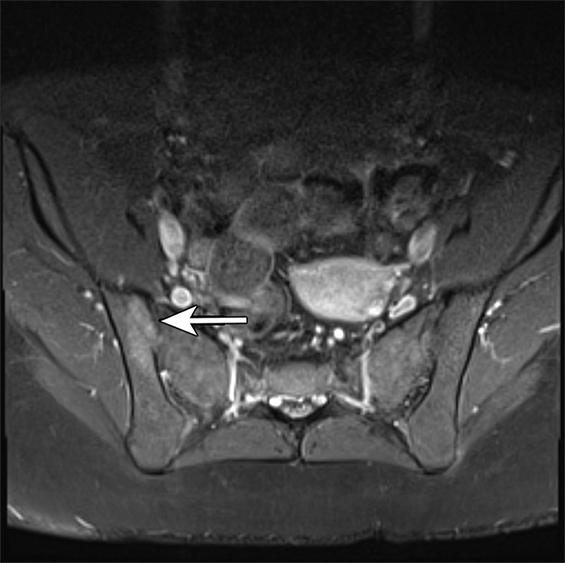
When our patient presented at the emergency department, she had a heart rate of 120 beats/min, was normotensive, and was febrile at 38.3°C. A chest x-ray showed bilateral pulmonary nodular opacities (Box 1). Magnetic resonance imaging of the lumbar spine 2 days later revealed signs of early osteomyelitis with subchondral bony oedema and contrast enhancement of the right sacroiliac joint (Box 2). Mycobacterium tuberculosis DNA was detected in two sputum samples by polymerase chain reaction. We diagnosed our patient with pulmonary and osseous TB and commenced anti-TB treatment: isoniazid, rifampicin, pyrazinamide, ethambutol and vitamin B6 backup.
Two weeks later, M. tuberculosis complex was isolated from a sputum culture and was found to be fully sensitive to first-line (standard) anti-TB drugs. The patient’s overall condition improved rapidly on treatment and the opacities seen on her chest x-ray cleared. Two weeks into treatment, however, the patient developed nausea and vomiting, and blood tests showed an increase in liver transaminase levels, supporting the clinical suspicion of drug-induced hepatitis. After all anti-TB medications were withdrawn, the patient felt better within 2 days and her liver transaminase levels were normal 10 days later. The anti-TB drugs were re-introduced sequentially and additively in escalating doses following international recommendations for the order of re-introduction,1 starting with ethambutol 800 mg daily and an increasing dose of rifampicin (up to 600 mg daily) over 4 days, adding isoniazid over the next 5 days (up to 300 mg daily) and finally adding pyrazinamide (up to a dose of 1500 mg daily) over 3 days. Two days after re-introduction of full dose pyrazinamide (and thus on full TB treatment), the patient experienced nausea, her liver transaminase levels increased again, and we suspected pyrazinamide as the cause of drug-induced hepatitis. After all anti-TB medications were again withdrawn and her liver transaminase levels again normalised, all anti-TB drugs excluding pyrazinamide were restarted at full dose. However, 16 days later, the patient again developed hepatitis. Subsequent treatment with rifampicin, moxifloxacin, ethambutol and pyrazinamide, but without isoniazid, was tolerated well by the patient without laboratory evidence of hepatitis.
Genotyping of the M. tuberculosis organisms by the 24-loci mycobacterial interspersed repetitive units variable number tandem repeat (MIRU-VNTR) method2 showed that the patient, her father and her sister had indistinguishable genotypes, suggesting that all had been infected with the same organism.
Contacts of patients who have active TB are routinely screened in countries with a low incidence of TB such as Australia. If they have evidence of LTBI, but not active TB, they are usually offered a course of preventive TB treatment with isoniazid daily for 6–9 months. Isoniazid is estimated to be up to 90% effective in eradicating LTBI,3 but it does not offer protection from subsequent re-infection.
This case emphasises the importance of repeating a course of preventive TB treatment with each significant new exposure. It is highly likely that our patient was re-infected with TB through contact with her sister (who was sputum smear-positive and likely to have been infected by the father), but we cannot exclude with certainty that active TB developed as a consequence of failed LTBI treatment and re-activation of TB after the first exposure. In both scenarios, the patient’s M. tuberculosis organism would be the same as the father’s. It is also possible that all three family members (or at least the father and the sister) were infected at the same time. Treatment of LTBI and full anti-TB treatment do not offer protection from subsequent re-infection with M. tuberculosis and individuals do not develop immunity to TB after exposure.4 Thus, treatment of LTBI is not a priority in countries with a high incidence of TB, ongoing transmission and a high risk of re-infection.5
In patients with previous evidence of LTBI, repeat testing with a tuberculin skin test or blood test (interferon gamma release assay) is not helpful to assess the risk of re-infection, as these tests often remain positive even after a full course of LTBI treatment.6,7 In people with repeat contact with active TB, the decision to give a course of preventive TB treatment should be informed by an assessment of the risk that transmission occurred (taking into account the infectiousness of the index case with active TB, and the duration and proximity of contact) and factors that affect the risk of TB re-activation (eg, immunosuppression or use of biological agents such as infliximab) in the person under consideration for preventive TB treatment.
Our patient developed isoniazid-induced hepatitis when she was on full TB treatment, while she previously had no problems with preventive isoniazid monotherapy. Patients with low-acetylator status of N-acetyltransferase 2 have a significantly increased risk of developing drug-induced hepatitis on anti-TB drugs (our patient was not tested for this).8 The concurrent exposure to drugs that induce cytochrome P450 enzymes (including rifampicin, which is routinely prescribed for TB) could have increased the risk of isoniazid-induced hepatotoxicity.9 This needs to be kept in mind when patients who tolerated isoniazid preventive therapy well develop hepatitis on full anti-TB treatment.Lessons from practice
It is possible for a person to be re-infected with tuberculosis (TB), even after a completed course of preventive TB treatment.
A person with repeat significant exposure to active TB should be considered for repeat preventive TB treatment.
Isoniazid could be the cause of drug-induced hepatitis in a person on multi-drug therapy for active TB, independently of whether isoniazid was previously tolerated well by the same person as monotherapy for TB prevention.
Competing interests
No relevant disclosures.
References
- Saukkonen JJ, Cohn DL, Jasmer RM, et al. An official ATS statement: hepatotoxicity of antituberculosis therapy. Am J Respir Crit Care Med 2006; 174: 935-952.
- Supply P, Allix C, Lesjean S, et al. Proposal for standardization of optimized mycobacterial interspersed repetitive unit-variable-number tandem repeat typing of Mycobacterium tuberculosis. J Clin Microbiol 2006; 44: 4498-4510.
- Comstock GW. How much isoniazid is needed for prevention of tuberculosis among immunocompetent adults? Int J Tuberc Lung Dis 1999; 3: 847-850.
- Dobler CC, Crawford AB, Jelfs PJ, et al. Recurrence of tuberculosis in a low-incidence setting. Eur Respir J 2009; 33: 160-167.
- World Health Organization. Guidelines on the management of latent tuberculosis infection. Geneva: WHO, 2015.
- O’Shea MK, Fletcher TE, Beeching NJ, et al. Tuberculin skin testing and treatment modulates interferon-gamma release assay results for latent tuberculosis in migrants. PLoS One 2014; 9: e97366.
- Pollock NR, Kashino SS, Napolitano DR, et al. Evaluation of the effect of treatment of latent tuberculosis infection on QuantiFERON-TB gold assay results. Infection Control 2009; 30: 392-395.
- Huang YS, Chern HD, Su WJ, et al. Polymorphism of the N-acetyltransferase 2 gene as a susceptibility risk factor for antituberculosis drug-induced hepatitis. Hepatology 2002; 35: 883-889.
- Ohno M, Yamaguchi I, Yamamoto I, et al. Slow N-acetyltransferase 2 genotype affects the incidence of isoniazid and rifampicin-induced hepatotoxicity. Int J Tuberc Lung Dis 2000; 4: 256-261.
Costs of Delivering the Hep B PAST Model of Care in Remote Australia: A Retrospective Pre–Post Study
Hoa Nguyen, Anh Le Tuan Nguyen, Paula Binks, Melita McKinnon, Emily Vintour-Cesar, Karen Wills, Nicola Stephens, Benjamin Cowie, Joshua S. Davis, Yuejen Zhao, Peter Nihill, Julie A. Campbell, Andrew J. Palmer, Jane Davies, Barbara de Graaff
Buruli Ulcer Acquired From Ringtail Possum Rescue
Daniel P. O'Brien, Naomi Clarke, Sara Bonnici, Mohammad A. Hussain
Q Fever Visceral Abscesses After Contact With Native Australian Marsupials
Samantha J. Laws, Enzo Binotto, James Stewart, Jennifer Ho, Trent Yarwood, Josh Hanson, Simon Smith
Hospital-Admitted Injection-Related Infections Among Incarcerated People Who Inject Drugs in Australia: A Retrospective Cohort Study
Andrew Palmer, Matthew Carter, Jeremy Yeo, Cecilia Shim, Jason Connor, Jeremy Hayllar, Gerald Holtmann, Naomi Moy, Elliott G. Playford, Naomi Runnegar, Paul J. Clark
The Live Attenuated Influenza Vaccine in Australia: An Additional Tool for Influenza Prevention
Cyra Patel, Alexis Pillsbury, Tran Nguyen, Xia Wang, Helen E. Quinn, Clayton K. Chiu, Allen C. Cheng, Katie L. Flanagan, Zhicheng Wang
Reflex Testing for Hepatitis D Infection: A Unique Opportunity to Reduce Hepatitis D-Related Chronic Liver Disease Deaths in Australia
Jessica Howell, Lauren Andersson, Miriam T. Levy, James O'Beirne, Leon Adams, Katharine Irvine, Avik Majumdar, Golo Ahlenstiel, Kathy Jackson, Krispin Hajkowicz, Joseph Doyle, Jane Davies, Sarah Cherian, Wayne Dimech, Alexander J. Thompson