




Volume 203 - Issue 6
The AMA Specialist Trainee Survey 2014: a survey of hospital-based specialty trainees and general practice registrars
Authors: Julian Grabek, James A Churchill and Sally Banfield
Med J Aust 2015; 203 (6): 254-255. || doi: 10.5694/mja15.00396
Published online: 21 September 2015
Published online: 21 September 2015
AMA survey of trainees identifies positives and negatives in their training experiences
In 2010, the Australian Medical Association (AMA) conducted its first Specialist Trainee Survey (STS)1 to provide medical colleges with feedback from trainees about key facets of their training and other aspects of their operations.
The AMA repeated the STS in May 2014,2 when it surveyed both hospital-based specialty trainees (the STS) and general practice registrars (the General Practice Registrar Survey) to monitor trends and emerging issues in vocational training.
Overall, hospital-based specialist trainees who responded to the 2014 STS reported a high level of satisfaction with their work and training, and have a more positive view about their training experience than those surveyed 4 years ago.
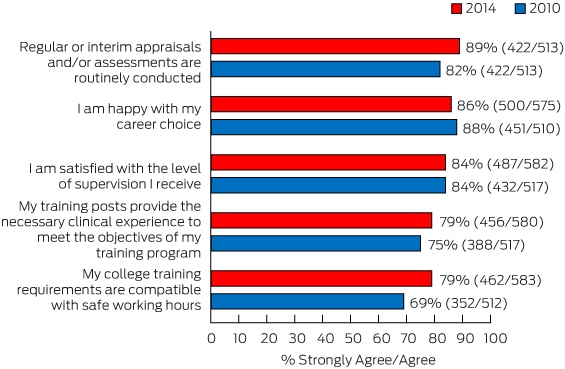
Trainees continue to express high levels of confidence about their career choice, level of supervision, standard of training, clinical experience and safety of the required working hours (Box 1).
It is notable that trainees’ opinions about whether they are working appropriate hours clearly improved between 2010 and 2014, with the proportion of those agreeing that college training requirements were compatible with safety rising from 69% to 79%. This is consistent with results of the AMA Safe Hours Audit,3 which found that hours of work and levels of fatigue risk have decreased over the past 10 years.
Notable improvements were also seen in areas relating to exam content, such as its relevance to practice and appropriateness for the level of training. Other areas of improvement included guidelines for the recognition of prior learning, and the time required to complete training for those with flexible training arrangements.
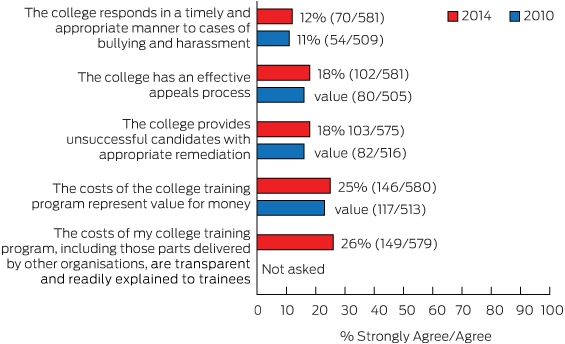
Disappointingly, many areas of trainee dissatisfaction had not changed since 2010. Responsiveness by the colleges to bullying and harassment, appeals and remediation processes, feedback, and the cost of training are ongoing areas where trainees are still dissatisfied. Trainees are also uncertain about how to gain access to academic streams and accredited overseas rotations as part of their training program (Box 2).
The ability to run two parallel surveys of hospital-based trainees and general practice registrars also provided valuable insight into these training environments. General practice registrars were more positive than specialist trainees about many aspects of their training program, most notably their employment prospects at the end of training, costs of training, availability of flexible training options, relevance and quality of educational activities, recognition of prior learning, and their personal health and wellbeing.
This survey continues to be one method for obtaining independent feedback from trainees about the quality of their training, in light of ongoing pressure on availability of vocational training places, changes to governance arrangements for health workforce planning and GP training, concerns about mental health of doctors, and an increasingly tight fiscal environment.
Notwithstanding its limitations, we hope that this report will prompt relevant institutions to internally review their education and training policies, focusing particularly on the areas that trainees are dissatisfied. The report also highlights areas requiring further scrutiny as part of the ongoing review by the Australian Medical Council of accreditation standards for specialist medical education programs. A single annual National Training Survey would be an excellent mechanism for efficiently monitoring and informing the quality of medical training. This approach has been successfully adopted in the United Kingdom.4
Ultimately, the AMA hopes that this survey continues to assist the improvement of trainees’ experiences and the quality of Australia’s medical education system.
Competing interests
No relevant disclosures.
References
- Mitchell RD, Markwell AL, Fielke RJ, et al. The 2010 specialist trainees survey. Med J Aust 2011; 195: 382.
- Australian Medical Association. AMA Specialist Trainee Survey 2014. Report of findings. Canberra: AMA, 2015. https://ama.com.au/article/2014-ama-specialist-trainee-survey-report-findings-february-2015 (accessed Jul 2015).
- Australian Medical Association. 2011 AMA Safe Hours Audit. Canberra: AMA, 2012. https://ama.com.au/article/2011-ama-safe-hours-audit-9 (accessed Jul 2015).
- General Medical Council. National Training Survey 2014. Key findings. London: GMC, 2014. http://www.gmc-uk.org/National_training_survey_2014_key_findings_report_1114.pdf_58504492.pdf (accessed Jul 2015).
Capturing the Benefits of Clinical Quality Registries
Taryn Bessen, Stephen McDonald
Medical Colleges Have an Obligation to Ensure Full Participation in Clinical Quality Registries
Thomas J. Hugh
Getting on the Same Page: Why Australia Needs a National Maternity Early Warning System (MEWS) Chart
Briony A. Cutts, Lucy Bowyer, Nisha Khot, Sandra Lowe, Stefan C. Kane
Data for Equity: Can Linked Administrative Data Inform Pathways to More Equitable Child Health?
Sarah Gray, Shuaijun Guo, Meredith O'Connor, Elodie O'Connor, Katrina Williams, Hannah Badland, Susan Woolfenden, Josie Dickerson, Gerry Redmond, Marnie Downes, Sharon R. Goldfeld
Specialty College Selection: Why Change is Critical to Support a Future Rural Workforce
Matthew R. McGrail, Jenny May AM, Katherine Logan
Differentiated and simplified oral HIV pre‐exposure prophylaxis (PrEP) models hold the key to virtually eliminating HIV transmission in Australia by 2030
Tyson Arapali, Sarah Warzywoda, Anthony K J Smith, Curtis Chan, Timothy R Broady, Erin Sullivan, Catherine MacPhail, Mohamed A Hammoud, Alexander Dowell‐Day, Benjamin R Bavinton