




Reflections
Book reviews
Volume 201 - Issue 9
Creating agency in Aboriginal health
Author: Dameyon Bonson
Med J Aust 2014; 201 (9): 540. || doi: 10.5694/mja14.01096
Published online: 28 October 2014
Published online: 28 October 2014
PAT ANDERSON, chair of the Lowitja Institute, Australia's National Institute for Aboriginal and Torres Strait Islander Health Research, provides generous praise to the authors of this work for their valuable contribution to research and practice of empowerment in Aboriginal health (http://www.lowitja.org.au/promoting-aboriginal-health-family-wellbeing-empowerment-approach). When you read this text you will find that the praise is well deserved. However, it would have been handy if it had also ...
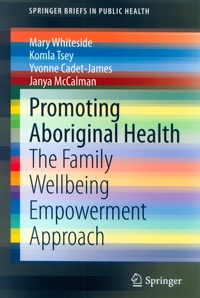
Promoting Aboriginal health. The family wellbeing empowerment approach.
Mary Whiteside, Komla Tsey, Yvonne Cadet-James, Janya McCalman. Switzerland: Springer, 2014 (70 pp, $85.99). ISBN 9783319046174.
PAT ANDERSON, chair of the Lowitja Institute, Australia's National Institute for Aboriginal and Torres Strait Islander Health Research, provides generous praise to the authors of this work for their valuable contribution to research and practice of empowerment in Aboriginal health (http://www.lowitja.org.au/promoting-aboriginal-health-family-wellbeing-empowerment-approach). When you read this text you will find that the praise is well deserved. However, it would have been handy if it had also included author profiles, particularly for identifying ethnicity. Identifying ethnicity allows the reader to understand an author's social, historical and political background.
The book provides a step-by-step guide to the evolution of an empowerment program specific to Aboriginal Australians. What makes it really useful is the painting-by-numbers approach to ethical research methods in Aboriginal health. This is a particular plus for non-Indigenous readers.
I agree with the authors that “empowerment is highly relevant for promoting the health of Aboriginal Australians” (p vii). As more and more health activities operate under the banner of “empowerment”, the potential to pathologise (us) Aboriginal Australians as without agency is of concern; this text, however, does not do this. For starters, the language used in it is strengths based and empowerment is seen as a strategy for Aboriginal health (p xiv) and capacity enhancement (p 2). The term “capacity enhancement” indicates recognition of pre-existing capacity; unlike “capacity building”, which may imply there is none.
What is not highlighted enough in Aboriginal health literature is the voices of Aboriginal men. So it was extremely pleasing to hear them throughout this work: “now I can love my wife and children because I love myself”; “[I'm] one of those fellas that's proud, I'm just happy, I'm me” (pp 20–21). The book echoes with the voices of many Aboriginal Australians, capturing the changes they experienced when engaged with the Family Wellbeing Empowerment Program (FWEP).
One question I often come across when working in remote communities is: “After people are empowered, then what?” Chapters 6 and 7 provide the answer to the “then what”, with a subtle message about the importance of the self-maintenance of that power. After all, the FWEP is not a final destination but somewhere to visit, and perhaps stay a while. The FWEP will not give you power, but it will create an environment where you can rediscover, strengthen and maintain your own power.
Finally, with regards to the cost of the book, I recommend getting the e-book directly from Springer rather than buying the hard copy.
Medical Colleges Have an Obligation to Ensure Full Participation in Clinical Quality Registries
Thomas J. Hugh
Getting on the Same Page: Why Australia Needs a National Maternity Early Warning System (MEWS) Chart
Briony A. Cutts, Lucy Bowyer, Nisha Khot, Sandra Lowe, Stefan C. Kane
Data for Equity: Can Linked Administrative Data Inform Pathways to More Equitable Child Health?
Sarah Gray, Shuaijun Guo, Meredith O'Connor, Elodie O'Connor, Katrina Williams, Hannah Badland, Susan Woolfenden, Josie Dickerson, Gerry Redmond, Marnie Downes, Sharon R. Goldfeld
Specialty College Selection: Why Change is Critical to Support a Future Rural Workforce
Matthew R. McGrail, Jenny May AM, Katherine Logan
Differentiated and simplified oral HIV pre‐exposure prophylaxis (PrEP) models hold the key to virtually eliminating HIV transmission in Australia by 2030
Tyson Arapali, Sarah Warzywoda, Anthony K J Smith, Curtis Chan, Timothy R Broady, Erin Sullivan, Catherine MacPhail, Mohamed A Hammoud, Alexander Dowell‐Day, Benjamin R Bavinton
The number of cancer‐related deaths that could be attributable to spatial disparities in survival in Australia, 2010–2019: a retrospective population‐based cohort study
Charlotte K Bainomugisa, Jessica Cameron, Paramita Dasgupta, Peter Baade