




Reflections
Book review
Volume 201 - Issue 5
Baby and the bathwater
Author: Sarah Mares
Med J Aust 2014; 201 (5): 288. || doi: 10.5694/mja14.00549
Published online: 26 August 2014
Published online: 26 August 2014
Review of Overcoming baby blues: a comprehensive guide to perinatal depression by Gordon Parker, Kerrie Eyers, Philip Boyce.
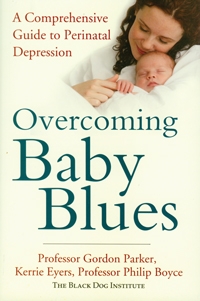
Overcoming baby blues: a comprehensive guide to perinatal depression
Gordon Parker, Kerrie Eyers, Philip Boyce. Sydney: Allen and Unwin, 2014 (256 pp, $27.99). ISBN 9781743316771.
THIS BOOK, part of the Black Dog Institute series, illustrates the misery, struggle and survival of parents during pregnancy and the baby's first year. It is written by authors with internationally acknowledged clinical and research expertise in mood disorders and perinatal depression. The particular strength of this book is its use of patient stories (from the Institute's annual writing competition). More than being about just “baby blues”, it covers anxiety and depressive reactions, adjustment disorder, melancholic depression, psychosis and bipolar disorder.
In the preface, the authors write:
we act as editors of these stories, seeking to blend our essayists' views from the inside out with our clinical and research experience from the outside in (pp. xiv)
This is occasionally uncomfortable because the book struggles to find a coherent voice.
The early chapters provide an excellent overview of perinatal mood disorders, risk factors, screening, diagnosis and treatment options. There is a clinical feel to this section and regular reference to the particular Black Dog approach to mood disorders. Perhaps it is intended to empower parents, but some sections read more like a useful introductory text for clinicians, than a book for women with depression. From Chapter 5 onwards, the book is a useful, accessible resource for families, including the appendix on medication use in the perinatal period.
There is a chapter on fathers and the extended family, and an acknowledgement that they are often overlooked despite mounting evidence that their support influences both a woman's risk of illness and her recovery.
One significant concern is the statement: “it takes a pretty high and constant level of abuse to have a marked negative effect on infant psychological development” (p 40). This may be an attempt to protect parents from guilt, but it is inaccurate. It is not adequate to think about the wellbeing of new parents, without also acknowledging the experience of their little one. The infant is potentially affected by parental depression and protective factors for the whole family need to be identified. Remember, don't forget the baby!
Overall, this is a useful book containing a great deal of information and that is eloquently illustrated by personal stories that bring it to life. Clinicians would do well to read it themselves before deciding how best to use it with their clients.
Acknowledgements
I was assisted in this review by colleagues in the perinatal team at Jade House, Karitane, in south-west Sydney.
Barriers and Facilitators to Timely Detection and Optimal Management of Chronic Wet Cough in Aboriginal Children Across Australia From the Perspectives of Carers of Aboriginal Children: A Qualitative Study
Gloria T. Y. Lau, Pam Laird, Robyn Aitken, Melanie Barwick, Liam Bedford, Emily R. Bowden, Jamie Everingham, Angela Fuery, Reece Griffin, Neha Jain, Mina Kinghorn, Renae Knapp, Gabrielle B. McCallum, Peter Morris, Richard Norman, Peter C. Richmond, Aarti Saiganesh, Slade Sibosado, Cameron Taylor, Maree Toombs, Roz Walker, Joan Wilson, Anne B. Chang, André Schultz
Barriers and Facilitators to Timely Detection and Optimal Management of Chronic Wet Cough in Aboriginal Children Across Australia From the Perspective of Health Care Providers: A Qualitative Study
Gloria T. Y. Lau, Pamela Laird, Robyn Aitken, Melanie Barwick, Liam Bedford, Emily R. Bowden, Corey Dalton, Jamie Everingham, Angela Fuery, Reece Griffin, Neha Jain, Mina Kinghorn, Renae Knapp, Gabrielle B. McCallum, Peter Morris, Richard Norman, Peter C. Richmond, Aarti Saiganesh, Slade Sibosado, Maree Toombs, Roz Walker, Joan Wilson, Anne B. Chang, André Schultz
Short-Term Safety of Concomitant Meningococcal B and National Immunisation Program Vaccines in Infants Aged < 15 Months: A Survey-Based Surveillance Study
Thuy Nguyen, Evelyn C. S. Tay, Michael Dymock, Thomas L. Snelling, Lucy Dawes, Julie Marsh, Yue Wu, Alan Leeb, Nicholas Wood, Lucy Deng
The GenV Biobank: Enabling Biological Research in a Large Longitudinal Population-Representative Cohort of Australian Newborns and Their Parents
Katherine Lange, Kim L. Powell, Yeukai Mangwiro, Tony Frugier, Donna T. Geddes, Melissa Wake, Richard Saffery
Watchful Waiting Compared With Immediate Antibiotics for Urban Aboriginal and Torres Strait Islander Children With Uncomplicated Acute Otitis Media (WATCH): A Non-Inferiority Randomised Controlled Trial
Jennifer S. Reath, Hasantha Gunasekera, Sanja Lujic, Amanda J. Leach, Letitia Campbell, Robyn Walsh, Tim Usherwood, Geoffrey K. Spurling, Claudette A. Tyson, Deborah A. Askew, Kelvin Kong, Chelsea J. Watego, Peter Morris, Wendy Hu, Penelope A. Abbott
A Rare Case of Storage Mite Anaphylaxis in Infancy
Eliza Kluckow, Katie Frith