




Volume 200 - Issue 7
Internet slimming, thyrotoxicosis and the liver
Authors: Janet V Warner, Adam P Morton, Ashley-Jane Hall, Michael G Henman and Louis F S Pool
Med J Aust 2014; 200 (7): 419-420. || doi: 10.5694/mja13.10765
Published online: 21 April 2014
Published online: 21 April 2014
Beware of herbal supplements from unregulated sources
Clinical record
A 34-year-old woman presented with palpitations, tremor and fatigue. Investigations revealed mild thyrotoxicosis, with a free thyroxine level of 30 pmol/L (reference interval [RI], 10–20 pmol/L), a free triiodo-thyronine level of 16.9 pmol/L (RI, 2.8–6.8 pmol/L) and a thyroid-stimulating hormone level < 0.05 mIU/L (RI, 0.4–4 mIU/L). Liver enzyme levels were mildly abnormal — alkaline phosphatase, 121 U/L (RI, 30–115 U/L); γ-glutamyl transferase, 134 U/L (RI, 0–45 U/L); and alanine aminotransferase, 49 U/L (RI, 0–45 U/L) — except for aspartate aminotransferase, 26 U/L (RI, 0–41 U/L). The patient denied neck pain and intake of medications, alcohol or iodine. Her medical and family histories were unremarkable, and body mass index was 29.4 kg/m2. The thyroid was normal to palpation with no bruit. There was no ophthalmopathy or dermopathy. Gastrointestinal examination was unremarkable. Further investigations included negative test results for thyroid-stimulating hormone receptor, antithyroglobulin and antithyroid peroxidase antibodies, normal thyroid ultrasound and colour-flow Doppler results, and low–normal uptake throughout both thyroid lobes on technetium-99m nuclear medicine scan. Viral and autoimmune hepatitis, haemochromatosis, Wilson disease and α-1 antitrypsin deficiency were excluded as the cause of hepatitis. Liver ultrasound was unremarkable.
The patient subsequently provided an 8-week history of ingestion of 4 capsules per day of a Gingko biloba and green tea extract obtained from China to assist with weight loss. It was claimed that the capsules contained only plant material.
Two remaining capsules were analysed. Each contained 390 mg of green–brown powder resembling dried plant matter. Analysis of a saline extract demonstrated a free thyroxine level of 17.6 pmol/L and a free triiodothyronine level of 14.0 pmol/L. Histological examination of a cell block of the powder revealed thyroid tissue with abundant colloid and positive immunohistochemical staining for thyroglobulin (Figure). Analysis of a methanol extract by liquid chromatography–tandem mass spectrometry demonstrated the presence a compound whose molecular signature matched that of the appetite suppressant sibutramine.
Resolution of thyrotoxicosis occurred within 6 weeks of cessation of the supplement. Liver function test results were improving but remained abnormal 4 months later.
Histological images of slurry, showing thyroid tissue with abundant colloid
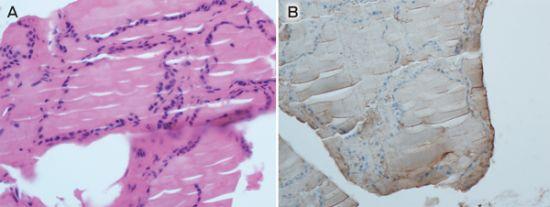
A: Haematoxylin–eosin stain (original magnification, × 400). B: Immunohistochemical stain for thyroglobulin (original magnification, × 400).
Herbal dietary supplements are readily available over the internet with no regulation of their efficacy, safety or contents. The Therapeutic Goods Administration has issued a warning against the importation and use of these products.1 However, with convenience, anonymity, lower cost and, perhaps, ignorance of the risks, the practice persists and its scale is unknown.
Given that no herbal ingredient has been shown to have significant pharmacological efficacy as an agent of weight loss, it is not surprising that adulteration of non-prescription slimming products with pharmacologically active substances occurs. Desiccated porcine and bovine thyroid tissue, a past treatment for hypothyroidism, is still available through compounding pharmacies and can be readily purchased online. Thyrotoxicosis caused by ingestion of animal thyroid tissue in minced beef and herbal supplements has been reported.2,3 In the present case, the addition of desiccated raw thyroid to the plant material in the capsules was probably the cause of thyrotoxicosis.
Although no reports of infectious disease following the consumption of dried raw animal tissue from herbal supplements could be found in the literature, contracting an infection is possible — for example, due to spore-forming pathogens. A recent Australian report on the presence of thyroid tissue in a dietary supplement3 also measured a significant amount of thyroid-stimulating hormone in the material, suggesting the additional presence of pituitary tissue. Although the risk of developing variant Creutzfeldt–Jakob disease from ingestion of bovine spongiform encephalopathy-infected tissue is probably low in this setting, it is possible.4
Lessons from practice
This case highlights the need to systematically enquire about the use of herbal supplements in all patients.
Specifically, a history of ingestion of slimming remedies or other herbal supplements should be sought in patients with unexplained thyrotoxicosis and/or liver injury.
The use of herbal supplements and medicinal products purchased from unregulated sources over the internet is potentially hazardous and should be actively discouraged.
The adulteration of dietary supplements and herbal medicines with synthetic drugs was first described over 10 years ago. Adulterants have included steroids, opiates, non-steroidal anti-inflammatories, appetite suppressants, chlorpropamide, and sildenafil and its analogues.5 The presence of these agents is often only discovered when adverse reactions occur. Although many adulterants are prescription medications in current use, of additional concern in this case is that sibutramine has been withdrawn from sale in Australia due to increased risk of cardiovascular events associated with its use.6
In these products, the natural herbal constituents themselves may also be unsafe. Herbal supplements containing usnic acid, ma huang (ephedra), Teucrium species and other terpenoid-containing compounds have all been associated with death or the need for liver transplantation due to hepatotoxicity.7 Reversible hepatotoxicity has been reported with sibutramine use.8 While sibutramine ingestion may have been the cause of hepatotoxicity in this patient, effects of other, unidentified hepatotoxins are also possible.
Competing interests
No relevant disclosures.
References
- Australian Government Department of Health, Therapeutic Goods Administration. Buying medicines and medical devices over the Internet. 7 February 2011. http://www.tga.gov.au/consumers/information-online-internet.htm (accessed Nov 2013).
- Hedberg CW, Fishbein DB, Janssen RS, et al. An outbreak of thyrotoxicosis caused by the consumption of bovine thyroid gland in ground beef. N Engl J Med 1987; 316: 993-998. i1140538
- Dimeski G, Lampe G, Brown NN. Chinese herbal supplements the cause of thyrotoxicosis. Pathology 2013; 45: 185-186. i1140540
- Schonberger LB, Belay ED, Sejvar JJ; Centers for Disease Control and Prevention. vCJD (variant Creutzfeldt-Jakob disease). Risk for travelers. 21 February 2013. http://www.cdc.gov/ncidod/dvrd/vcjd/risk_travelers.htm (accessed Nov 2013).
- Bogusz MJ, Hassan H, Al-Enazi E, et al. Application of LC–ESI–MS–MS for detection of synthetic adulterants in herbal remedies. J Pharm Biomed Anal 2006; 41: 554-564. i1140544
- Abbott Laboratories. Sibutramine (brand name Reductil) information – Australia. 14 October 2012. http://web.archive.org/web/20101014014348/http://sibutramine.com/australia/en-au (accessed Nov 2013).
- Chitturi S, Farrell GC. Hepatotoxic slimming aids and other herbal hepatotoxins. J Gastroenterol Hepatol 2008; 23: 366-373. i1140548
- Chounta A, Tsiodras S, Zouridakis S, et al. Sibutramine use associated with reversible hepatotoxicity. Ann Intern Med 2005; 143: 763-764. i1140551
When ‘Liver Enzymes’ Are Not Hepatic: Late-Onset Pompe Disease
Shauna Madigan, Georgina England, Wayne Rankin
Primary Hyperparathyroidism in Adults: Recent Developments in Diagnosis and Management
Elizabeth Wootton, Sunita M. C. De Sousa, Richard L. Prince, Donald S. A. McLeod, David A. Pattison, Mathis Grossmann
Severe Hypoglycaemia Secondary to Chronic Opioid-Induced Hypothalamic–Pituitary–Adrenal Axis Suppression: An Under-Recognised Phenomenon
Michael Do, Annabelle Hayes, Malgorzata Brzozowska
Rethinking diabetes care for Indigenous Australians: the need for Indigenous‐codesigned and led diabetes models of care
Natalie Nanayakkara, Sharon Atkinson‐Briggs, Alicia J Jenkins, Neale D Cohen
The first Australian evidence‐based guidelines on male infertility
Darren J Katz, Liza O’Donnell, Robert I McLachlan, Tim J Moss, Clare V Boothroyd, Veena Jayadev, Sarah R Catford