




Reflections
Book review
Volume 200 - Issue 5
Layperson’s guide to pandemics
Author: Merryn C McKinnon
Med J Aust 2014; 200 (5): 297. || doi: 10.5694/mja13.00232
Published online: 17 March 2014
Published online: 17 March 2014
PANDEMICS, by Nobel Laureate Professor Peter Doherty, is based on the premise of equipping the public to be alert, not alarmed.The book, using a question-and-answer format, begins by giving the reader a crash course in the immune system and how the human body responds to invaders. It then provides a historical overview of pandemics and how respiratory infections, like influenza, are the greatest pandemic threat. ...
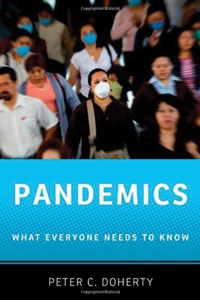
Pandemics: what everyone needs to know.
Peter C Doherty. New York: Oxford University Press, 2013 (192 pp, $16.52). ISBN 9780199898121.
PANDEMICS, by Nobel Laureate Professor Peter Doherty, is based on the premise of equipping the public to be alert, not alarmed.
The book, using a question-and-answer format, begins by giving the reader a crash course in the immune system and how the human body responds to invaders. It then provides a historical overview of pandemics and how respiratory infections, like influenza, are the greatest pandemic threat. Doherty then outlines the role of animals, such as birds and bats, as well as the influence of climate change, antibiotic resistance and air travel on how diseases are spread. He discusses the strengths and limitations of the responses to pandemics, and how we might protect ourselves against them in the future.
Although the book is aimed at a lay audience, the level of information provided borders, at times, on the overwhelming. Yet, at the point when readers might begin to despair and give up, Doherty acknowledges the problem and provides a precis that helps to reorient the reader to the key point being made. That said, it is likely to be only the very interested and dedicated who will continue to persevere in some sections. However, this does not detract from the overall usefulness of the book.
The final chapter, which deals with personal responsibility, should be compulsory reading for anyone who ever travels. It hammers home the message of the role that everyone plays in managing the spread of disease, and it describes the steps that individuals can take to minimise risk as well as to manage an outbreak should one occur. This chapter and the conclusions, which are dot points of the most salient items raised in the book, are probably the most relevant ideas and messages for the reader to take away.
Despite the subject, the book is remarkably reassuring. Using examples, such as the new strains of the H7N9 avian influenza virus discovered in China, Doherty illustrates how the global health community has rallied and worked cooperatively to prepare for the worst-case scenario. Parts of the text are highly suitable for allaying the fears of the “worried well”. The book itself would be a useful resource for those wanting a solid overview of infectious diseases and their global management.
Costs of Delivering the Hep B PAST Model of Care in Remote Australia: A Retrospective Pre–Post Study
Hoa Nguyen, Anh Le Tuan Nguyen, Paula Binks, Melita McKinnon, Emily Vintour-Cesar, Karen Wills, Nicola Stephens, Benjamin Cowie, Joshua S. Davis, Yuejen Zhao, Peter Nihill, Julie A. Campbell, Andrew J. Palmer, Jane Davies, Barbara de Graaff
Buruli Ulcer Acquired From Ringtail Possum Rescue
Daniel P. O'Brien, Naomi Clarke, Sara Bonnici, Mohammad A. Hussain
Q Fever Visceral Abscesses After Contact With Native Australian Marsupials
Samantha J. Laws, Enzo Binotto, James Stewart, Jennifer Ho, Trent Yarwood, Josh Hanson, Simon Smith
Hospital-Admitted Injection-Related Infections Among Incarcerated People Who Inject Drugs in Australia: A Retrospective Cohort Study
Andrew Palmer, Matthew Carter, Jeremy Yeo, Cecilia Shim, Jason Connor, Jeremy Hayllar, Gerald Holtmann, Naomi Moy, Elliott G. Playford, Naomi Runnegar, Paul J. Clark
The Live Attenuated Influenza Vaccine in Australia: An Additional Tool for Influenza Prevention
Cyra Patel, Alexis Pillsbury, Tran Nguyen, Xia Wang, Helen E. Quinn, Clayton K. Chiu, Allen C. Cheng, Katie L. Flanagan, Zhicheng Wang
Reflex Testing for Hepatitis D Infection: A Unique Opportunity to Reduce Hepatitis D-Related Chronic Liver Disease Deaths in Australia
Jessica Howell, Lauren Andersson, Miriam T. Levy, James O'Beirne, Leon Adams, Katharine Irvine, Avik Majumdar, Golo Ahlenstiel, Kathy Jackson, Krispin Hajkowicz, Joseph Doyle, Jane Davies, Sarah Cherian, Wayne Dimech, Alexander J. Thompson