




Volume 199 - Issue 11
Murra Mullangari — Pathways Alive and Well
Author: Romlie Mokak
Med J Aust 2013; 199 (11): 796. || doi: 10.5694/mja13.10894
Published online: 16 December 2013
Published online: 16 December 2013
A qualified, culturally competent Aboriginal and Torres Strait Islander health workforce is vital for making a difference to Indigenous health
A clinically qualified and culturally competent Aboriginal and Torres Strait Islander health workforce is vital if Australia is to make a difference to Indigenous health
The Murra Mullangari — Pathways Alive and Well program is an initiative of the Australian Indigenous Doctors’ Association (AIDA) in partnership with other peak Indigenous organisations. Using culture and identity as a strength, the program was developed with the aims of building the aspirations and capacity of Aboriginal and Torres Strait Islander senior high school students to remain in the academic pipeline and pursue careers in health.
In the language of the Ngambri people, upon whose lands the inaugural program was held, Murra is the path and Mullangari is health and wellbeing coming from the ceremonies, including the Bogong Moth Ceremony.
The program was informed by the Patty Iron Cloud National Native American Youth Initiative, run in Washington DC each year by AIDA’s peer organisation — the Association of American Indian Physicians. After attending the program in 2010, three senior members of AIDA returned committed to establishing a similar program across all health careers, rather than just medicine and biomedical research. After almost 2 years of seeking financial support for an Australian program, commitment was given by the Australian Government to establish a pilot program in June 2012.
In April 2013, the inaugural Murra Mullangari — Pathways Alive and Well program commenced, with 30 Indigenous senior secondary students (from almost 200 applicants) travelling to Canberra to participate in a 5-day residential component, which included a traditional welcome to country by Aunty Matilda House at the Aboriginal Tent Embassy, a smoking ceremony and the warm words of former Governor-General and AIDA Patron, Sir William Deane, who highlighted the importance of education and the pursuit of dreams.
The students visited local and national institutions such as the Winnunga Nimmityjah Aboriginal Health Service, the Australian Institute of Aboriginal and Torres Strait Islander Studies and the Australian Institute of Sport. Participants took part in interactive workshops at the Australian National University Medical School and University of Canberra Faculty of Health, as well as learning about university entry pathways and support at the Tjabal and Ngunnawal Indigenous Higher Education Centres. The program also featured workshops led by current health professionals in the disciplines of medicine, exercise science, nutrition, Aboriginal health work, psychology and nursing.
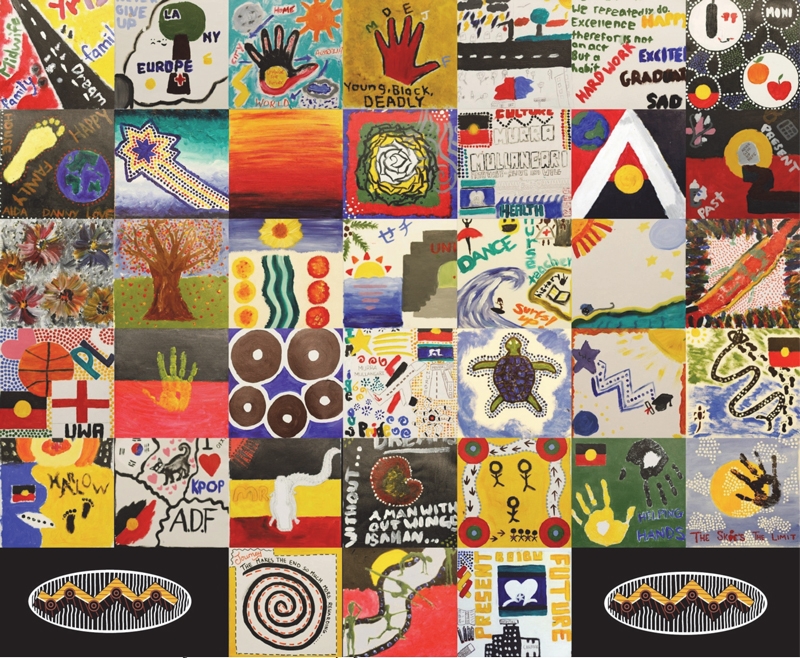
Murra Mullangari Facilitator Gregory Phillips encouraged participants to express themselves and their aspirations through painting. This artwork is a combination of the reflections of all 30 participants along with the program staff, facilitator and group leaders, on culture, the Murra Mullangari experience and their continuing personal goals.
Murra Mullangari partners continue to seek funding support to run further programs and would welcome contact from any MJA readers.
Competing interests
No relevant disclosures.
Acknowledgements
The Murra Mullangari — Pathways Alive and Well program is funded by the Department of Education, Employment and Workplace Relations, auspiced by AIDA and designed and delivered in partnership with peak Indigenous health organisations: Indigenous Allied Health Australia, Indigenous Dentists’ Association of Australia, Congress of Aboriginal and Torres Strait Islander Nurses and Midwives, Australian Indigenous Psychologists Association, National Aboriginal and Torres Strait Islander Health Workers’ Association, and National Aboriginal Community Controlled Health Organisation.
Provenance: Not commissioned; not externally peer reviewed.