




Volume 199 - Issue 11
Children and clandestine drug laboratories: the unseen victims
Authors: Sharon L Hawkrigg and Peter M Winterton
Med J Aust 2013; 199 (11): 739-741. || doi: 10.5694/mja13.10684
Published online: 16 December 2013
Published online: 16 December 2013
Children at clandestine drug laboratories are at risk of physical injury as well as exposure to methamphetamine and toxic chemicals
To the Editor: Recent amendments to the Misuse of Drugs Act 1981 (WA) have introduced mandatory prison sentences for parents who endanger their children’s health and safety by having them present at a clandestine drug laboratory.1 Despite legal and law enforcement awareness of this increasing problem across Australia, a criminal offence in all states since 2005, many medical professionals remain unaware of the dangers of clandestine laboratories.
A clandestine drug laboratory refers to an illicit operation consisting of apparatus and/or chemicals that either have been or could be used in the manufacture or synthesis of drugs, most commonly methamphetamine.2 Such laboratories range from rudimentary set-ups using simple chemical techniques to highly sophisticated complex operations.2 They can be located anywhere — residential dwellings, hotel rooms, apartments, vehicles, campgrounds and commercial establishments.2
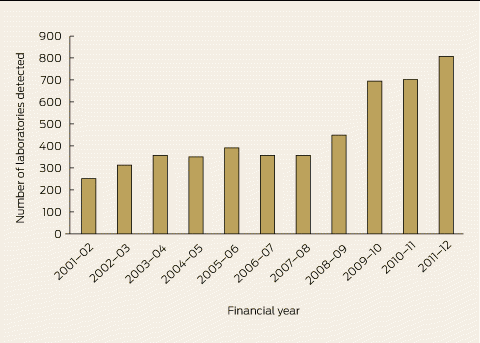
Between 2009–10 and 2010–11 in Western Australia, there was a 50% increase in the number of clandestine laboratories detected (from 118 in 2009–10 to 171 in 2010–11).3 There were children at risk in about 40% of these laboratories.3 These trends are observed nationwide, with the Australian Crime Commission report on illicit drugs detailing a record high of 809 laboratories detected across Australia in 2011–12 (Box).3
Risks to children exposed to clandestine laboratories include physical injury — one in five laboratories is discovered after explosions,3 and many laboratories are booby trapped or have firearms present;2,5 and exposure to methamphetamine, which can be deposited in the vicinity during manufacture, and to toxic chemicals used or produced in the process.2,5 Symptoms of exposure to toxic by-products and methamphetamine include respiratory and neurological problems.2,5,6 Fatalities have been reported.5,6 The risk that children living in these conditions will have been exposed to child abuse and neglect is high.5,6
A child who has been discovered at a clandestine methamphetamine laboratory must undergo decontamination, usually on site by trained personnel; and a full medical assessment, with particular attention to neurodevelopment. Documentation of findings needs to be complete, as a report may be required by criminal or child protection agencies. Many of these children will require referral to a paediatrician for ongoing management.
We would urge all health professionals in Australia who are involved in the care of children and adolescents to familiarise themselves with this emerging public health concern. The United States National Alliance for Drug Endangered Children provides a good overview of the medical evaluation of children found in drug labs that could be adapted for use in Australia.5
Competing interests
No relevant disclosures.
References
- Parliament of Western Australia. Misuse of Drugs Amendment Bill 2011. http://www.parliament.wa. gov.au/parliament/bills.nsf/BillProgressPopup? openForm&ParentUNID=5F7DB1AA42D659AC 482578F00019DC92 (accessed Sep 2013).
- Martyny JW, Arbuckle SL, McCammon CS Jr, et al. Chemical concentrations and contamination associated with clandestine methamphetamine laboratories. Chem Health Saf 2007; 14: 40-52. i1142926
- Australian Crime Commission. Illicit drug data report 2011-12. http://www.crimecommission.gov. au/publications/illicit-drug-data-report/illicit-drug-data-report-2011-12 (accessed Nov 2013).
- Australian Crime Commission. Illicit drug data report 2010-11. http://www.crimecommission.gov. au/publications/illicit-drug-data-report/illicit-drug-data-report-2010-11 (accessed Nov 2013).
- Mecham N, Melini J. Unintentional victims: development of a protocol for the care of children exposed to chemicals at methamphetamine laboratories. Pediatr Emerg Care 2002; 18: 327-332. i1142934
- National Alliance for Drug Endangered Children. National guideline for medical evaluation of children found in drug labs. http://www.national dec.org/directory/91242/95026 (accessed Jun 2013).
Barriers and Facilitators to Timely Detection and Optimal Management of Chronic Wet Cough in Aboriginal Children Across Australia From the Perspectives of Carers of Aboriginal Children: A Qualitative Study
Gloria T. Y. Lau, Pam Laird, Robyn Aitken, Melanie Barwick, Liam Bedford, Emily R. Bowden, Jamie Everingham, Angela Fuery, Reece Griffin, Neha Jain, Mina Kinghorn, Renae Knapp, Gabrielle B. McCallum, Peter Morris, Richard Norman, Peter C. Richmond, Aarti Saiganesh, Slade Sibosado, Cameron Taylor, Maree Toombs, Roz Walker, Joan Wilson, Anne B. Chang, André Schultz
Barriers and Facilitators to Timely Detection and Optimal Management of Chronic Wet Cough in Aboriginal Children Across Australia From the Perspective of Health Care Providers: A Qualitative Study
Gloria T. Y. Lau, Pamela Laird, Robyn Aitken, Melanie Barwick, Liam Bedford, Emily R. Bowden, Corey Dalton, Jamie Everingham, Angela Fuery, Reece Griffin, Neha Jain, Mina Kinghorn, Renae Knapp, Gabrielle B. McCallum, Peter Morris, Richard Norman, Peter C. Richmond, Aarti Saiganesh, Slade Sibosado, Maree Toombs, Roz Walker, Joan Wilson, Anne B. Chang, André Schultz
Short-Term Safety of Concomitant Meningococcal B and National Immunisation Program Vaccines in Infants Aged < 15 Months: A Survey-Based Surveillance Study
Thuy Nguyen, Evelyn C. S. Tay, Michael Dymock, Thomas L. Snelling, Lucy Dawes, Julie Marsh, Yue Wu, Alan Leeb, Nicholas Wood, Lucy Deng
The GenV Biobank: Enabling Biological Research in a Large Longitudinal Population-Representative Cohort of Australian Newborns and Their Parents
Katherine Lange, Kim L. Powell, Yeukai Mangwiro, Tony Frugier, Donna T. Geddes, Melissa Wake, Richard Saffery
Watchful Waiting Compared With Immediate Antibiotics for Urban Aboriginal and Torres Strait Islander Children With Uncomplicated Acute Otitis Media (WATCH): A Non-Inferiority Randomised Controlled Trial
Jennifer S. Reath, Hasantha Gunasekera, Sanja Lujic, Amanda J. Leach, Letitia Campbell, Robyn Walsh, Tim Usherwood, Geoffrey K. Spurling, Claudette A. Tyson, Deborah A. Askew, Kelvin Kong, Chelsea J. Watego, Peter Morris, Wendy Hu, Penelope A. Abbott
A Rare Case of Storage Mite Anaphylaxis in Infancy
Eliza Kluckow, Katie Frith