





Volume 198 - Issue 9
Neuropsychology beyond psychometry
Author: John D G Watson
Med J Aust 2013; 198 (9): 507. || doi: 10.5694/mja12.11758
Published online: 20 May 2013
Published online: 20 May 2013
WHEN ONCE ASKED about the qualities of a good clinician, I replied that, as well as a fundamental interest in the human condition and the skills to fully appreciate the meaning of people’s stories, good clinicians should be good storytellers themselves. Why good storytellers? History-taking requires much more than a few words jotted down or typed out - it needs compassion and understanding, informed by ...
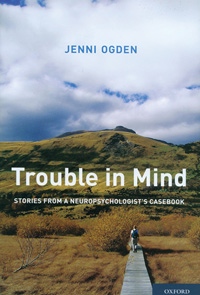
Trouble in mind: stories from a neuropsychologist’s casebook.
Jenni A Ogden. Oxford: Oxford University Press, 2012 (xiv + 413 pp, $40.00). ISBN 9780199827008.
WHEN ONCE ASKED about the qualities of a good clinician, I replied that, as well as a fundamental interest in the human condition and the skills to fully appreciate the meaning of people’s stories, good clinicians should be good storytellers themselves.
Why good storytellers? History-taking requires much more than a few words jotted down or typed out — it needs compassion and understanding, informed by knowledge, skill and experience. To understand the patient’s story for a diagnosis, to refer a patient to colleagues, and most importantly, to tell the patient what is going on, and what comes next.
New Zealander Dr Jenni Ogden, one of the world’s foremost clinical neuropsychologists, is well worth listening to. Her compassion, care, experience, and supreme interest in the human condition and its stories is evident. Her technical exposition, and choice of references, covering the fundamentals of cognitive dysfunction and its impact, hits the mark.
The book takes the reader chapter by chapter, and case by case, through the most important aspects of clinical neuropsychology. All chapters, many of them topical, reward the reader. In “Just a few knocks on the head”, two 16-year-old New Zealand boys, aspiring to play elite level rugby union, have their lives affected deeply by repeated concussions — a subject currently much debated. But Dr Ogden leavens the story by taking two young men from the opposite sides of the tracks and interweaving their experiences, with an unexpected turn of events: there is good news at the end.
The poignant “The long goodbye” tells of Sophie, a young wife and mother looking after her own mother with Alzheimer disease, but then realising she has the same symptoms. Dr Ogden does not spare our feelings as she sets out the disease processes and abnormal neurological functioning, alas still incurable, but helps us to empathise with the intergenerational pain of this family and its future.
The book shows what good clinical neuropsychology is all about. Discussing Sophie’s psychometric test results, Dr Ogden states: “Sophie’s psychologist made the mistake of thinking that an average score is a normal score, whereas she should have compared the scores with an estimate of Sophie’s premorbid abilities.” This “salient lesson” shows that, through clinically relevant information gathering, diagnoses and differential diagnoses, and through suggesting investigations and possible treatment, good clinical neuropsychologists go beyond mere psychometric practice.
Dr Ogden brings great depth to understanding cognitive disability in this book. Anyone with even a passing interest in the brain and mind (meaning, any reader of the MJA) will benefit from her book — it is great value for money.
Capturing the Benefits of Clinical Quality Registries
Taryn Bessen, Stephen McDonald
Medical Colleges Have an Obligation to Ensure Full Participation in Clinical Quality Registries
Thomas J. Hugh
Getting on the Same Page: Why Australia Needs a National Maternity Early Warning System (MEWS) Chart
Briony A. Cutts, Lucy Bowyer, Nisha Khot, Sandra Lowe, Stefan C. Kane
Data for Equity: Can Linked Administrative Data Inform Pathways to More Equitable Child Health?
Sarah Gray, Shuaijun Guo, Meredith O'Connor, Elodie O'Connor, Katrina Williams, Hannah Badland, Susan Woolfenden, Josie Dickerson, Gerry Redmond, Marnie Downes, Sharon R. Goldfeld
Specialty College Selection: Why Change is Critical to Support a Future Rural Workforce
Matthew R. McGrail, Jenny May AM, Katherine Logan
Differentiated and simplified oral HIV pre‐exposure prophylaxis (PrEP) models hold the key to virtually eliminating HIV transmission in Australia by 2030
Tyson Arapali, Sarah Warzywoda, Anthony K J Smith, Curtis Chan, Timothy R Broady, Erin Sullivan, Catherine MacPhail, Mohamed A Hammoud, Alexander Dowell‐Day, Benjamin R Bavinton