




Volume 197 - Issue 8
Severe burns from alkali drain cleaner
Authors: Rachel A D’Cruz, Erik R La Hei and Andrew J A Holland
Med J Aust 2012; 197 (8): 446. || doi: 10.5694/mja12.10995
Published online: 15 October 2012
Published online: 15 October 2012
To the Editor: Alkali drain cleaner has previously been reported to cause oral, oesophageal and cutaneous burns.-4 The risk of
these cleaners causing full thickness cutaneous burns in children needs
to be emphasised.
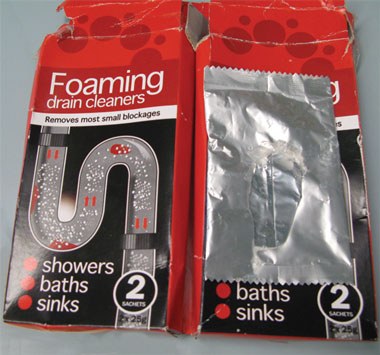
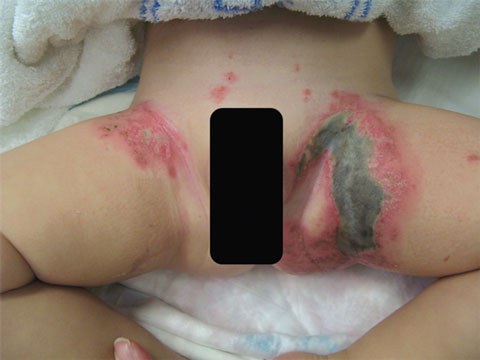
Two toddlers recently presented to our hospital with severe burns after exposure to alkali drain cleaning products. An 18-month-old boy opened the box and bit open the silver foil packet of a foaming ...
To the Editor: Alkali drain cleaner has previously been reported to cause oral, oesophageal and cutaneous burns.1-4 The risk of these cleaners causing full thickness cutaneous burns in children needs to be emphasised.
Two toddlers recently presented to our hospital with severe burns after exposure to alkali drain cleaning products. An 18-month-old boy opened the box and bit open the silver foil packet of a foaming drain cleaner (Box 1). In addition to oral burns, he was found to have sustained full thickness burns down to subcutaneous fat in both groins and the left thigh (Box 2), with evidence of the cleaner found in his nappy. First aid had not been given. The second patient was a 3-year-old boy who had been playing with the drain cleaner with his siblings. Despite receiving immediate first aid of 30 minutes of cold running water, he sustained full thickness burns in the right groin down to deep fascia. Both patients required surgical debridement and split skin grafting.
These two cases highlight the severity of chemical burns that may be caused by a readily available household item. All corrosive chemical products should have clear warning labels with first aid recommendations, be sold exclusively in childproof containers and be stored out of reach at all times. In the event of an injury, clothing should be totally removed, including any nappy, to ensure that all remaining chemical has been removed, and the area irrigated with cold running water for at least 20 minutes.
Competing interests
No relevant disclosures.
Acknowledgements
We gratefully acknowledge the guidance, support, experience and enthusiasm of John G Harvey and for his assistance in reviewing the manuscript.
References
- Al-Qattan MM, Pitkanen J. Delayed primary excision and grafting of full thickness alkali burns of the hand and forearm. Burns 2001; 27: 398-400. 1
- Janousek P, Jurovcík M, Grabec P, Kabelka Z. Corrosive oesophagitis in children following ingestion of sodium hydroxide granules — a case report. Int J Pediatr Otorhinolaryngol 2005; 69: 1257-1260. 2
- Pitkanen J, Al-Qattan MM. Epidemiology of domestic chemical burns in Saudi Arabia. Burns 2001; 27: 376-378. 3
- Yanturali S, Yaka E, Ersoy G. Chemical injury to the tongue following contact with sodium hydroxide drain cleaner. Vet Hum Toxicol 2004; 46: 319-321. CHDIEEEC
Barriers and Facilitators to Timely Detection and Optimal Management of Chronic Wet Cough in Aboriginal Children Across Australia From the Perspectives of Carers of Aboriginal Children: A Qualitative Study
Gloria T. Y. Lau, Pam Laird, Robyn Aitken, Melanie Barwick, Liam Bedford, Emily R. Bowden, Jamie Everingham, Angela Fuery, Reece Griffin, Neha Jain, Mina Kinghorn, Renae Knapp, Gabrielle B. McCallum, Peter Morris, Richard Norman, Peter C. Richmond, Aarti Saiganesh, Slade Sibosado, Cameron Taylor, Maree Toombs, Roz Walker, Joan Wilson, Anne B. Chang, André Schultz
Barriers and Facilitators to Timely Detection and Optimal Management of Chronic Wet Cough in Aboriginal Children Across Australia From the Perspective of Health Care Providers: A Qualitative Study
Gloria T. Y. Lau, Pamela Laird, Robyn Aitken, Melanie Barwick, Liam Bedford, Emily R. Bowden, Corey Dalton, Jamie Everingham, Angela Fuery, Reece Griffin, Neha Jain, Mina Kinghorn, Renae Knapp, Gabrielle B. McCallum, Peter Morris, Richard Norman, Peter C. Richmond, Aarti Saiganesh, Slade Sibosado, Maree Toombs, Roz Walker, Joan Wilson, Anne B. Chang, André Schultz
Short-Term Safety of Concomitant Meningococcal B and National Immunisation Program Vaccines in Infants Aged < 15 Months: A Survey-Based Surveillance Study
Thuy Nguyen, Evelyn C. S. Tay, Michael Dymock, Thomas L. Snelling, Lucy Dawes, Julie Marsh, Yue Wu, Alan Leeb, Nicholas Wood, Lucy Deng
The GenV Biobank: Enabling Biological Research in a Large Longitudinal Population-Representative Cohort of Australian Newborns and Their Parents
Katherine Lange, Kim L. Powell, Yeukai Mangwiro, Tony Frugier, Donna T. Geddes, Melissa Wake, Richard Saffery
Watchful Waiting Compared With Immediate Antibiotics for Urban Aboriginal and Torres Strait Islander Children With Uncomplicated Acute Otitis Media (WATCH): A Non-Inferiority Randomised Controlled Trial
Jennifer S. Reath, Hasantha Gunasekera, Sanja Lujic, Amanda J. Leach, Letitia Campbell, Robyn Walsh, Tim Usherwood, Geoffrey K. Spurling, Claudette A. Tyson, Deborah A. Askew, Kelvin Kong, Chelsea J. Watego, Peter Morris, Wendy Hu, Penelope A. Abbott
A Rare Case of Storage Mite Anaphylaxis in Infancy
Eliza Kluckow, Katie Frith