Volume 197 - Issue 5
University of Melbourne Medical School: reflections of a graduate
Author: Sir Peter J Morris
Med J Aust 2012; 197 (5): 301-302. || doi: 10.5694/mja12.11191
Published online: 3 September 2012
Published online: 3 September 2012
Sir Peter Morris received an Honorary Doctor of Laws and delivered the 40th Halford Oration, “Organ transplantation: a medical miracle of the 20th century”, on 5 July 2012, as part of the celebrations for the 150th anniversary of the foundation of the University of Melbourne Medical School ...
Sir Peter Morris received an Honorary Doctor of Laws and delivered the 40th Halford Oration, “Organ transplantation: a medical miracle of the 20th century”, on 5 July 2012, as part of the celebrations for the 150th anniversary of the foundation of the University of Melbourne Medical School
As I was about to give the 40th Halford Oration as part of the 150th anniversary of the founding of the University of Melbourne Medical School in 1862 by George Britton Halford, I was invited by the Journal to reflect briefly on my own time there almost 60 years ago. I matriculated in 1951 and entered medicine in 1952. However, it was touch and go that I ended up doing medicine, as I had enrolled and been accepted for metallurgical engineering. But as the end of 1951 approached, I decided for a variety of reasons that I would like to change to medicine. My widowed mother took me up to the university to meet the registrar for admissions to discuss this possible change of plan. In retrospect, it seems amazing, but he seemed to think there was no problem if I wanted to change. This was presumably because I had a Commonwealth Scholarship. Also, as the registrar pointed out, there were no strict entry criteria into the first year, although there was a very strict quota thereafter, as only 160 students would go on to the rest of the course at the end of the first year.
In that first year, we studied biology, botany, physics and chemistry. As I had not done biology at school, this was quite important for me. I can’t remember too much other than the dissection of rats and shark heads. Professor Rogers was the professor of physics, and the highlight of his lectures, which is still firmly imprinted in my mind, was when he took a brick off the table at the front of the lecture theatre, held it up and then dropped it with an enormous crash, exclaiming “that is gravity”. I had been well taught in chemistry and physics at Xavier College, so it wasn’t too difficult. However, I was relieved to hear that I had done well enough in the exams to get into the quota to go on to the subsequent 5 years of the course. Before we started the second year, many of us had to spend 3 months at Puckapunyal doing the first part of our National Service, and that was an experience to say the least, but one which in a strange way I quite enjoyed.
Back at the university, over the next 2 years we did an amazing amount of anatomy, together with physiology and biochemistry. Professor Roy (Pansy) Wright was our main lecturer in physiology and never gave didactic lectures. He was always trying to get us to think for ourselves, which was a difficult but always entertaining task. Anatomy was rote learning, but we also dissected the body from head to toe over the 2 years. The professor of anatomy was the very well known Professor Sid Sunderland; also memorable were his deputies, Professors Ray and Russell, who used to peer down from the window high above the huge dissecting room, looking for any misbehaviour among the students. We were also taught tutorials by young surgeons who were interested in anatomy, and I suppose the most famous teacher in my time was the late Bob Marshall, who used a blackboard for beautiful displays of anatomy, which he drew simultaneously with both hands using a variety of coloured chalks — an amazing performance. Biochemistry was taught by Professor Victor Trikojus, and I well remember his excitement when Hans Krebs was awarded the Nobel Prize for his discovery of what became known as the Krebs cycle. Many lectures were spent going through the Krebs cycle, which we all listened to with interest, but I have to say that I for one didn’t really understand it and I have to confess that I still don’t to this day. It is amazing that on my first day as a Nuffield Professor of Surgery in Oxford some 20 years later, I went to my office at 8 in the morning and there was an envelope right in the middle of my desk saying welcome. I opened it up and read a note saying: “Dear Peter, welcome to Oxford. You will have a great time here; I am just down the end of the corridor if you have time to pop in for a cup of coffee. With all best wishes, Hans Krebs”. I had in fact thought that Krebs was dead, but far from it — although retired, he still ran an active laboratory!
During those first couple of years, I was to meet my future wife Jocelyn Gorman, who was in the same year, although we only really linked up after we had both graduated. I then applied and was accepted for the St Vincent’s Clinical School and had 3 great years there. The teaching by the medical and surgical staff was absolutely outstanding, and I can still say that today, having seen teaching all over the world as well as being very involved in it myself during my career. For example, Gerry Brosnan and Jim McCoy, two young surgeons, ran an outstanding “lumps and bumps” clinic purely for teaching on a Saturday morning, and I believe they paid for the patients to come to the teaching session themselves. There were numerous other outstanding teachers at the clinical school, including Taffy Heale, Max Biggins, John Horan and Bill Heath, and, in surgery, John Connell, Peter Ryan and Kevin Rush. Remember that in those days, teachers in the clinical school were honorary appointments at the hospital; they received no remuneration, but their dedication to teaching was incredible.
We also spent several months at the Royal Children’s Hospital and the Royal Women’s Hospital, where we lived in. During that time, we had to deliver 20 babies to be signed off as competent embryo obstetricians. The stay at the Women’s Hospital, dominated by Sir Lance Townsend, included the time of the Melbourne Olympics in 1956, which produced some problems, but with lots of cross cover, most of us got to the Games without missing any opportunities for deliveries!
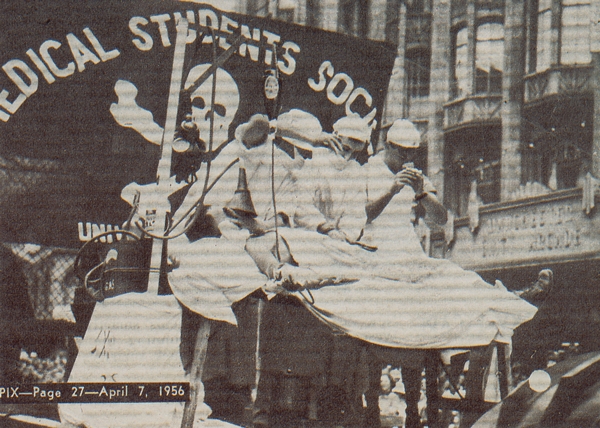
During those 6 years at the University of Melbourne Medical School, which I have to say were probably some of the best years of my life, I had many other interests such as playing cricket and baseball for the university, being a member of the Medical Students Society float in the Moomba Festival, all-night card games, and probably visiting too many pubs and parties. But I made many lifetime friends and at least managed to graduate, with no particular distinction, in contrast to Jocelyn who was right at the top of the tree. After graduation, I was fortunate to have high enough marks to get into St Vincent’s as a junior Resident Medical Officer, spending 2 more years there as a senior Resident Medical Officer and Surgical Registrar before leaving for the United Kingdom for 2 years of clinical training. I next moved to the United States for 4 further years of training in surgery and then in research. I then was offered a lecturer post (3rd assistant) in Professor Maurice Ewing’s university department at the Royal Melbourne Hospital at the end of 1967. After a productive 7 years there, finishing as Reader in Surgery, I was appointed to the Nuffield Chair of Surgery at the University of Oxford.
The University of Melbourne Medical School has a long and distinguished history and was the first medical school established in Australia. All these years later, I still look back on my time there with great fondness and remain very grateful for the outstanding teaching I was exposed to so many years ago, and the influence it had subsequently on my career.