




Volume 197 - Issue 4
20 years of The Fred Hollows Foundation
Author: David Moran
Med J Aust 2012; 197 (4): 244-245. || doi: 10.5694/mja12.11192
Published online: 20 August 2012
Published online: 20 August 2012
The Foundation’s global work stems from the personality of an energetic and admired clinician, teacher and advocateIt’s quite simple really. The Fred Hollows Foundation is 20 years old. It started as Fred was dying from renal cancer. Fred was gifted and energetic and visionary but he had to hand the show over to colleagues, fundraisers and a handful of people who could organise things so that ...
The Foundation’s global work stems from the personality of an energetic and admired clinician, teacher and advocate
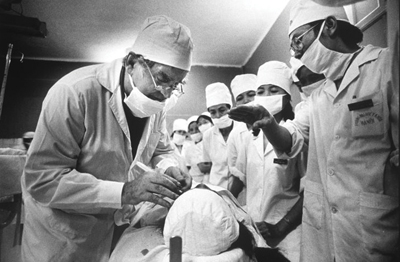
It’s quite simple really. The Fred Hollows Foundation is 20 years old. It started as Fred was dying from renal cancer. Fred was gifted and energetic and visionary but he had to hand the show over to colleagues, fundraisers and a handful of people who could organise things so that the intraocular lens (IOL) factories planned for Nepal, Eritrea and Vietnam could get built. In 1994, a year after Fred had lost his battle with cancer, two of those factories were built and continue to function today, producing more than 5 million lenses over the past two decades.
An alternative view of this is that The Fred Hollows Foundation would never have been formed if Fred had not been dying. He might have remained a notable (but not famous or heroic) figure, based in a small underfunded university department, struggling to raise the funds to organise the eccentric idea of low-cost IOL manufacture.
The reality is, as always, much more complex. A review of The Foundation, of Fred’s influence on it and of its many achievements is indeed a case study and a lesson in the complex interplay of fame, inspiration, a good cause, singular marketing skills and the willingness, energy and time of a whole army of good people with useful skills. If we are talking about complex interplay, let’s throw in a modest measure of chaos, but of love too. The result of all this is a large, growing, surprisingly effective organisation which pays a regular and valuable dividend of good sight and a reduction of suffering. The Foundation’s activities also greatly increase the capacity of its overseas partner groups, without which, of course, it could have achieved practically nothing.
In this interplay, I am fascinated and troubled by the part to do with fame. Fred is a famous hero. But fame itself is complex — seldom completely earned, often bought, nowadays part of the art of public relations people — and not always a desirable trait in a person. I find myself wondering how many famous people in the past did the washing up or bathed the kids.
Fred is famous with Australians and New Zealanders for a number of very public and well known reasons. To my mind, this is embodied in the concept of “the mythic Fred”. But many of us who knew him well have some trouble getting our head around this concept, or, at the very least, view this side of his public image with a wry smile. As a doctor, however, and among doctors, there are many good reasons for him to be famous.
For a start, he contributed greatly to medicine’s understanding of glaucoma, that dreadful and still poorly handled robber of sight. The population studies he and his co-workers undertook in the valleys of South Wales in the 1960s demonstrated that glaucoma was not a condition easily defined or regarded as a simple nexus between intraocular pressure and optic nerve head damage. These insights and the rigour with which they were presented in the literature continue to influence the management of glaucoma worldwide today.
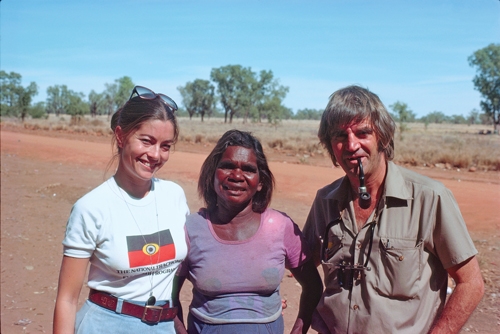
This work confirmed Fred’s interest in and commitment to working with diseases among the people. He deserves fame for taking academic and practical ophthalmology not just to remote Indigenous communities in Australia but to anyone and anywhere remote and underserved. He started doing this at a time when there were only a few people providing specialist services of any kind in the bush.
In the outback and in Central Australia, the frontier had not yet been advanced, certainly not in relation to specialist medical services. At some level, and dimly at first, he was one of the first to see that in a rich country like ours there is no excuse for neglecting services to remote communities and that it was simply wrong to write off the burden of diseases in Indigenous communities just because they are Indigenous communities. He did not accept that trachoma, leprosy, rheumatic heart and kidney disease, chronic ear disease, sexually transmissible infections and a culture of trauma and substance abuse were things you should just expect in Indigenous communities. He believed that they were amenable to intervention — medical, social and housing infrastructure interventions. Most importantly, he was prepared to do something about it.
He loved the bush, he had a strong religious background, he read liberation theologians, but in truth he went and worked in some of the toughest places on earth because he thought he should. He sweated, got hot and dirty, worked for days and weeks and months in bush sheds, church halls, in tents and under trees because he thought it was good work. And after work he mixed with, talked to, listened to and befriended the people in those communities. That was and is a rare thing. He should be famous among his fellow doctors for that alone.
But of all the reasons for his fame among doctors, it is as a teacher that he should be remembered. A subtle and intelligent teacher, Fred was always on the job, particularly for those whom he thought had some particular talent or promise. It was partly because he loved to learn and was always on the lookout for new views, insights and thoughts. Clinically, he wanted to hear from students, residents and registrars how they saw and interpreted symptoms and signs and disease progress as they affected individual patients, and how these conditions fitted into the context of their sufferers and their communities.
He particularly listened to young or junior people. You would often hear him recycling their ideas in an intellectual cud-chewing sort of way. He knew well that you couldn’t teach properly without learning. He wanted to have these discussions anywhere, any time. “Come up”, he shouted down to me once, “and bring the whisky”. “Up” in this case was three storeys up a scaffold on the side of his house, where he was working on the roof. With a bottle of whisky in hand and a florid (if mild) case of acrophobia, I somehow scrambled to the top and we sat, our legs swinging over the edge of the eaves, watching the sunset and sharing rather too much whisky.
What also followed was a 30-minute lesson on glaucoma management and a discussion on ethnic predisposition to diabetes and the effects of sunlight on the eyes. I think he wanted to talk about women as well. I don’t clearly remember how I got down. What followed reasonably soon afterwards, however, were our joint papers on sunlight as a risk factor for cataract1 and pterygium.2
As a teacher, he was not big on rubric even though he was a very good and engaging lecturer. He was good at putting students and juniors at ease, so that a discussion could ensue. Teaching and learning, both ways, both parties, was his thing, occasionally terminated explosively when one drifted off course into cant lists or blind acceptance of the conventional view.
I think Fred held the view, though I can’t remember hearing him articulate it, that you can only repay your teachers by teaching others. As one of the old guard now, I see evidence of this all around. Many of the great ophthalmology teachers in Australia today would agree that they got their intellectual start in ophthalmology in discussions with Fred.
Teaching and publication in public health and international ophthalmology, diabetic eye disease, retinal vascular disease and glaucoma would be much the poorer in Australia and the world had those many direct one-on-one, any-venue, any-time, with-or-without-whisky discussions not taken place. Fred should be famous for these conversations, this teaching, alone.
The story of The Fred Hollows Foundation is now well known and has been told multiple times. The personal, puzzling, intimate side of Fred, the man, the doctor, is not so easy to pin down and not so easy to tell. He is a man still vivid and active in many minds and lives, although he has been in his grave for 20 years. His family proudly love and cherish his memory, carefully unpicking the personal reality from the public figure. His is a fitting spirit and shade to have over the shoulders of the good people who work daily for The Foundation that bears his name. At the Sydney office alone, there are more than 80 workers dealing with partners and co-workers all over the world. It’s quite a big show. I’m not sure how things would go if Fred were to turn up at one of the daily meetings. I suspect there’d be trouble.
Aboriginal and Torres Strait Islander people should be aware that this article may contain images or names of people who have since passed away. The Fred Hollows Foundation would like to acknowledge these people and pay our respects to them and their families.
Summary of achievements of The Fred Hollows Foundation and its partners
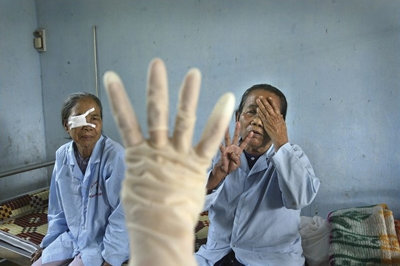
Revolutionised eye health by pioneering the introduction of modern cataract surgery in the developing world in the face of strong opposition, helping to restore sight to millions of people around the world
Set up high-tech intraocular lens factories in Eritrea and Nepal, helping to lower the cost of sight-saving surgery
The price of lenses dropped from hundreds of dollars to less than $10
Surgery is now possible for as little as $25 in some countries
Over 5 million lenses have been produced for export to over 75 countries
In the past 5 years alone, The Foundation worked with partners in over 20 countries to:
References
- Hollows FC, Moran DJ. Cataract — the ultraviolet risk factor. Lancet 1981; 318: 1249-1250. 0_CHDCBICB
- Moran DJ, Hollows FC . Pterygium and ultraviolet radiation: a positive correlation. Br J Ophthalmol 1984; 68: 343-346. 0_CHDFCADA