




Volume 197 - Issue 3
Emergency department overcrowding and mortality after the introduction of the 4-hour rule in Western Australia
Author: Shyan L Goh
Med J Aust 2012; 197 (3): 148. || doi: 10.5694/mja12.10828
Published online: 6 August 2012
Published online: 6 August 2012
To the Editor: I refer to Geelhoed and de Klerk’s article1 and related correspondence.2,3
While concerned with the rise in the overall rate of emergency department (ED) presentations, I am alarmed by the disproportionate increase in the ED admission rate (24% increase, from 3960 admissions per 10 000 ED presentations in July 2007 to June 2008, to 4910 admissions per 10 000 ED presentations in July 2010 to June 2011) since the introduction of ...
To the Editor: I refer to Geelhoed and de Klerk’s article1 and related correspondence.2,3
While concerned with the rise in the overall rate of emergency department (ED) presentations, I am alarmed by the disproportionate increase in the ED admission rate (24% increase, from 3960 admissions per 10 000 ED presentations in July 2007 to June 2008, to 4910 admissions per 10 000 ED presentations in July 2010 to June 2011) since the introduction of the 4-hour rule in Western Australia. The authors have failed to comment on this worrying trend. Incidentally, the staff at all three tertiary WA hospitals in Geelhoed and de Klerk’s study should be commended on accommodating up to 28 767 extra ED admissions annually, without an increase in mortality.1
The often misquoted study by Sprivulis and colleagues4 did not manage to uncouple the effects of ED access block from hospital overcrowding (> 90% bed occupancy) when analysing mortality rates. The authors stated that there were an estimated “120 deaths per annum associated with overcrowding in metropolitan Perth hospitals”, but that “[their] study did not examine the mechanisms by which overcrowding is associated with increased mortality”.4 Therefore, hospital-wide overcrowding should still be the target in any drive to reduce avoidable deaths.
Alternative mechanisms (other than the 4-hour rule) may account for reduced access block. Access block rates had been declining for 5 months before the 4-hour rule program was introduced, and for 12 months before “solution implementation” (Box).5 The reasons for this decline may include better medical handover (especially interhospital transfer), better staff education and protocol-driven patient care, as well as transient increases in hospital staffing (or beds).
With the introduction of new hospital programs (including rapid-response systems for clinical deterioration, statewide e-health and the Complex Needs Coordination Team), it will be difficult to attribute any future decline in hospital mortality in WA (after 2012) solely to access block reduction resulting from the 4-hour rule.
Rates of access block at Western Australian Stage 1 hospitals,* July 2007 to October 2011
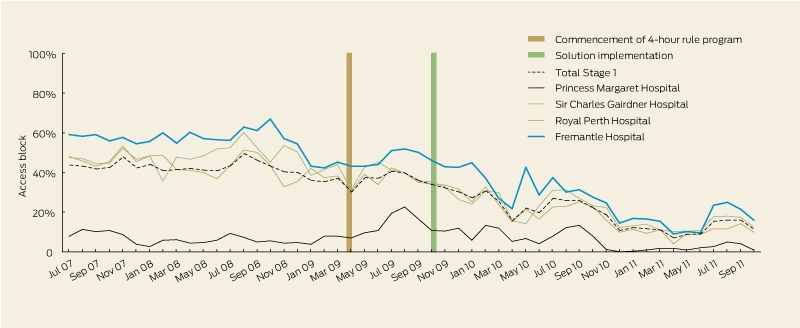
*The first hospitals to implement the 4-hour rule program in April 2009. † Solutions to access block were developed for implementation in October 2009 as part of the control phase of the 4-hour rule program.5 From Stokes.5 Reproduced with permission.
Competing interests
No relevant disclosures.
References
- Geelhoed GC, de Klerk NH. Emergency department overcrowding, mortality and the 4-hour rule in Western Australia. Med J Aust 2012; 196: 122-126. 0_BABFGJCE
- Mitra B, Cameron PA. Emergency department overcrowding and mortality after the introduction of the 4-hour rule in Western Australia [letter]. Med J Aust 2012; 196: 499. 0_CBBIBEIE
- Toh DJ, Thompson CH, Thomas JS, Faunt J. Emergency department overcrowding and mortality after the introduction of the 4-hour rule in Western Australia [letter]. Med J Aust 2012; 196: 499-500. 0_CBBCEFIA
- Sprivulis PC, Da Silva J-A, Jacobs IG, et al. The association between hospital overcrowding and mortality among patients admitted via Western Australian emergency departments. Med J Aust 2006; 184: 208-212. 0_i1142897
- Stokes B. Four hour rule program progress and issues review. Perth: Department of Health, 2011. http://www.health.wa.gov.au/publications/subject_index/ (accessed Jul 2012).
‘Once Bitten’: A Case of Tetanus Following Snakebite in Australia
Adrian A. S. Doherty, Naomi N. E. Clarke, Sarah Fletcher, Sarah Huffam, Camille V. Awburn, Eugene Athan
Epidemiology and Quality of Care for Aboriginal and Torres Strait Islander Peoples Treated by Emergency Medical Services for Stroke in Victoria, Australia: Retrospective Analysis of Linked Data
Candice Menezes, Ziad Nehme, Luke J. Burchill, Tegwyn McManamny, Angela Dos Santos, Michelle Crilly, Luke P. Dawson, Benjamin Clissold, David Anderson, Emily Nehme
Intranasal Adrenaline Use for the Management of Insect Venom-Induced Anaphylaxis
Thomas J. Young, Wilhelmina R. F. Johnson, Braydon L. Pennington, Troy Wanandy, Wun Y. Lau, Thanh-Thao A. Le
Gabapentinoid Poisoning Presentations to Victorian Emergency Departments: A 15-Year Trend Analysis
Bishaal Tej Gurung, Amy McNeilage, Angus Skeen, Tina Lam, Joanna F. Dipnall, Jane Hayman, Suzanne Nielsen, Ting Xia
They Brought the Hospital to Me
Hugh N. Burrill
Predictors of Ambulance Transport to Hospital for Older People Living in Tasmanian Aged Care Facilities: A Retrospective Cohort Study
Sharon Andrews, Pieter F. Fouche, Belinda Flanagan, Michael McDermott, Melanie Greenwood