




Volume 197 - Issue 2
Two forms of immunological recovery and immune reconstitution inflammatory syndrome in one patient
Authors: Sarah L McGuinness, Joseph S Doyle and Alan C Street
Med J Aust 2012; 197 (2): 92-93. || doi: 10.5694/mja12.10678
Published online: 16 July 2012
Published online: 16 July 2012
To the Editor: A 38-year-old HIV-positive Somalian refugee with a past history of pulmonary tuberculosis (TB) and poor compliance with antiretroviral therapy (ART) presented with fever, lethargy and mediastinal lymphadenopathy. He was diagnosed with fully drug-sensitive lymph node TB. The CD4 lymphocyte count at TB diagnosis was 20/µL (reference interval,
350-2630/µL), and the HIV RNA viral load was 99 000 copies/µL. Standard anti-TB treatment was commenced, and ART ...
To the Editor: A 38-year-old HIV-positive Somalian refugee with a past history of pulmonary tuberculosis (TB) and poor compliance with antiretroviral therapy (ART) presented with fever, lethargy and mediastinal lymphadenopathy. He was diagnosed with fully drug-sensitive lymph node TB. The CD4 lymphocyte count at TB diagnosis was 20/µL (reference interval, 350–2630/µL), and the HIV RNA viral load was 99 000 copies/µL. Standard anti-TB treatment was commenced, and ART was reinstated.
Two weeks later, he re-presented with lethargy, cough and night sweats. He reported compliance with both ART and anti-TB therapy. His HIV viral load had dropped to 1460 copies/µL, and his CD4 count had increased to 30/µL. A chest x-ray showed changes indicating a worsening of his condition and suggesting TB immune reconstitution inflammatory syndrome (IRIS). Both anti-TB therapy and ART were continued. Seventeen days after restarting ART, he developed weakness in his left arm and leg. Magnetic resonance imaging (MRI) of the brain showed white matter lesions with oedema in the right frontoparietal region, suggesting possible progressive multifocal leukoencephalopathy (PML) IRIS (Box). JC (John Cunningham) virus was not detected on initial cerebrospinal fluid polymerase chain reaction testing, but the diagnosis of PML was confirmed 3 months later, when the patient presented with a symptom flare and worsening changes apparent on MRI. A brain biopsy showed a perivascular inflammatory infiltrate of lymphocytes, and JC virus was detected in oligodendrocytes by Simian virus 40/BK virus immunostain. Corticosteroids were added, after which his condition slowly improved. He was eventually discharged to supported accommodation.
The beneficial immunological effects of ART result from the restoration of pathogen-specific immune responses.1 However, although recovery of immune function has substantial clinical benefits, it is sometimes accompanied by paradoxical adverse effects, including IRIS.
The timing of initiation of ART in patients co-infected with TB and HIV poses a dilemma. On the one hand, there is an increased risk of IRIS when anti-TB therapy and ART are commenced concurrently.2,3 On the other hand, recent studies have shown that delaying ART leads to higher rates of mortality and morbidity, particularly with CD4 counts of less than 50/µL.1,4 Despite the potential for complications associated with immune restoration, prompt institution of ART was necessary in our patient, given the risks of severe prolonged immunodeficiency. Although ART unmasked PML, it was ultimately crucial in the patient’s survival from this infection.
Magnetic resonance imaging of the brain at hemiparesis onset (A, B and C) and 3 months later (D, E and F)*
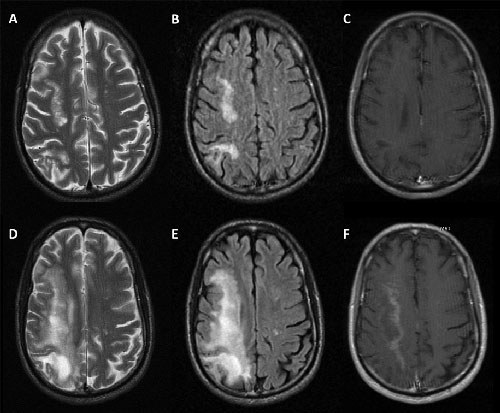
* T2 weighted (A and D), fluid attenuated inversion recovery (FLAIR) (B and E) and contrast enhanced T1 (C and F) sequences showing marked progression of findings, with extension of white matter lesions, mass effect with effacement of the sulci and new contrast enhancement — consistent with progressive multifocal leukoencephalopathy immune reconstitution inflammatory syndrome
Competing interests
No relevant disclosures.
Acknowledgements
We thank Olga Vujovic and Irani Ratnam for their contribution to the care of this patient.
References
- French MA. Immune reconstitution inflammatory syndrome: immune restoration disease 20 years on. Med J Aust 2012; 196: 318-321. 0_CBBGHDDF
- Blanc FX, Sok T, Laureillard D, et al; CAMELIA Study Team. Earlier versus later start of antiretroviral therapy in HIV-infected adults with tuberculosis. N Engl J Med 2011; 365: 1471-1481. 0_i1142876
- Abdool Karim SS, Naidoo K, Grobler A, et al. Timing of initiation of antiretroviral drugs during tuberculosis therapy. N Engl J Med 2010; 362: 697-706. 0_i1142879
- Abdool Karim SS, Naidoo K, Grobler A, et al. Integration of antiretroviral therapy with tuberculosis treatment. N Engl J Med 2011; 365: 1492-1501. 0_i1142881
Costs of Delivering the Hep B PAST Model of Care in Remote Australia: A Retrospective Pre–Post Study
Hoa Nguyen, Anh Le Tuan Nguyen, Paula Binks, Melita McKinnon, Emily Vintour-Cesar, Karen Wills, Nicola Stephens, Benjamin Cowie, Joshua S. Davis, Yuejen Zhao, Peter Nihill, Julie A. Campbell, Andrew J. Palmer, Jane Davies, Barbara de Graaff
Buruli Ulcer Acquired From Ringtail Possum Rescue
Daniel P. O'Brien, Naomi Clarke, Sara Bonnici, Mohammad A. Hussain
Q Fever Visceral Abscesses After Contact With Native Australian Marsupials
Samantha J. Laws, Enzo Binotto, James Stewart, Jennifer Ho, Trent Yarwood, Josh Hanson, Simon Smith
Hospital-Admitted Injection-Related Infections Among Incarcerated People Who Inject Drugs in Australia: A Retrospective Cohort Study
Andrew Palmer, Matthew Carter, Jeremy Yeo, Cecilia Shim, Jason Connor, Jeremy Hayllar, Gerald Holtmann, Naomi Moy, Elliott G. Playford, Naomi Runnegar, Paul J. Clark
The Live Attenuated Influenza Vaccine in Australia: An Additional Tool for Influenza Prevention
Cyra Patel, Alexis Pillsbury, Tran Nguyen, Xia Wang, Helen E. Quinn, Clayton K. Chiu, Allen C. Cheng, Katie L. Flanagan, Zhicheng Wang
Reflex Testing for Hepatitis D Infection: A Unique Opportunity to Reduce Hepatitis D-Related Chronic Liver Disease Deaths in Australia
Jessica Howell, Lauren Andersson, Miriam T. Levy, James O'Beirne, Leon Adams, Katharine Irvine, Avik Majumdar, Golo Ahlenstiel, Kathy Jackson, Krispin Hajkowicz, Joseph Doyle, Jane Davies, Sarah Cherian, Wayne Dimech, Alexander J. Thompson